
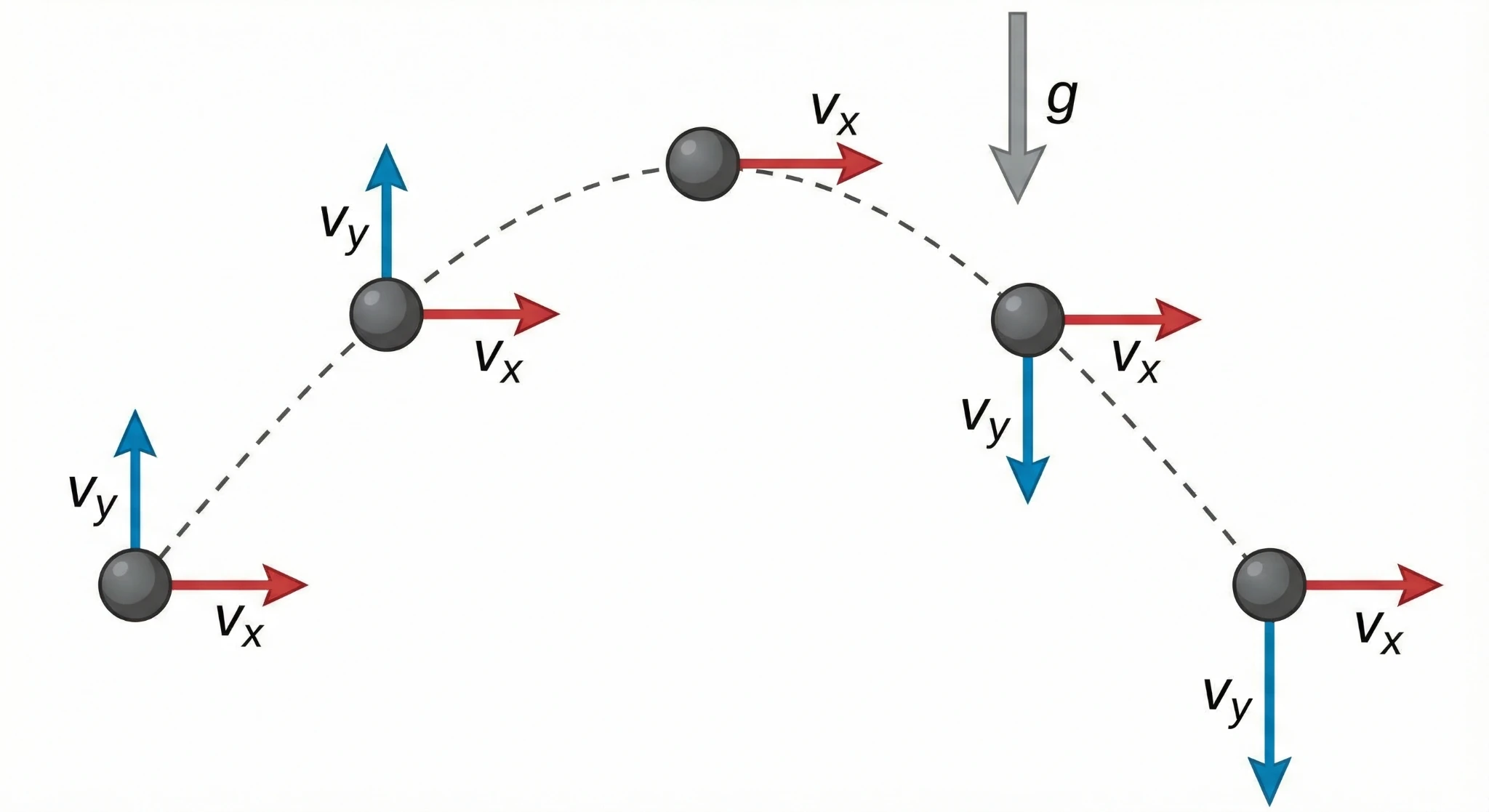
« Back to AP Physics Guide / Unit 1: Kinematics
AP Physics 1: Projectile Motion & Vectors
1. Breaking Down Vectors
Before solving projectile problems, you must be able to split a diagonal velocity vector into its components. In AP Physics 1, we use trigonometry (SOH CAH TOA) to do this.

 ) into its horizontal (
 ) and vertical (
 ) components using trigonometry.
- Horizontal Component (vx):

- Vertical Component (vy):


Calculus Note: AP Physics 1 does not use unit vectors ( ) or dot products. Stick to x and y components.
2. The Two Rules of Projectile Motion
If you memorize nothing else, memorize this table. This is how you set up every FRQ.
| Axis | Acceleration | Velocity Behavior | Equation to Use |
|---|---|---|---|
| Horizontal (X) |  |
Constant Velocity |  |
| Vertical (Y) |  |
Changing (Free Fall) | Use “Big 3” Kinematics Equations |
The Bridge: The only variable that is the same for both X and Y sides is Time (t).

 ).
).3. Three Scenarios You Will See

A. Horizontal Launch
Object thrown straight off a cliff.
- Initial
- Initial
- Time depends only on height!

B. Angled Launch (Ground-to-Ground)
Object kicked like a soccer ball.
- At the peak height, (but is still there!)
- Time up = Time down (if landing at same height).
4. AP-Style Concept Check
Try this “Paragraph Length Response” style question. No numbers allowed!
Question: Two identical balls are released from the top of a cliff at the same time. Ball A is dropped from rest. Ball B is thrown horizontally outward with speed . Which ball hits the ground first? Justify your answer.
Click to see the Answer
Answer: They hit at the same time.
Reasoning: The vertical motion of an object is independent of its horizontal motion. Both balls start with an initial vertical velocity of zero ( ) and fall the same vertical distance (
 ) under the same acceleration due to gravity (). Therefore, according to the equation
  , the time
  to fall must be identical for both.
5. AP-Style Derivation Practice
On the AP Exam, you are often asked to derive equations using only variables. Practice these three common scenarios. Do not memorize the final answers; memorize the steps!
Derivation 1: Total Horizontal Range ( )
)
Find the horizontal distance derived in terms of  ,
,  , and .
Click to see Step-by-Step Derivation
Step 1: Horizontal Motion
 (Eq 1)
Step 2: Vertical Motion (Find Time)
Total displacement  .
.
 (Eq 2)
Step 3: Substitute and Solve

Derivation 2: Maximum Height ( )
)
Find the peak height derived in terms of , , and .
Click to see Step-by-Step Derivation
The Key Concept:
At the very peak of the flight, the vertical velocity () is zero.
Step 1: Choose the Right Equation
We don’t know time, so use the time-independent equation:

Step 2: Substitute Variables
Final vertical velocity 
Initial vertical velocity 
Acceleration 
Displacement 
Step 3: Solve for


Derivation 3: Equation of Trajectory (Path)
Prove that the path is a parabola by finding  as a function of
  .
.
Click to see Step-by-Step Derivation
Goal: Eliminate time () from the equations.
Step 1: Solve for using Horizontal Equation

 (Eq A)
Step 2: Plug into the Vertical Equation


Step 3: Simplify
Use the identity  :
:

Notice that this follows the form  , which is mathematically a downward-opening parabola.
6. Don’t Lose Easy Points!
❌ The “Velocity at Peak” Trap
Mistake: Saying velocity is zero at the peak.
Truth: Only the vertical velocity () is zero. The horizontal velocity () is still there!
❌ The “Acceleration” Trap
Mistake: Saying acceleration is zero at the peak.
Truth: Acceleration is always  downwards, even at the very top.
Ready for the next step?
Go to Unit 2: Forces »« Back to AP Physics Guide / Unit 1: Kinematics
AP Physics 1: Projectile Motion
Projectile motion describes the two-dimensional motion of an object launched into the air under the influence of gravity. Although the object’s path appears complex, every projectile problem can be solved by analyzing two simple motions occurring simultaneously: horizontal motion and vertical motion.

Learning Objectives
By the end of this lesson, you will be able to:
- Differentiate between scalars and vectors.
- Resolve a vector into its horizontal and vertical components using trigonometry.
- Explain why horizontal and vertical motions are independent.
- Analyze projectile motion using separate x- and y-direction equations.
- Calculate time of flight, maximum height, and horizontal range.
- Solve AP Physics 1 free-response and multiple-choice projectile motion problems confidently.
Projectile motion combines nearly every major idea learned in Unit 1—including vectors, kinematics equations, graph interpretation, and problem-solving strategies. Mastering this topic provides a strong foundation for later units involving forces, energy, and circular motion.
Scalars and Vectors
Before studying projectile motion, it is important to understand the difference between scalar and vector quantities. Every projectile problem involves vectors because both the magnitude and the direction of motion matter.

| Scalar Quantity | Vector Quantity |
|---|---|
| Has magnitude only. | Has both magnitude and direction. |
| Represented by a numerical value and unit. | Represented by a numerical value, unit, and direction (or an arrow). |
| Examples: distance, mass, time, temperature, energy, speed. | Examples: displacement, velocity, acceleration, force, momentum. |
Why Are Vectors Important in Projectile Motion?
When an object is launched into the air, it does not move only upward or only forward. Instead, its motion occurs simultaneously in two perpendicular directions:
- Horizontal (x-direction): Determines how far the projectile travels.
- Vertical (y-direction): Determines how high the projectile rises and how long it remains in the air.
Since motion occurs in two directions at the same time, the initial velocity must be treated as a vector. In the next section, this vector will be resolved into horizontal and vertical components, allowing each direction to be analyzed independently.
A scalar answers “How much?”
A vector answers “How much and in which direction?”
Representing Vectors
In physics, vectors are represented by arrows. The length of the arrow represents the vector’s magnitude, while the arrowhead indicates its direction. Before solving projectile motion problems, it is important to understand how vectors are drawn and interpreted.
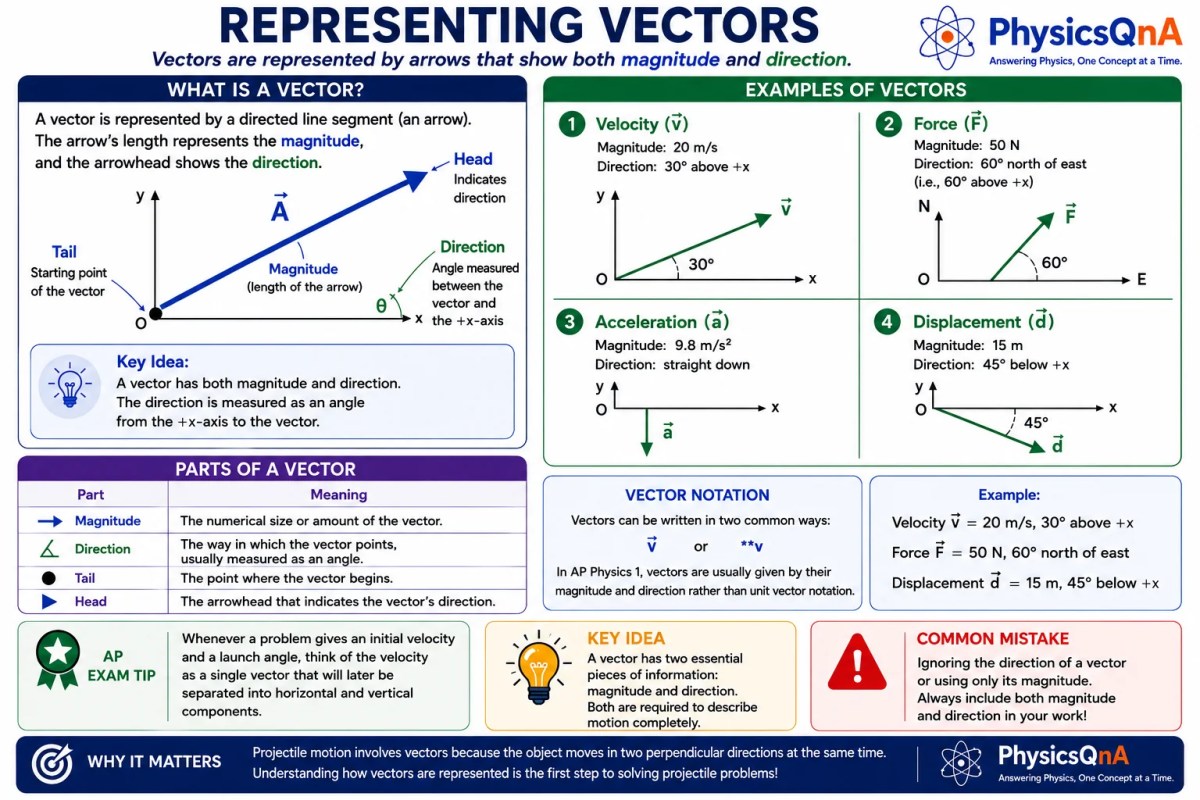
Parts of a Vector
| Part | Meaning |
|---|---|
| Magnitude | The numerical size or amount of the vector. |
| Direction | The way in which the vector points, usually measured as an angle. |
| Tail | The point where the vector begins. |
| Head | The arrowhead that indicates the vector’s direction. |
Vector Notation
Vectors are commonly written using a bold letter (such as v) or with an arrow above the symbol ( ). In AP Physics 1, vectors are usually identified by their magnitude and direction rather than using unit vector notation.
Whenever a problem gives an initial velocity and a launch angle, think of the velocity as a single vector that will later be separated into horizontal and vertical components.
The next section shows how a vector can be resolved into two perpendicular components using trigonometry. This is the key step in solving every projectile motion problem.
Resolving Vectors into Components
A projectile is launched with a single initial velocity, but that velocity acts in two different directions simultaneously. To analyze the motion, the initial velocity vector is separated into two perpendicular components: a horizontal component and a vertical component. This process is called vector resolution or resolving a vector into components.
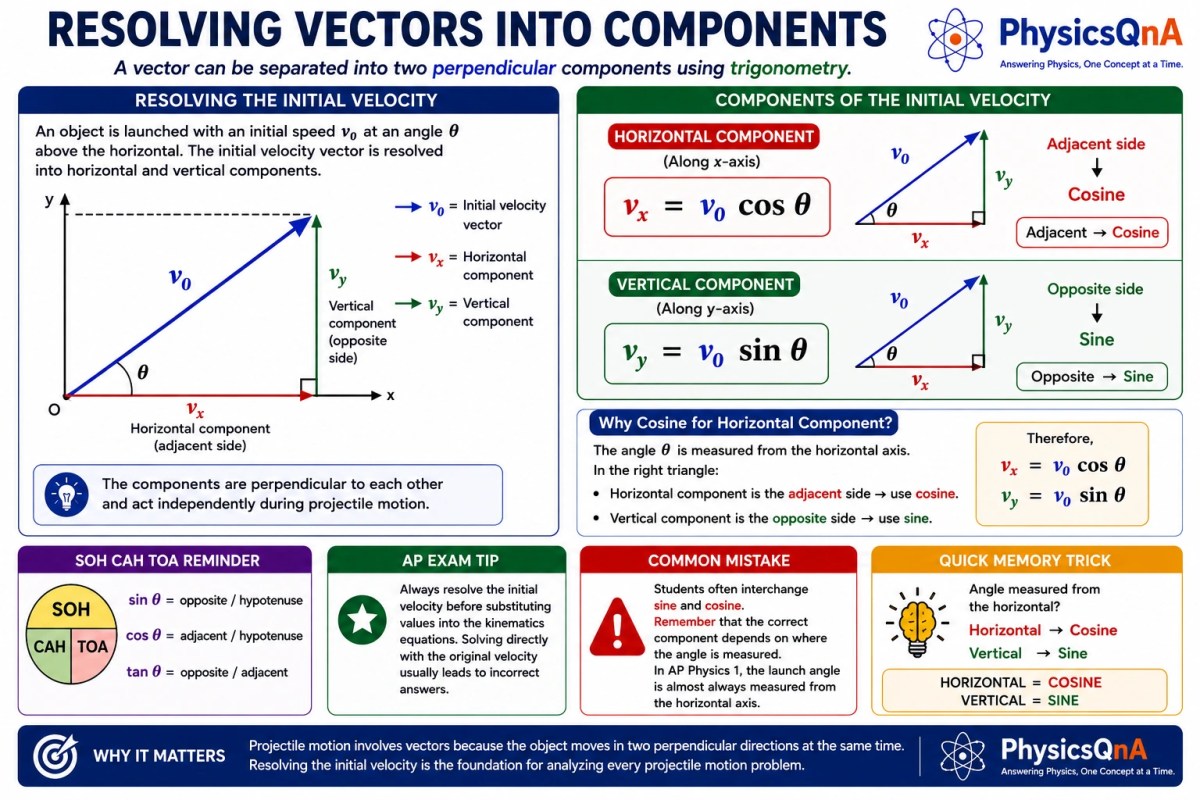
Horizontal and Vertical Components
Suppose an object is launched with an initial speed v at an angle θ above the horizontal.
Horizontal component

Vertical component

The horizontal component determines how fast the projectile moves across the ground, while the vertical component determines how high it rises and how long it remains in the air.
Why Cosine for the Horizontal Component?
The launch angle θ is measured from the horizontal axis. In the right triangle formed by the vector and its components, the horizontal component lies adjacent to the angle.
- Adjacent side → Cosine
- Opposite side → Sine
Therefore,
If the launch angle is measured from the horizontal,
- Horizontal → Cosine
- Vertical → Sine
Always resolve the initial velocity before substituting values into the kinematics equations. Solving directly with the original velocity usually leads to incorrect answers.
Students often interchange sine and cosine. Remember that the correct component depends on where the angle is measured. In AP Physics 1, the launch angle is almost always measured from the horizontal axis.
Independence of Horizontal and Vertical Motion
The key to solving every projectile motion problem is understanding that the horizontal and vertical motions are independent. Although the object follows a single curved path, its motion can be analyzed as two separate one-dimensional motions occurring at the same time.
Gravity acts only in the vertical direction. Therefore, the horizontal motion is unaffected by gravity, while the vertical motion experiences a constant downward acceleration.
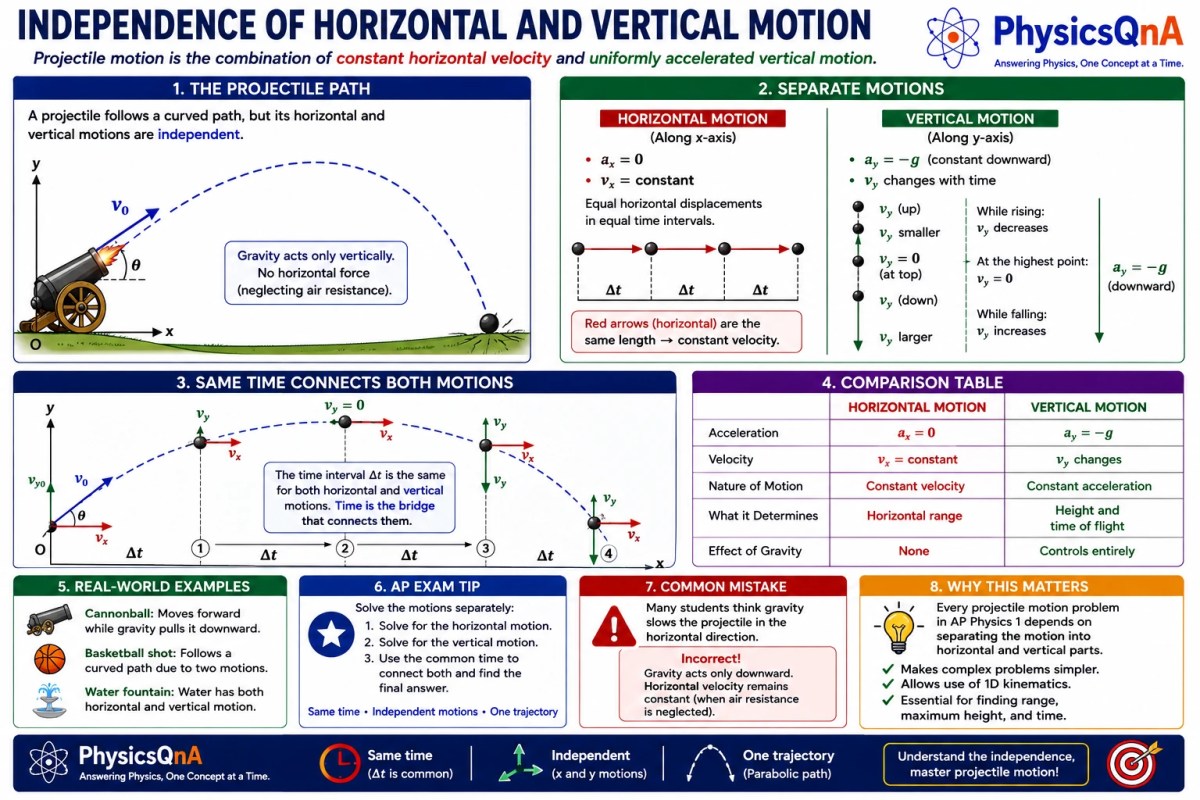
Horizontal Motion
In the absence of air resistance, no horizontal force acts on the projectile after it leaves the launcher. According to Newton’s First Law, the projectile continues moving with a constant horizontal velocity.
- Horizontal acceleration:
- Horizontal velocity remains constant.
- Horizontal displacement increases uniformly with time.
Vertical Motion
The vertical motion is affected only by gravity. The projectile accelerates downward throughout its flight, causing the vertical velocity to decrease while rising, become zero at the highest point, and increase downward during the descent.
- Vertical acceleration:
- Vertical velocity changes continuously.
- Maximum height occurs when .
 .
.Comparing the Two Motions
| Horizontal Motion | Vertical Motion |
|---|---|
Acceleration  |
Acceleration  |
| Velocity remains constant | Velocity changes with time |
| Determines the horizontal range | Determines height and time of flight |
| Independent of gravity | Controlled entirely by gravity |
Always solve the horizontal and vertical motions separately. The only quantity shared by both motions is time. Once the time is known from one direction, it can immediately be used in the other.
Many students believe that gravity slows the projectile in the horizontal direction. This is incorrect. Gravity acts only downward, so the horizontal velocity remains constant when air resistance is neglected.
- A basketball shot follows a curved path because the horizontal and vertical motions occur simultaneously.
- A cannonball continues moving forward while gravity pulls it downward.
- Water leaving a fountain forms a projectile because it has both horizontal and vertical motion.
A projectile follows one curved trajectory, but it is always analyzed as two independent motions:
- Horizontal motion → Constant velocity
- Vertical motion → Constant acceleration due to gravity
- Time connects both motions.
5. Projectile Motion Equations
Once the initial velocity has been resolved into horizontal and vertical components, projectile motion can be analyzed using two separate sets of kinematics equations. Since the horizontal and vertical motions are independent, each direction is solved separately before combining the results.
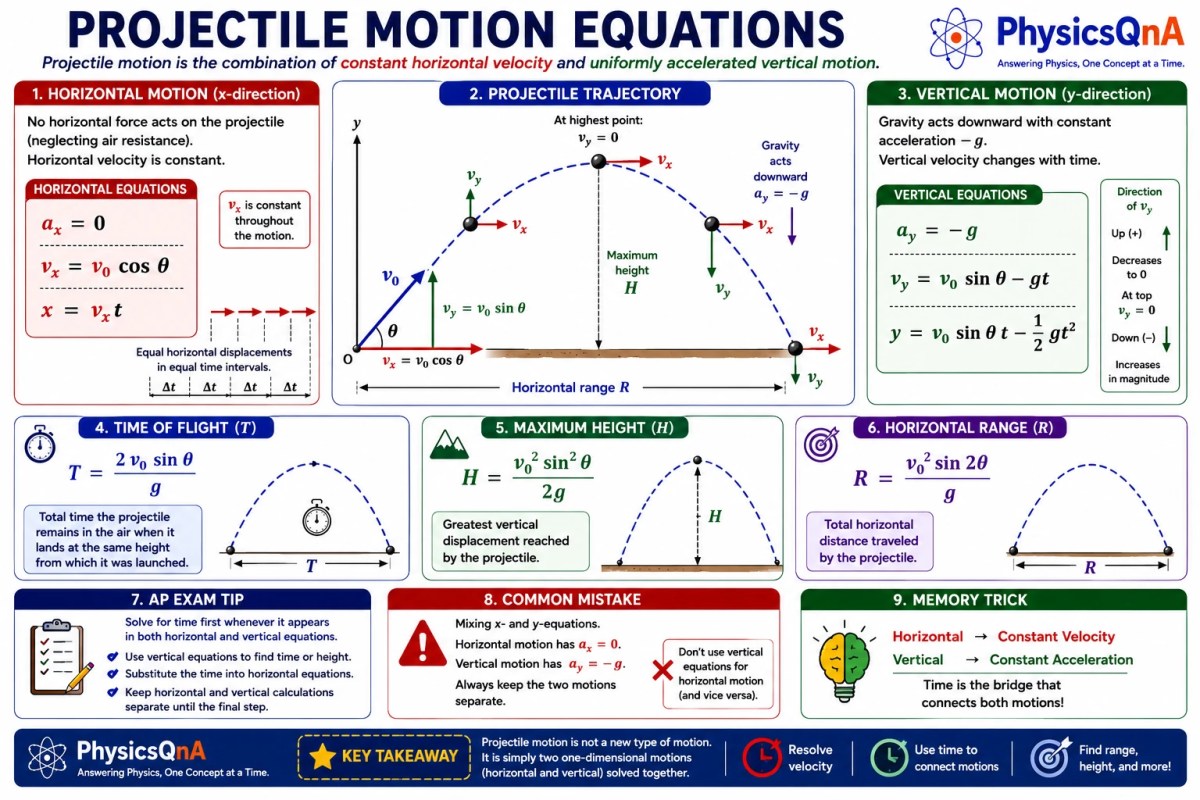
Horizontal Motion (x-direction)
Since no horizontal force acts on the projectile (neglecting air resistance), its horizontal acceleration is zero. Therefore, the horizontal velocity remains constant throughout the motion.
Horizontal Equations
![\[ a_x=0 \]](https://i0.wp.com/physicsqanda.com/wp-content/ql-cache/quicklatex.com-78314800ec5fae73d99688cc6aa3dec5_l3.png?resize=50%2C14&ssl=1 "Rendered by QuickLaTeX.com")
![\[ v_x=v_0\cos\theta \]](https://i0.wp.com/physicsqanda.com/wp-content/ql-cache/quicklatex.com-e3fb850b5e40d7dea1f65609efcc9f96_l3.png?resize=96%2C14&ssl=1 "Rendered by QuickLaTeX.com")
![\[ x=v_xt \]](https://i0.wp.com/physicsqanda.com/wp-content/ql-cache/quicklatex.com-5e626f58b5308910171685275dcc6f83_l3.png?resize=57%2C14&ssl=1 "Rendered by QuickLaTeX.com")
Vertical Motion (y-direction)
Gravity produces a constant downward acceleration throughout the flight. The vertical velocity continuously changes until the projectile reaches its maximum height, after which it increases downward.
Vertical Equations
![\[ a_y=-g \]](https://i0.wp.com/physicsqanda.com/wp-content/ql-cache/quicklatex.com-9cb42012517f2898974c7ae28267dbe1_l3.png?resize=64%2C13&ssl=1 "Rendered by QuickLaTeX.com")
![\[ v_y=v_0\sin\theta-gt \]](https://i0.wp.com/physicsqanda.com/wp-content/ql-cache/quicklatex.com-c45f27b768c38ed8f710895f78ef90b8_l3.png?resize=130%2C17&ssl=1 "Rendered by QuickLaTeX.com")
![\[ y=v_0\sin\theta\,t-\frac12gt^2 \]](https://i0.wp.com/physicsqanda.com/wp-content/ql-cache/quicklatex.com-c3ef2a604762b6d36a8a4cbb2369d98a_l3.png?resize=152%2C36&ssl=1 "Rendered by QuickLaTeX.com")
Important Projectile Motion Formulas
For projectiles launched and landing at the same vertical level, several useful formulas can be derived directly from the kinematics equations.
| Quantity | Formula | Meaning |
|---|---|---|
| Time of Flight |
|
Total time the projectile remains in the air. |
| Maximum Height |
|
Highest vertical position reached. |
| Horizontal Range |
|
Total horizontal distance traveled. |
![\[ H=\frac{v_0^2\sin^2\theta}{2g} \]](https://i0.wp.com/physicsqanda.com/wp-content/ql-cache/quicklatex.com-a2f31542cedc6e5e4422452fbd015c05_l3.png?resize=104%2C44&ssl=1 "Rendered by QuickLaTeX.com")
Choosing the Correct Equation
Every projectile problem becomes much easier after identifying the unknown quantity. Select the equation that contains only one unknown variable whenever possible.
- Resolve the initial velocity into horizontal and vertical components.
- Use the vertical equations to calculate the required time or height.
- Substitute the time into the horizontal equation to determine the range or horizontal displacement.
- Combine both directions to describe the complete motion.
Do not mix horizontal and vertical equations. The horizontal motion has zero acceleration, whereas the vertical motion always has an acceleration of
 . Keep the two directions separate throughout the calculation.
- Horizontal → Constant Velocity
- Vertical → Constant Acceleration
- Time links both motions.
Projectile motion is not a new type of motion. It is simply the combination of two familiar one-dimensional motions:
- Horizontal motion with constant velocity.
- Vertical motion with constant acceleration due to gravity.
- Both motions occur simultaneously and are connected only through time.
8. Time of Flight, Maximum Height, and Horizontal Range
Once the initial velocity has been separated into horizontal and vertical components, three important quantities can be calculated for every projectile:
| Quantity | Meaning | Symbol |
|---|---|---|
| Time of Flight | Total time the projectile remains in the air. | T |
| Maximum Height | Highest vertical position reached. | H |
| Horizontal Range | Total horizontal distance traveled. | R |
These equations apply when the projectile is launched and lands at the same vertical height, which is the most common situation encountered in AP Physics 1.
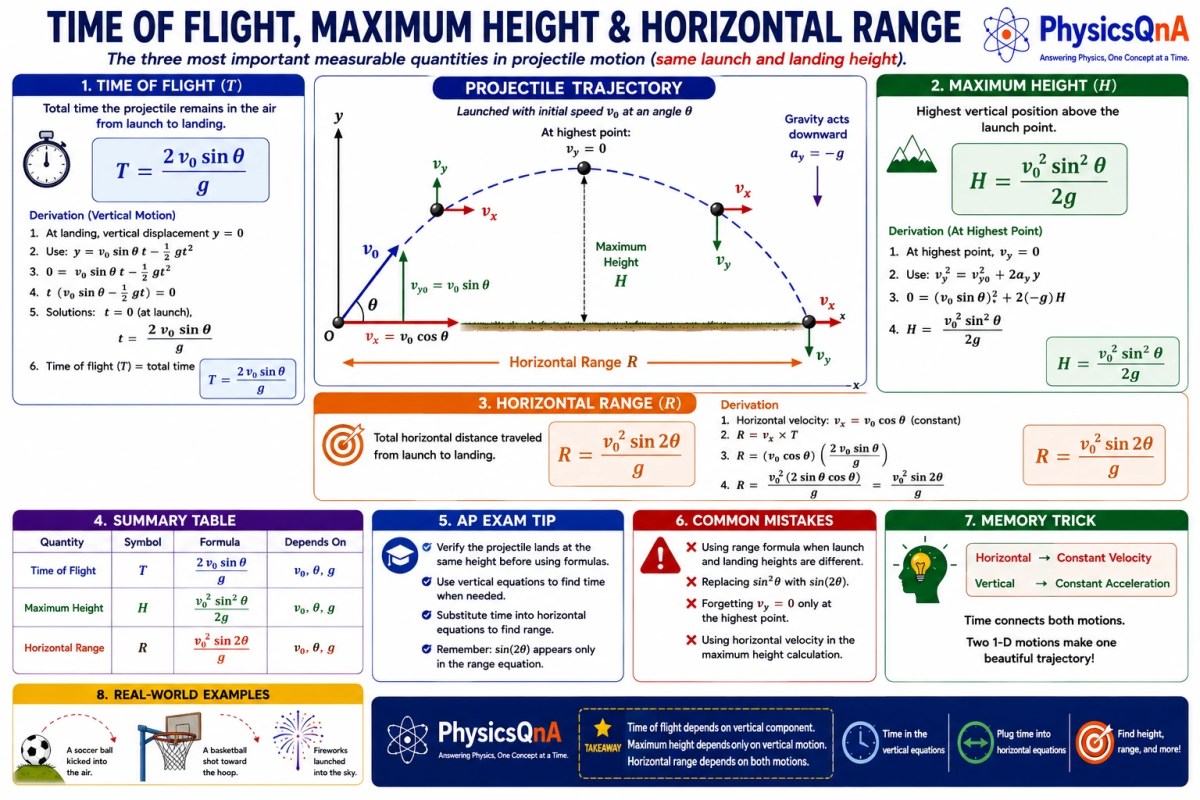
Time of Flight
The projectile rises and falls under constant acceleration due to gravity. Since the upward journey and downward journey take equal amounts of time (for equal launch and landing heights), the total time of flight is:
Maximum Height
At the highest point of the trajectory, the vertical velocity becomes zero. Applying the kinematic equation gives:
Horizontal Range
The range equals the constant horizontal velocity multiplied by the total time of flight. Combining these relationships produces:
- Always verify whether the projectile lands at the same height before using these formulas.
- If launch and landing heights differ, use the kinematic equations instead of memorized formulas.
- Remember that sin(2θ) appears only in the horizontal range equation.
- Using the range equation when the projectile lands at a different height.
- Replacing sin²θ with sin(2θ).
- Forgetting that the vertical velocity is zero only at the highest point.
- Using horizontal velocity in the maximum height calculation.
- Time of Flight depends on the vertical component of velocity.
- Maximum Height depends only on vertical motion.
- Horizontal Range depends on both horizontal and vertical motion.
- All three equations are derived from the same kinematic principles.
9. Solving Projectile Motion Problems
Most AP Physics 1 projectile questions can be solved using the same systematic approach. Rather than memorizing many formulas, focus on identifying the known quantities and solving the horizontal and vertical motions separately.
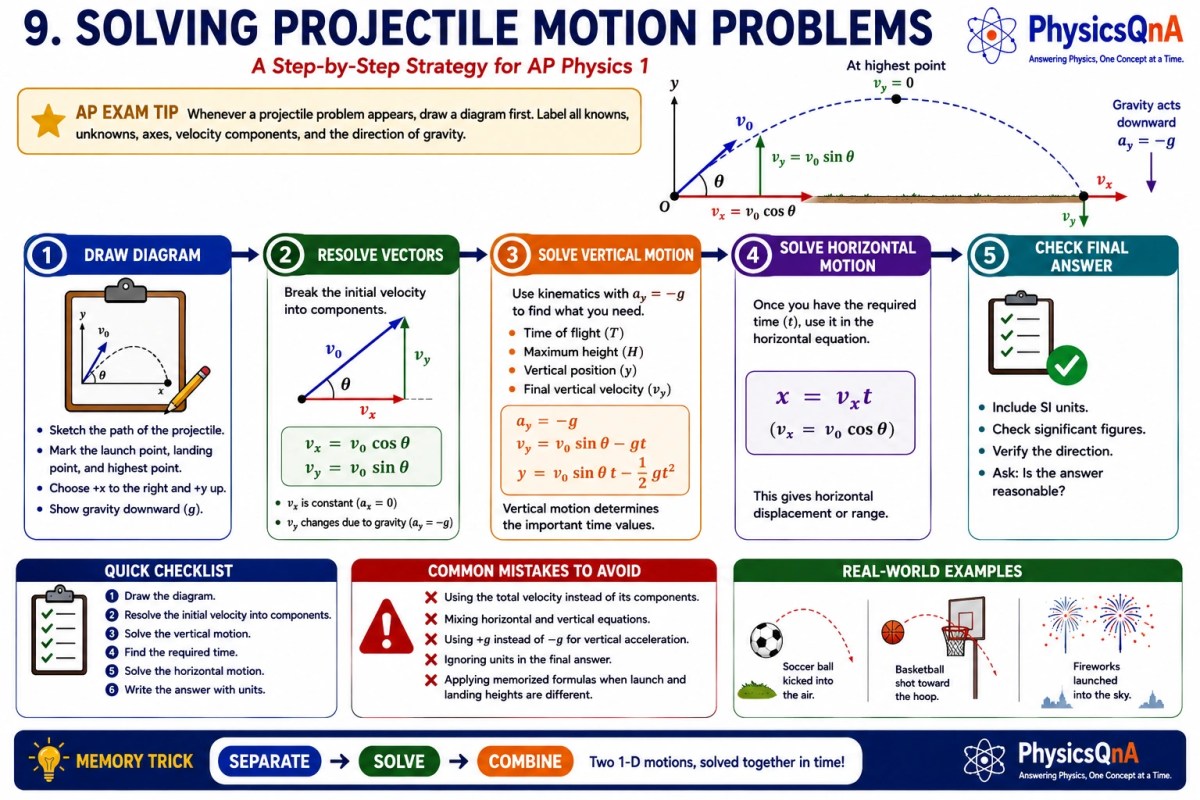
Step 1 — Draw the Situation
Sketch the projectile’s path and identify:
- Launch angle (θ)
- Initial speed (v₀)
- Horizontal direction (x-axis)
- Vertical direction (y-axis)
- Acceleration due to gravity (g)
Step 2 — Resolve the Initial Velocity
Convert the initial velocity into horizontal and vertical components.
![\[ v_y=v_0\sin\theta \]](https://i0.wp.com/physicsqanda.com/wp-content/ql-cache/quicklatex.com-8c7bd355f1f942f6f05d73ec156de6ab_l3.png?resize=94%2C17&ssl=1 "Rendered by QuickLaTeX.com")
Step 3 — Solve the Vertical Motion
The vertical motion determines the important time values because gravity acts only in this direction.
- Time of flight
- Maximum height
- Vertical position
- Final vertical velocity
Step 4 — Solve the Horizontal Motion
After finding the required time, substitute it into the horizontal equation.
This gives the horizontal displacement or range.
Step 5 — Check the Answer
- Include SI units.
- Check significant figures.
- Verify the direction.
- Ask whether the answer is physically reasonable.
- Draw the diagram.
- Resolve vectors.
- Solve vertical motion.
- Find the required time.
- Solve horizontal motion.
- Write the answer with units.
- Using the total velocity instead of its components.
- Mixing horizontal and vertical equations.
- Using +g instead of −g.
- Ignoring units.
- Applying memorized formulas when launch and landing heights are different.
Every projectile motion problem becomes much simpler after separating the motion into two independent one-dimensional motions. Nearly every AP Physics question follows this same sequence of steps.
10. Worked Example: Finding the Maximum Height
Now let’s apply everything learned so far by solving a complete projectile motion problem step by step. The goal is not simply to obtain the answer, but to understand the reasoning behind every calculation.
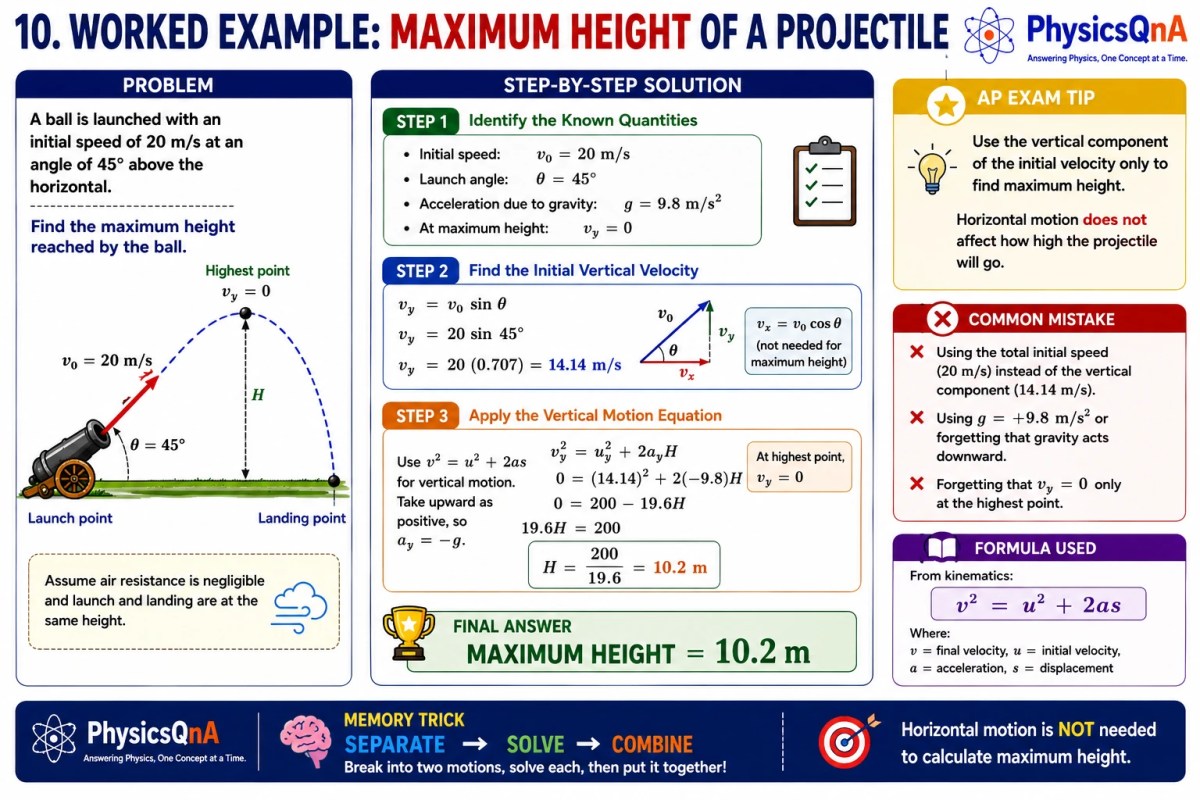
Problem
Find the maximum height reached by the ball.
Step 1 — Identify the Known Quantities
- Initial speed:
- Launch angle:
- Acceleration:
- At maximum height:


Step 2 — Find the Initial Vertical Velocity
Resolve the launch velocity into its vertical component.
![\[ v_y=20\sin45^\circ \]](https://i0.wp.com/physicsqanda.com/wp-content/ql-cache/quicklatex.com-805463efe4d1b559dca773ec6a6aa8fc_l3.png?resize=111%2C19&ssl=1 "Rendered by QuickLaTeX.com")
![\[ v_y=20(0.707)=14.14\text{ m/s} \]](https://i0.wp.com/physicsqanda.com/wp-content/ql-cache/quicklatex.com-4a5741505b1763a18a19b5f2373de6ed_l3.png?resize=214%2C19&ssl=1 "Rendered by QuickLaTeX.com")
Step 3 — Apply the Vertical Motion Equation
Use the equation relating velocity and displacement.
![\[ v_y^2=u_y^2-2gH \]](https://i0.wp.com/physicsqanda.com/wp-content/ql-cache/quicklatex.com-726c24da59409d0549214b7cc896a2ce_l3.png?resize=114%2C24&ssl=1 "Rendered by QuickLaTeX.com")
![\[ 0=(14.14)^2-2(9.8)H \]](https://i0.wp.com/physicsqanda.com/wp-content/ql-cache/quicklatex.com-060f555957b311cb7d9a46eb7c94b9b7_l3.png?resize=178%2C22&ssl=1 "Rendered by QuickLaTeX.com")
![\[ H=\frac{200}{19.6} \]](https://i0.wp.com/physicsqanda.com/wp-content/ql-cache/quicklatex.com-20496f5a24cbc9724c7d392823f910d4_l3.png?resize=74%2C36&ssl=1 "Rendered by QuickLaTeX.com")
![\[ H=10.2\text{ m} \]](https://i0.wp.com/physicsqanda.com/wp-content/ql-cache/quicklatex.com-67e02ff43413f68221432a6d4040db7e_l3.png?resize=92%2C12&ssl=1 "Rendered by QuickLaTeX.com")
Final Answer
- Using the total initial velocity (20 m/s) instead of the vertical component (14.14 m/s).
- Using instead of treating gravity as downward in the equation.
- Forgetting that the vertical velocity becomes zero only at the highest point.
 instead of treating gravity as downward in the equation.
Every maximum-height problem begins by resolving the launch velocity into vertical and horizontal components. Only the vertical motion is needed to calculate the highest point.
11. Worked Example: Time of Flight and Horizontal Range
In this example, the projectile is launched and lands at the same vertical height. This allows the standard projectile motion formulas to be used directly. The example demonstrates how to determine both the total time the projectile remains in the air and the horizontal distance it travels.
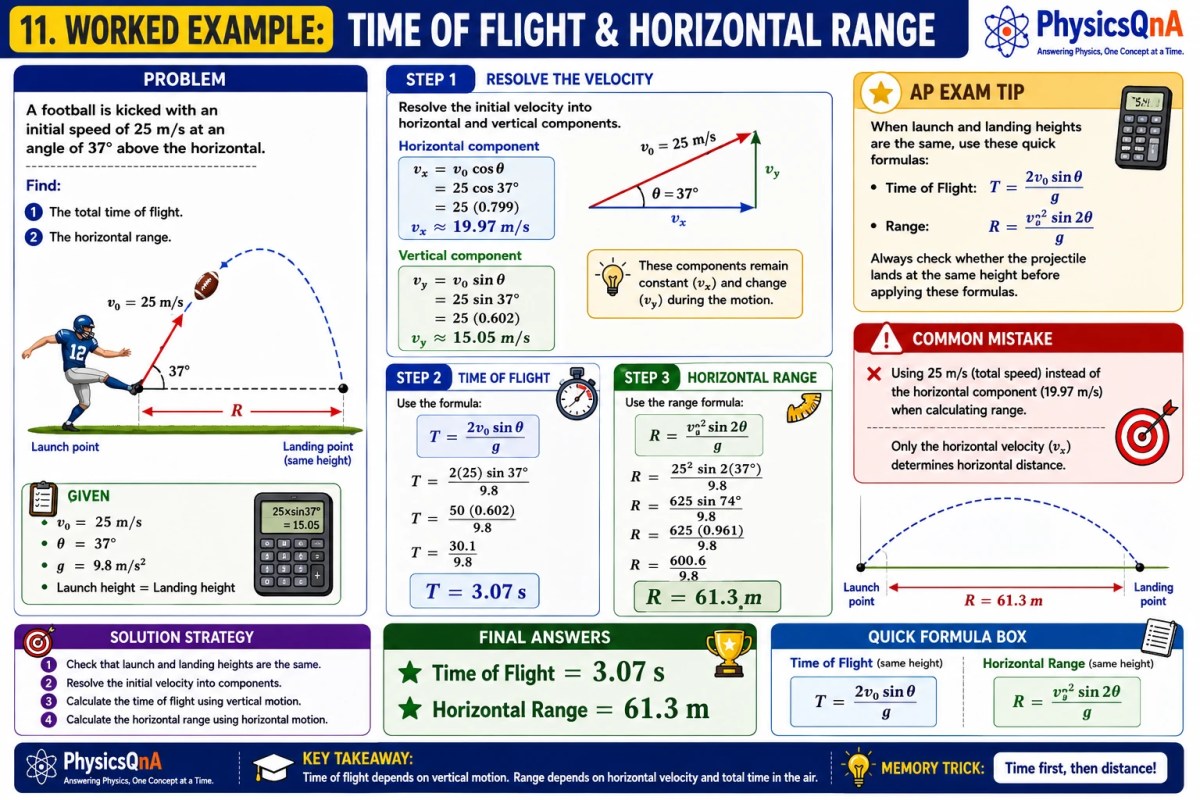
Problem
Find:
- The total time of flight.
- The horizontal range.
Step 1 — Identify the Known Quantities
- Initial speed:
- Launch angle:
- Acceleration due to gravity:
- Launch height = Landing height


Step 2 — Calculate the Time of Flight
Use the standard equation:
![\[ T=\frac{2v_0\sin\theta}{g} \]](https://i0.wp.com/physicsqanda.com/wp-content/ql-cache/quicklatex.com-7d302bf0a9b2d39634a980f6508ec2bb_l3.png?resize=100%2C40&ssl=1 "Rendered by QuickLaTeX.com")
![\[ T=\frac{2(25)\sin37^\circ}{9.8} \]](https://i0.wp.com/physicsqanda.com/wp-content/ql-cache/quicklatex.com-0b1546f2eb3b18d6739dc0e170d7e135_l3.png?resize=132%2C38&ssl=1 "Rendered by QuickLaTeX.com")
![\[ T=\frac{50(0.602)}{9.8} \]](https://i0.wp.com/physicsqanda.com/wp-content/ql-cache/quicklatex.com-c71bdd0920c276bf4dfc57ffb5587077_l3.png?resize=110%2C38&ssl=1 "Rendered by QuickLaTeX.com")
![\[ T=\frac{30.1}{9.8} \]](https://i0.wp.com/physicsqanda.com/wp-content/ql-cache/quicklatex.com-36bf2d8a036f0f117bbdbee318f1962d_l3.png?resize=70%2C36&ssl=1 "Rendered by QuickLaTeX.com")
![\[ T=3.07\text{ s} \]](https://i0.wp.com/physicsqanda.com/wp-content/ql-cache/quicklatex.com-ee654cb699018a0d86223407bb03b0e4_l3.png?resize=81%2C13&ssl=1 "Rendered by QuickLaTeX.com")
Step 3 — Calculate the Horizontal Range
Use the range equation:
![\[ R=\frac{v_0^2\sin2\theta}{g} \]](https://i0.wp.com/physicsqanda.com/wp-content/ql-cache/quicklatex.com-3cdd55342e3a39902d3eea21e0337c2b_l3.png?resize=102%2C43&ssl=1 "Rendered by QuickLaTeX.com")
![\[ R=\frac{25^2\sin74^\circ}{9.8} \]](https://i0.wp.com/physicsqanda.com/wp-content/ql-cache/quicklatex.com-e6b70ed8b542c57c3e68f7b15d22c718_l3.png?resize=118%2C39&ssl=1 "Rendered by QuickLaTeX.com")
![\[ R=\frac{625(0.961)}{9.8} \]](https://i0.wp.com/physicsqanda.com/wp-content/ql-cache/quicklatex.com-bba0ee7371f2f7235ee6c9998147b283_l3.png?resize=120%2C38&ssl=1 "Rendered by QuickLaTeX.com")
![\[ R=\frac{600.6}{9.8} \]](https://i0.wp.com/physicsqanda.com/wp-content/ql-cache/quicklatex.com-01d8525d5cd3f7ba7e4976c8e22e2b13_l3.png?resize=80%2C36&ssl=1 "Rendered by QuickLaTeX.com")
![\[ R=61.3\text{ m} \]](https://i0.wp.com/physicsqanda.com/wp-content/ql-cache/quicklatex.com-e60fbb1bf83ccdf06a6043d4a59b73ad_l3.png?resize=90%2C12&ssl=1 "Rendered by QuickLaTeX.com")
Final Answers
Horizontal Range = 61.3 m
- Check whether the projectile lands at the same height.
- Calculate the time of flight.
- Use the range equation or multiply horizontal velocity by time.
- Write the final answer with SI units.
- Using the range equation when the landing height is different.
- Forgetting that the angle inside the range equation is 2θ.
- Using degrees incorrectly in the calculator.
- Omitting units in the final answer.
For projectiles launched and landing at the same height, the time of flight depends on the vertical motion, while the horizontal range depends on both the horizontal velocity and the total flight time.
12. Practice Problems (Easy → Medium → AP Level)
Now it’s time to apply the concepts learned throughout this lesson. These practice problems gradually increase in difficulty, beginning with straightforward calculations and progressing to AP Physics 1 style conceptual and multi-step questions.
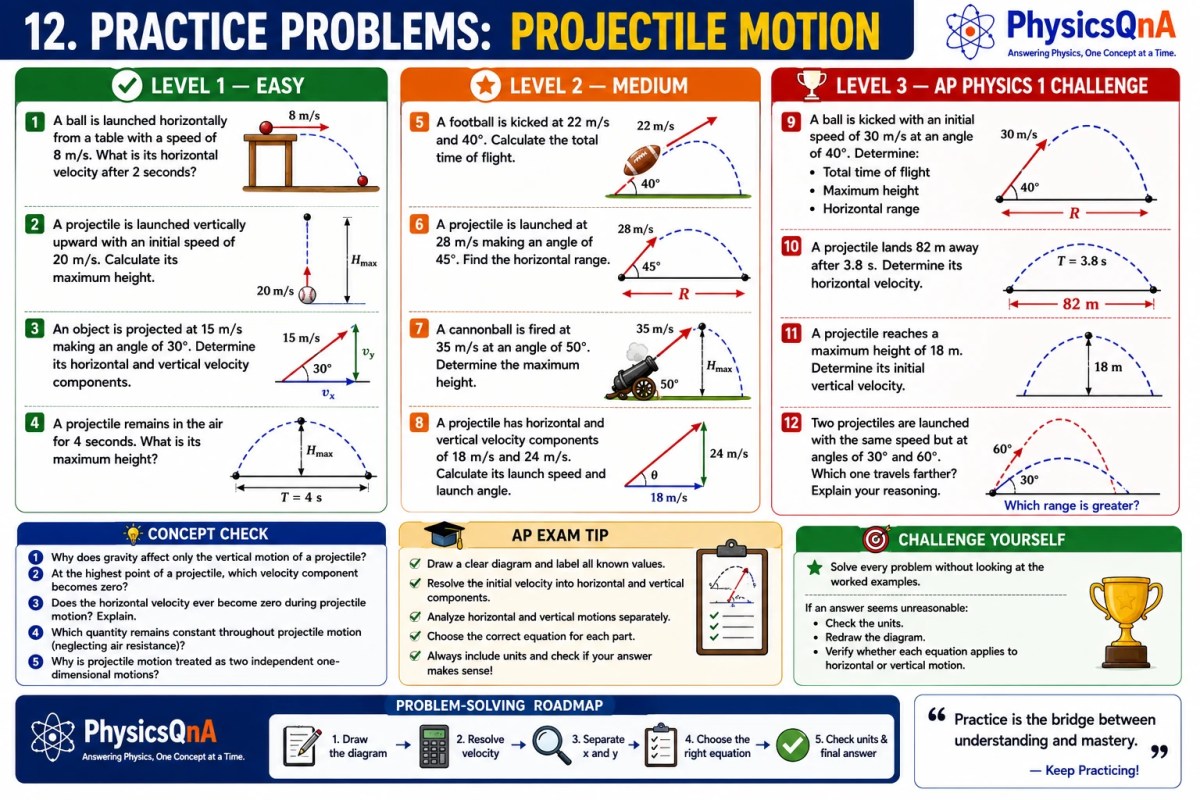
Level 1 — Easy
- A ball is launched horizontally from a table with a speed of 8 m/s. What is its horizontal velocity after 2 seconds?
- A projectile is launched vertically upward with an initial speed of 20 m/s. Calculate its maximum height.
- An object is projected at 15 m/s making an angle of 30°. Determine its horizontal and vertical velocity components.
- A projectile remains in the air for 4 seconds. What is its maximum height?
Level 2 — Medium
- A football is kicked at 22 m/s and 40°. Calculate the total time of flight.
- A projectile is launched at 28 m/s making an angle of 45°. Find the horizontal range.
- A cannonball is fired at 35 m/s at an angle of 50°. Determine the maximum height.
- A projectile has horizontal and vertical velocity components of 18 m/s and 24 m/s. Calculate its launch speed and launch angle.
Level 3 — AP Physics 1 Challenge
-
A ball is kicked with an initial speed of 30 m/s at an angle of 40°. Determine:
- Total time of flight
- Maximum height
- Horizontal range
- A projectile lands 82 m away after 3.8 s. Determine its horizontal velocity.
- A projectile reaches a maximum height of 18 m. Determine its initial vertical velocity.
- Two projectiles are launched with the same speed but at angles of 30° and 60°. Which one travels farther? Explain your reasoning.
Concept Check
- Why does gravity affect only the vertical motion of a projectile?
- At the highest point of a projectile, which velocity component becomes zero?
- Does the horizontal velocity ever become zero during projectile motion? Explain.
- Which quantity remains constant throughout projectile motion (neglecting air resistance)?
- Why is projectile motion treated as two independent one-dimensional motions?
Solve every problem without looking at the worked examples. If an answer seems unreasonable, check the units, redraw the diagram, and verify whether each equation applies to horizontal motion or vertical motion.
After completing these practice problems, solving AP Physics 1 projectile motion questions should become a systematic process:
- Draw the diagram.
- Resolve the velocity into components.
- Analyze horizontal and vertical motion separately.
- Select the appropriate equation.
- Check units and reasonableness of the final answer.
13. Common AP Physics 1 Mistakes
Many errors in projectile motion are caused by using the correct equations in the wrong direction or confusing horizontal and vertical quantities. Learning to recognize these common mistakes will improve accuracy and save valuable marks on the AP Physics 1 exam.

Mistake 1 — Mixing Horizontal and Vertical Motion
Horizontal equations should only contain horizontal quantities, while vertical equations should only contain vertical quantities. Never substitute a vertical velocity into a horizontal equation.
Mistake 2 — Forgetting that Gravity Acts Only Vertically
Gravity changes only the vertical velocity. The horizontal velocity remains constant throughout projectile motion when air resistance is neglected.
Mistake 3 — Using the Wrong Trigonometric Function
When the launch angle is measured from the horizontal,
- Horizontal component = v0 cos θ
- Vertical component = v0 sin θ
Always identify the adjacent and opposite sides before selecting sine or cosine.
Mistake 4 — Assuming Velocity is Zero at the Highest Point
Only the vertical component of velocity becomes zero at the highest point. The projectile continues moving horizontally with constant velocity.
Mistake 5 — Ignoring Units
Always write answers with SI units:
- Displacement → m
- Velocity → m/s
- Acceleration → m/s²
- Time → s
Quick Checklist Before Submitting an Answer
- ✓ Resolved the initial velocity into components.
- ✓ Used separate equations for x- and y-motion.
- ✓ Used the correct trigonometric function.
- ✓ Included the effect of gravity only in the vertical direction.
- ✓ Checked units and significant figures.
- ✓ Verified that the answer is physically reasonable.
Most AP Physics projectile motion questions become much easier after drawing a diagram, resolving the initial velocity into components, and treating horizontal and vertical motions independently.
14. Concept Check / Quick Quiz
Before moving on to AP-style multiple-choice questions, take a few minutes to check your understanding of the core concepts covered in this lesson. These questions focus on reasoning rather than lengthy calculations.
Quick Quiz
- A projectile reaches its highest point. Which velocity component is zero?
- Which velocity component remains constant throughout projectile motion (neglecting air resistance)?
- Why is projectile motion considered two independent one-dimensional motions?
- A ball is launched at an angle of 45°. Which trigonometric function is used to determine the horizontal component of the initial velocity?
- If the launch speed is doubled while the launch angle remains the same, what happens to the horizontal velocity component?
- At every point during projectile motion, what is the direction of gravitational acceleration?
-
Which of the following quantities remains constant during projectile motion?
- Horizontal velocity
- Vertical velocity
- Acceleration due to gravity
- Both A and C
- True or False: At the highest point of the trajectory, the projectile is momentarily at rest.
- A projectile is launched horizontally from a cliff. What is its initial vertical velocity?
- Which quantity determines how far a projectile travels horizontally?

Answers
- Vertical velocity (vy)
- Horizontal velocity (vx)
- Gravity acts only in the vertical direction, so horizontal and vertical motions can be analyzed separately.
- Cosine
- It doubles.
- Vertically downward.
- Both A and C
- False
- Zero
- The horizontal velocity and the total time of flight.
- 9–10 correct: Excellent! Ready for AP-style questions.
- 7–8 correct: Good understanding. Review the vector components and projectile equations.
- Below 7: Revisit the worked examples before attempting the AP-level questions.
15. Multiple Choice Questions (AP Physics 1 Style)
The following questions are modeled after the style and reasoning expected on the AP Physics 1 examination. Some questions require calculations, while others test conceptual understanding. Attempt every question before checking the answer key.

Questions
-
A projectile reaches its highest point. Which quantity is zero?
- Horizontal velocity
- Vertical velocity
- Acceleration
- Horizontal acceleration
-
Ignoring air resistance, which quantity remains constant throughout projectile motion?
- Vertical velocity
- Resultant velocity
- Horizontal velocity
- Height
-
A ball is launched with speed v at an angle θ above the horizontal. Which expression gives the horizontal component of the initial velocity?
- v sin θ
- v cos θ
- v tan θ
- v/sec θ
-
A projectile is launched horizontally from a cliff. Its initial vertical velocity is
- g
- −g
- 0
- Depends on height
-
At every point during projectile motion, the acceleration is
- Horizontal
- Along the direction of motion
- Vertically downward
- Zero
-
A projectile is launched at 20 m/s and 30°. The horizontal component of the initial velocity is approximately
- 10 m/s
- 17.3 m/s
- 20 m/s
- 15 m/s
-
Which launch angle gives the greatest horizontal range when launch and landing occur at the same height?
- 30°
- 45°
- 60°
- 75°
-
A projectile has reached its maximum height. Which statement is correct?
- Both velocity components are zero.
- The projectile stops moving.
- Vertical velocity is zero but acceleration remains downward.
- Acceleration becomes zero.
-
If the launch speed doubles while the angle remains unchanged, the horizontal component
- Halves
- Remains unchanged
- Doubles
- Quadruples
-
Which equation is used to determine the maximum height?
- v = u + at
- v² = u² + 2as
- s = ut
- P = mv
-
Neglecting air resistance, the path of a projectile is
- Linear
- Circular
- Parabolic
- Elliptical
-
Which factor affects the time of flight?
- Horizontal velocity only
- Vertical component of initial velocity
- Mass only
- Horizontal range
Answer Key
| Q | Ans | Q | Ans | Q | Ans |
|---|---|---|---|---|---|
| 1 | B | 5 | C | 9 | C |
| 2 | C | 6 | B | 10 | B |
| 3 | B | 7 | B | 11 | C |
| 4 | C | 8 | C | 12 | B |
The next section contains a complete AP Physics 1 Free-Response Question (FRQ) with a detailed, step-by-step solution similar to those found on the actual AP exam.
16. AP Physics 1 Free Response Question (FRQ)
The following free-response question is modeled after the style of the College Board AP Physics 1 examination. Show all work, include diagrams where appropriate, justify each step, and clearly state the final answer with proper units.
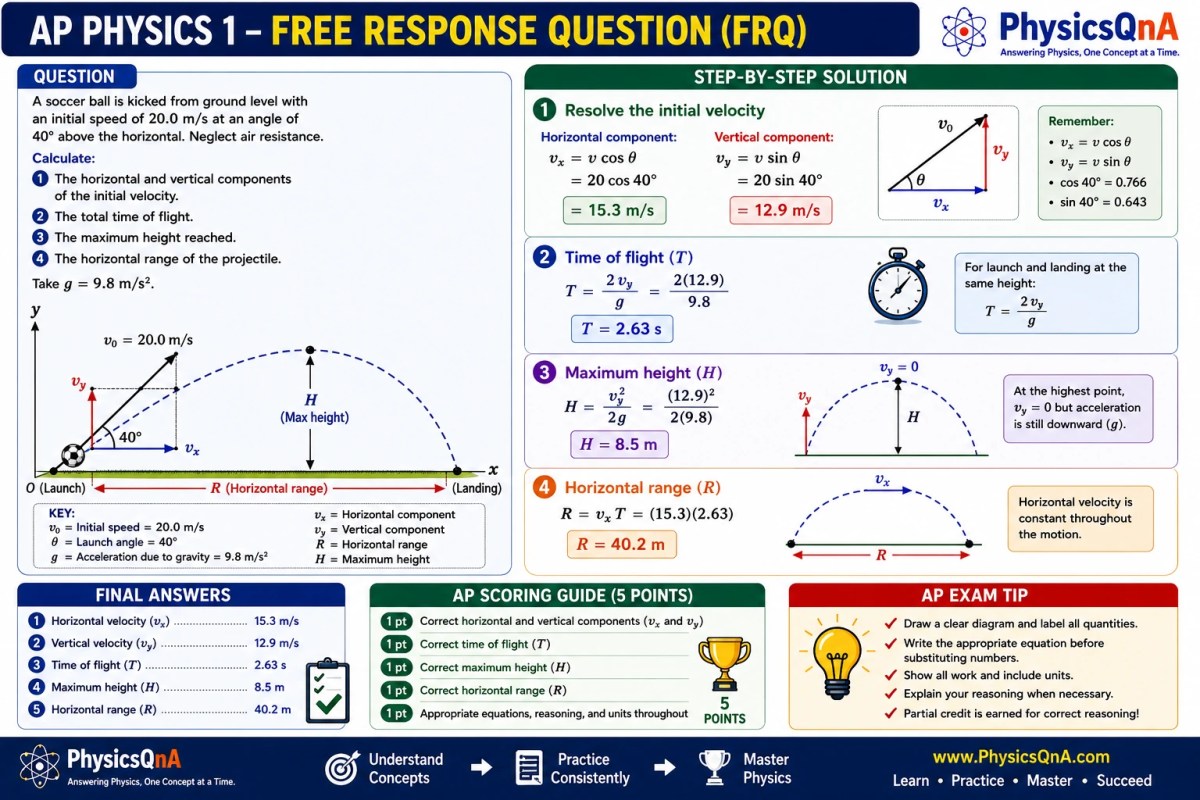
Question
A soccer ball is kicked from ground level with an initial speed of 20.0 m/s at an angle of 40° above the horizontal. Neglect air resistance.
Calculate:
- The horizontal and vertical components of the initial velocity.
- The total time of flight.
- The maximum height reached.
- The horizontal range of the projectile.
Take g = 9.8 m/s².
Complete Solution
Step 1. Resolve the initial velocity
vx = v cos θ = 20 cos 40° ≈ 15.3 m/s
vy = v sin θ = 20 sin 40° ≈ 12.9 m/s
Step 2. Time of flight
T = 2vy/g = 2(12.9)/9.8 ≈ 2.63 s
Step 3. Maximum height
H = vy2 / 2g = (12.9)² / (2×9.8) ≈ 8.5 m
Step 4. Horizontal range
R = vxT = 15.3 × 2.63 ≈ 40.2 m
Final Answers
- Horizontal velocity: 15.3 m/s
- Vertical velocity: 12.9 m/s
- Time of flight: 2.63 s
- Maximum height: 8.5 m
- Horizontal range: 40.2 m
- 1 point — Correct vector components
- 1 point — Correct time of flight
- 1 point — Correct maximum height
- 1 point — Correct horizontal range
- 1 point — Appropriate equations, reasoning, and units
17. Real-World Applications of Projectile Motion
Projectile motion is much more than a classroom topic. Engineers, athletes, scientists, and military professionals use the same principles to predict the motion of objects traveling through the air. Understanding projectile motion helps explain how objects move under the influence of gravity and allows accurate predictions of where they will land.

Common Applications
| Field | Application of Projectile Motion |
|---|---|
| Sports | Basketball shots, football passes, cricket throws, golf drives, javelin, and long jump analysis. |
| Engineering | Designing water fountains, ballistics software, robotic launch systems, and safety simulations. |
| Firefighting | Selecting the correct angle and pressure for water jets to reach elevated locations. |
| Military | Predicting artillery shell trajectories and targeting systems. |
| Space Science | Planning rocket launches, satellite deployment, and spacecraft landing trajectories. |
| Entertainment | Creating realistic animations and physics-based simulations in video games and films. |
Why Projectile Motion Matters
- Predicts where an object will land.
- Improves accuracy in sports and engineering.
- Supports safer designs and better planning.
- Forms the foundation for advanced mechanics and orbital motion.
- Demonstrates how mathematics models real physical systems.
Although real objects often experience air resistance, the ideal projectile model provides an excellent approximation for many practical situations and serves as the basis for more advanced motion analysis.
18. Summary / Key Takeaways
Projectile motion becomes much easier when the motion is separated into its horizontal and vertical components. The key is to treat these two motions independently while remembering that they occur simultaneously.
A projectile has: constant horizontal velocity and constant vertical acceleration due to gravity. Together, these produce a parabolic trajectory.

Key Concepts to Remember
- Projectile motion is two-dimensional motion that can be analyzed as independent horizontal and vertical motions.
- The initial velocity can be resolved into two components: vx and vy.
- The horizontal acceleration is zero: ax = 0.
- The vertical acceleration is constant and directed downward: ay = −g.
- Horizontal velocity remains constant when air resistance is neglected.
- Vertical velocity changes continuously because of gravity.
- At the highest point, the vertical velocity is zero: vy = 0.
- The acceleration is still directed downward at the highest point.
- For launch and landing at the same height, the time of ascent equals the time of descent.
- The horizontal range depends on horizontal velocity and total time of flight.
The Problem-Solving Strategy
- Draw the situation. Identify the launch angle, initial velocity, height, and range.
- Choose the x- and y-axes.
- Resolve the initial velocity into horizontal and vertical components.
- Analyze horizontal motion using constant velocity.
- Analyze vertical motion using constant acceleration due to gravity.
- Use the appropriate kinematics equation.
- Combine the horizontal and vertical results to obtain the required quantity.
- Check the answer for reasonable magnitude, direction, and units.
Projectile motion problems often look complicated because the object moves in two dimensions. The mathematics becomes much simpler when the motion is separated into independent x- and y-direction problems.
The next section provides a compact Projectile Motion Formula Sheet containing the equations and relationships needed for quick AP Physics 1 revision.
19. Projectile Motion Formula Sheet
Use this formula sheet for quick revision before attempting AP Physics 1 projectile-motion questions. The equations are organized by horizontal motion, vertical motion, and common projectile results.
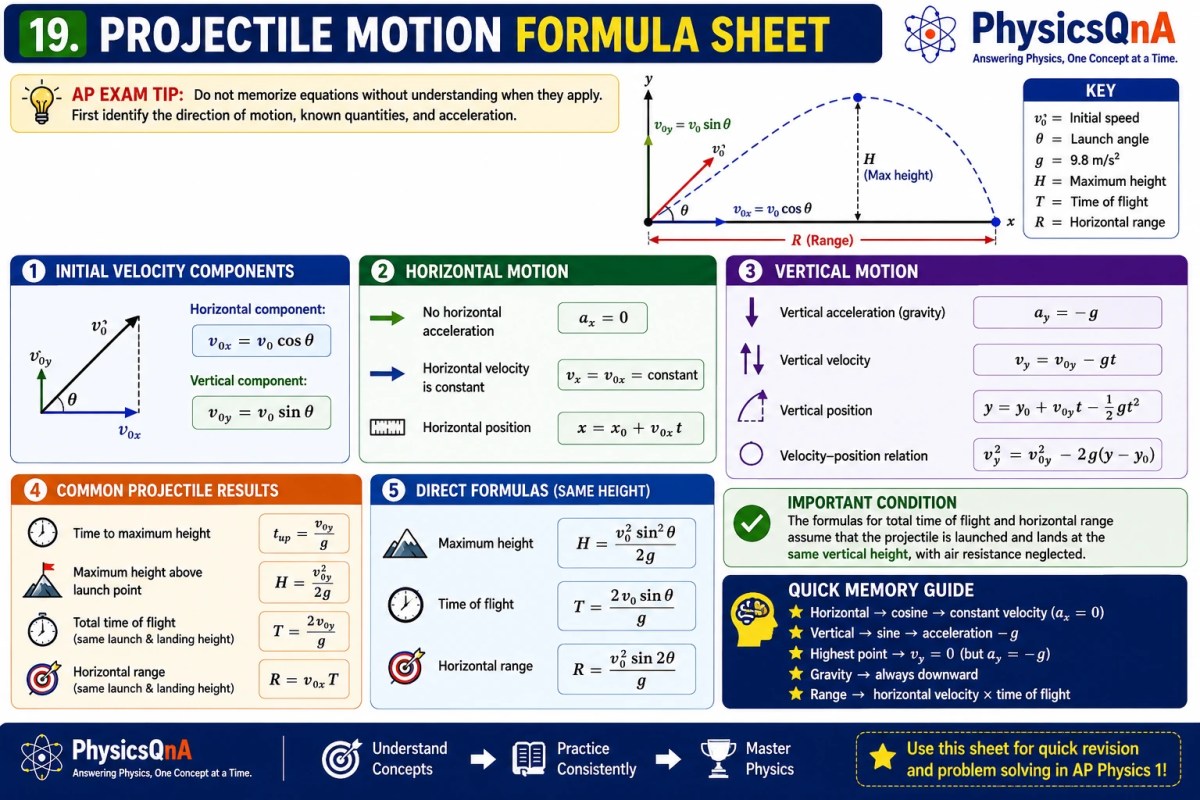
1. Initial Velocity Components
Horizontal: v0x = v0 cos θ
Vertical: v0y = v0 sin θ
2. Horizontal Motion
ax = 0
vx = v0x = constant
x = x0 + v0xt
3. Vertical Motion
ay = −g
vy = v0y − gt
y = y0 + v0yt − ½gt2
vy2 = v0y2 − 2g(y − y0)
4. Common Projectile Results
Time to maximum height: tup = v0y/g
Maximum height above launch point: H = v0y2/(2g)
Total time of flight, same launch and landing height: T = 2v0y/g
Horizontal range, same launch and landing height: R = v0xT
5. Direct Formulas for Launch Speed and Angle
Maximum height: H = v02sin2θ/(2g)
Time of flight: T = 2v0sin θ/g
Range: R = v02sin(2θ)/g
The commonly used formulas for total time of flight and horizontal range assume that the projectile is launched and lands at the same vertical height, with air resistance neglected.
- Horizontal → cosine → constant velocity
- Vertical → sine → acceleration −g
- Highest point → vy = 0
- Gravity → always downward
- Range → horizontal velocity × time
20. Frequently Asked Questions About Projectile Motion
Projectile motion can seem difficult at first because an object is moving horizontally and vertically at the same time. The questions below address the most common conceptual and calculation-related questions about projectile motion in AP Physics 1.
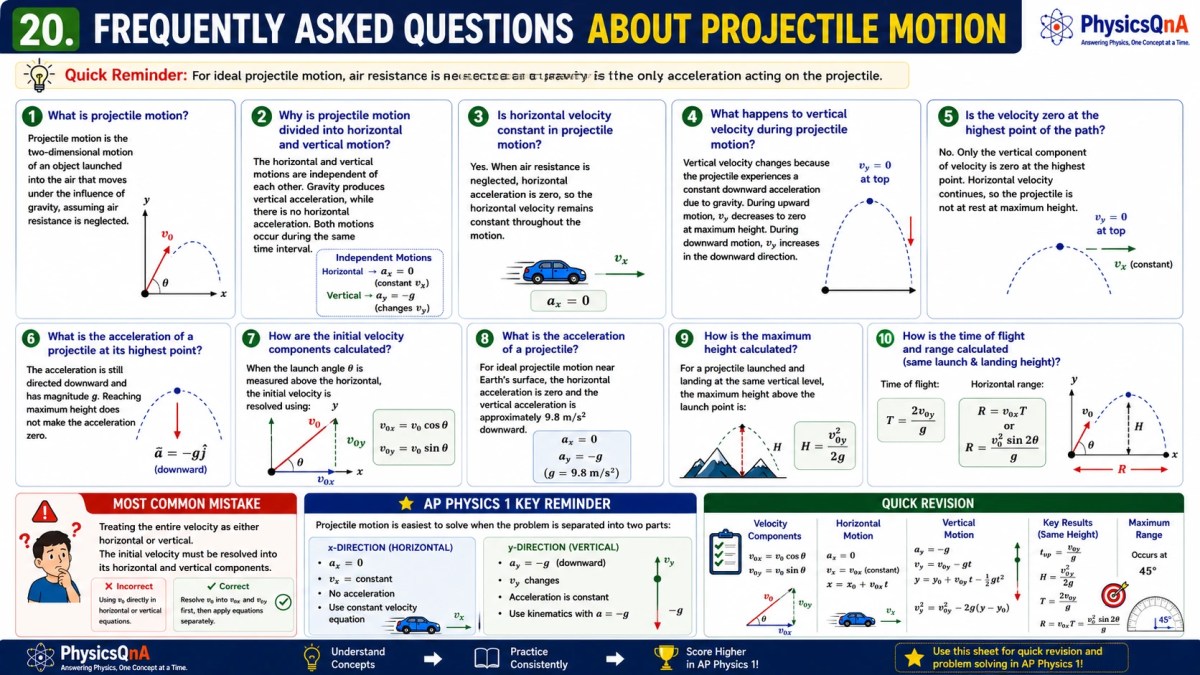
1. What is projectile motion?
Projectile motion is the two-dimensional motion of an object launched into the air that moves under the influence of gravity, assuming air resistance is neglected. The motion can be separated into horizontal and vertical components.
2. Why is projectile motion divided into horizontal and vertical motion?
The horizontal and vertical motions are independent of each other. Gravity produces vertical acceleration, while there is no horizontal acceleration in the ideal projectile-motion model. Both motions occur during the same time interval.
3. Is horizontal velocity constant in projectile motion?
Yes. When air resistance is neglected, horizontal acceleration is zero, so the horizontal velocity remains constant throughout the motion.
4. What happens to vertical velocity during projectile motion?
Vertical velocity changes because the projectile experiences a constant downward acceleration due to gravity. During upward motion, the vertical velocity decreases until it becomes zero at maximum height. During downward motion, the vertical velocity increases in the downward direction.
5. Is the velocity zero at the highest point of a projectile’s path?
No. Only the vertical component of velocity is zero at the highest point. If the projectile has horizontal velocity, it continues moving horizontally. Therefore, the projectile is not generally at rest at maximum height.
6. What is the acceleration of a projectile at its highest point?
The acceleration is still directed downward and has magnitude g. Reaching maximum height does not make the acceleration zero.
7. How are the initial velocity components calculated?
When the launch angle θ is measured above the horizontal, the initial velocity is resolved using:
8. What is the acceleration of a projectile?
For ideal projectile motion near Earth’s surface, the horizontal acceleration is zero and the vertical acceleration is approximately 9.8 m/s² downward.
9. How is the maximum height of a projectile calculated?
For a projectile launched and landing at the same vertical level, the maximum height above the launch point can be found from the initial vertical velocity:
10. How is the time of flight calculated?
When the projectile lands at the same height from which it was launched, the total time of flight is:
For launch and landing at different heights, the vertical kinematics equation must be used instead of this same-height formula.
11. What is the horizontal range of a projectile?
The horizontal range is the horizontal distance traveled by the projectile from its launch point to its landing point. It can be calculated using:
For launch and landing at the same height, the range can also be written as:
12. What launch angle gives the maximum range?
For a projectile launched and landing at the same height, with a fixed initial speed and negligible air resistance, the maximum theoretical horizontal range occurs at a launch angle of 45°.
13. Does mass affect projectile motion?
In the ideal projectile-motion model, mass does not affect the acceleration due to gravity. Therefore, two objects launched under the same conditions have the same ideal gravitational acceleration, provided air resistance is neglected.
14. What is the most common mistake in projectile-motion problems?
A common mistake is treating the entire velocity as either horizontal or vertical. The initial velocity must first be resolved into its horizontal and vertical components. Another common mistake is assuming that acceleration becomes zero at maximum height.
Projectile motion is easiest to solve when the problem is separated into two parts:
- x-direction: constant velocity, ax = 0
- y-direction: constant acceleration, ay = −g
Return to the Formula Sheet for quick revision, then test understanding with the Concept Check, AP-style MCQs, and FRQ before moving to the next lesson.