
« Back to AP Guide / Unit 2: Dynamics
Newton’s Laws & Free Body Diagrams (FBDs)
1. Newton’s First Law (Inertia)
“An object at rest stays at rest, and an object in motion stays in motion with constant velocity, unless acted upon by a net external force.”
Inertia is the resistance to change in motion. It is measured entirely by Mass (
 ). A 10kg rock has twice the inertia of a 5kg rock. It is harder to start moving, and harder to stop.
2. Newton’s Second Law ( )
)
 )
)This is the most important equation in AP Physics 1.

- 👉 Acceleration is directly proportional to Net Force.
- 👉 Acceleration is inversely proportional to Mass.
- 👉 Direction: Acceleration always points in the same direction as the Net Force.
3. How to Draw Free Body Diagrams (FBDs)
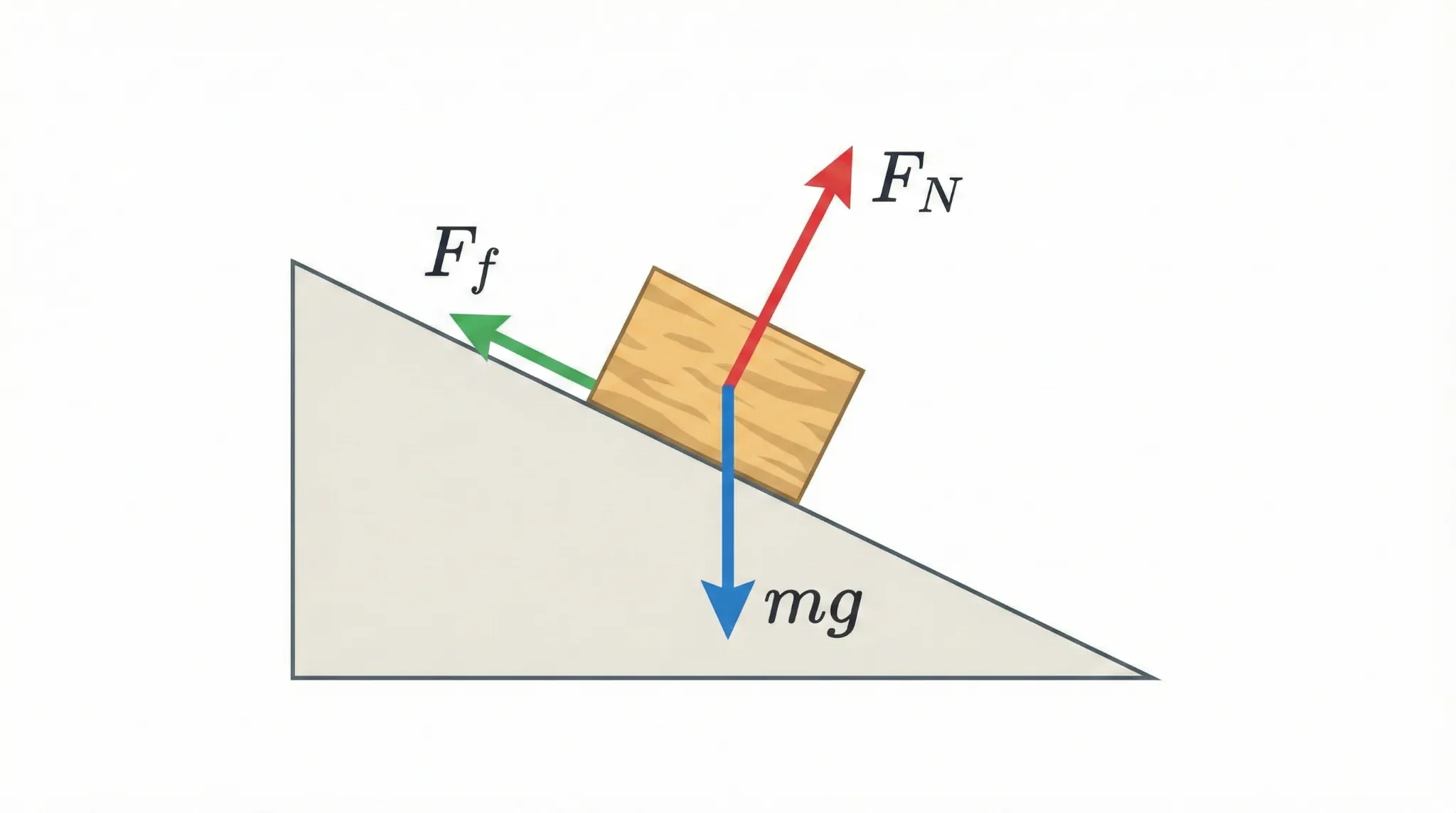
On the AP Exam, drawing a correct FBD is often worth massive points. Follow these rules strictly:

 ) is perpendicular to the surface, and Gravity (
 ) is always straight down.
| 1. The Dot | Represent the object as a single dot. |
| 2. The Arrows | Draw arrows pointing away from the dot. Length = Magnitude. |
| 3. The Labels | Label every force (e.g.,  , , , ,  ). Never label velocity or acceleration on an FBD! ). Never label velocity or acceleration on an FBD! |
4. Mass vs. Weight (Don’t Mix Them!)
Mass ()
 )
)- Measured in kg.
- Amount of “stuff” in an object.
- Constant everywhere (Earth, Moon, Space).
Weight ()
- Measured in Newtons (N).
- The force of gravity pulling on you.
- Changes based on gravity ().
 ).
).5. Newton’s Third Law
“For every action, there is an equal and opposite reaction.”
Example: If you push a wall, the wall pushes YOU. (One force on wall, one force on you).

6. AP-Style Practice Questions
Question 1 (The Mosquito): A massive truck smashes into a tiny mosquito on the highway. Which exerts a larger force?
▶ Click for Answer
Answer: They exert the EXACT SAME force.
Why? Newton’s 3rd Law. Force of Truck on Mosquito = Force of Mosquito on Truck. The mosquito dies not because the force is bigger, but because its mass is tiny, so its acceleration is huge.
Question 2 (The Elevator): You are standing in an elevator that is accelerating UPWARD. How does the Normal Force () from the floor compare to your Weight ()?
▶ Click for Answer
Answer:  (You feel heavier).
Reasoning:
Write Newton’s 2nd Law: 


Since  is positive (up), must be larger than .