
« Back to AP Guide / Unit 2: Dynamics
Friction: Static vs. Kinetic & The “Funky” Formula
1. The “Funky” Formula
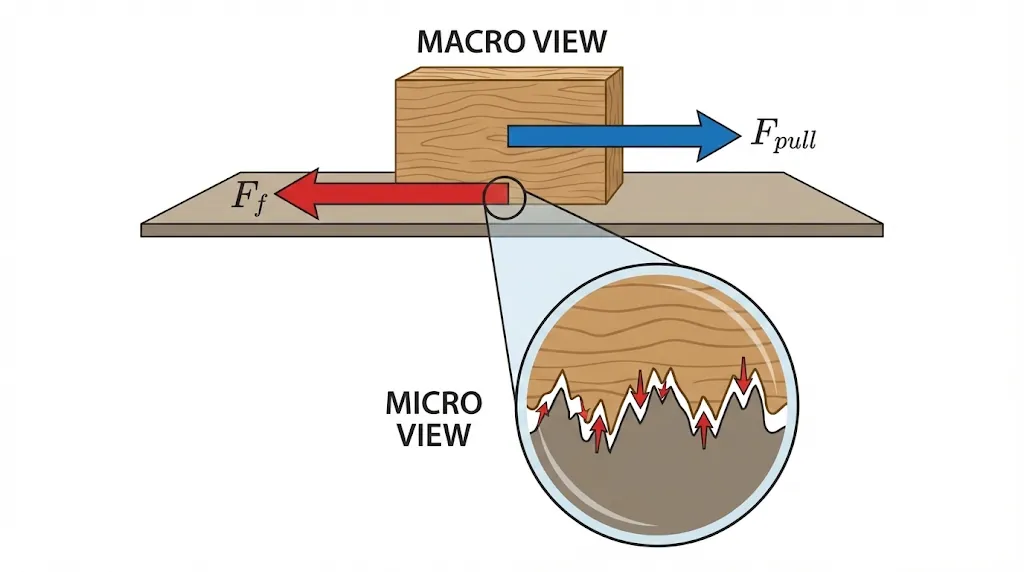
Friction depends on only two things: how rough the surfaces are and how hard they are smashed together.

-
1. The Coefficient of Friction (
 ): A number between 0 and 1 that rates “roughness.”
(Ice on Ice, Rubber on Concrete ). It has NO units!
-
2. Normal Force (): How hard the surfaces press against each other.
(Heavier object = More = More Friction).
 ): A number between 0 and 1 that rates “roughness.”
 , Rubber on Concrete
  ). It has NO units!
 ): How hard the surfaces press against each other.
Notice that Surface Area is NOT in the equation! Sliding a brick on its wide face or its skinny side produces the exact same friction.
2. Static vs. Kinetic: The Battle
There are two types of friction, and they behave very differently.

Static Friction ()
 )
)“Sticking” Force
- Acts when object is NOT sliding.
- It’s smart! It adjusts its strength to exactly match the push, up to a maximum limit.
- Equation:

Kinetic Friction ()
 )
)“Sliding” Force
- Acts when object IS sliding.
- It’s dumb! It is always the same constant value, no matter how fast you slide.
- Equation:

 . It is always harder to start moving something (Static) than to keep it moving (Kinetic). This is why the graph “drops” once you start sliding.
3. The Direction Trap: Walking
Does friction always oppose motion? NO! Friction opposes slipping.
Example: Walking.
When you walk, your foot tries to slip backward. Therefore, Static Friction pushes your foot FORWARD. Without friction, you would slip in place (like a cartoon character on ice).
4. AP-Style Practice Questions
Question 1 (The Magic Number): A  block rests on a floor. The coefficient of static friction is
  . You push the block horizontally with
  of force. What is the friction force?
▶ Click for Answer
Answer: (Not 40 N!)
Reasoning:
Step 1: Calculate the Max Limit.
 .
.
Step 2: Check your push.
You are pushing with , which is less than the limit ( ).
).
Therefore, the block does not move, and Static Friction simply matches your push to cancel it out.
Question 2 (The Slide): Once the block is moving, you keep pushing it at a constant velocity. If  , how much force must you apply?
▶ Click for Answer
Answer:
Reasoning:
Constant velocity means  , so Net Force = 0.
Your Push = Kinetic Friction.
 .
.