
« Back to AP Physics Guide / AP Physics 1 – Unit 3: Orbits & Kepler’s Laws (Topics 3.6-3.8)
AP Physics 1 – Orbits & Kepler’s Laws: v = √(GM/r) and T² ∝ r³
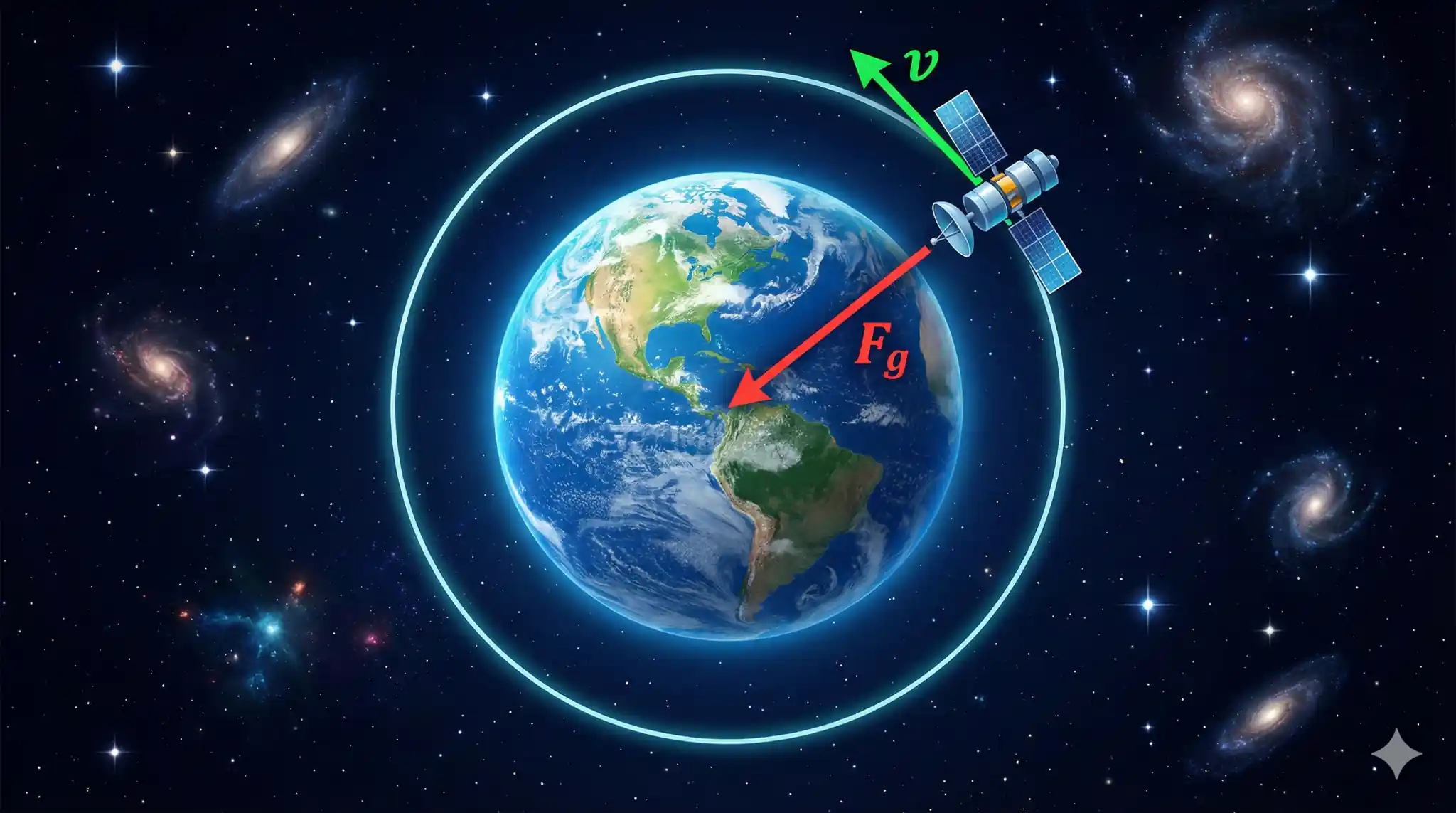
From satellites to moons: Objects in circular orbits are essentially falling forever. In this final guide for Unit 3, we derive the orbital velocity equation, prove Kepler’s Third Law, and solve AP-style orbit problems.
1. Orbital Velocity: The Gravity-Centripetal Balance
A satellite stays in orbit because the Gravitational Force pulls it inward with exactly the strength needed to provide the Centripetal Force.
The Derivation You Must Know


Solve for v:

- Note: Little mass
 (the satellite) cancels out! Speed depends only on the planet mass and radius .
 (the satellite) cancels out! Speed depends only on the planet mass
  and radius
 Gravity is stronger, so you must move FASTER to stay in orbit.

Gravity is stronger, so you must move FASTER.
2. Orbital Period: Kepler’s Third Law
How long does one full orbit take? By combining velocity with the circle circumference formula ( ), we find a powerful relationship.

 . Substituting
  gives us
  .
.

This means if you know the radius, you know the period. They are locked together.
3. Kepler’s Three Laws (Summary)

- 1st Law (The Law of Ellipses): All planets move in elliptical orbits, with the sun at one focus. (Note: In AP Physics 1, we usually approximate orbits as perfect circles to make the math easier).
-
2nd Law (The Law of Equal Areas): A line that connects a planet to the sun sweeps out equal areas in equal times.
Physics Reason: This is a direct consequence of the Conservation of Angular Momentum. As the radius decreases, speed must increase to keep angular momentum constant.
-
3rd Law (The Law of Harmonics): The square of the period of any planet is proportional to the cube of the semimajor axis of its orbit ().

 constant.
4. AP Physics 1 Practice Problems
Problem 1: The Speed Ratio
Satellite B orbits at distance  from the center of a planet. Satellite A orbits at distance
  . How does the speed of Satellite B compare to A?
Click to see answer
Answer: 
Formula:  .
.
Since  increased by factor of 4,
  changes by factor of
  .
.
Problem 2: Kepler’s Calculation
A planet takes 8 years to orbit a star at a distance of 4 AU. How long would it take to orbit at a distance of 1 AU?
Click to see answer
Answer: 1 year
Use ratio: 

 .
.