
« Back to AP Physics Guide / Unit 7 Part 1: Torque & Equilibrium
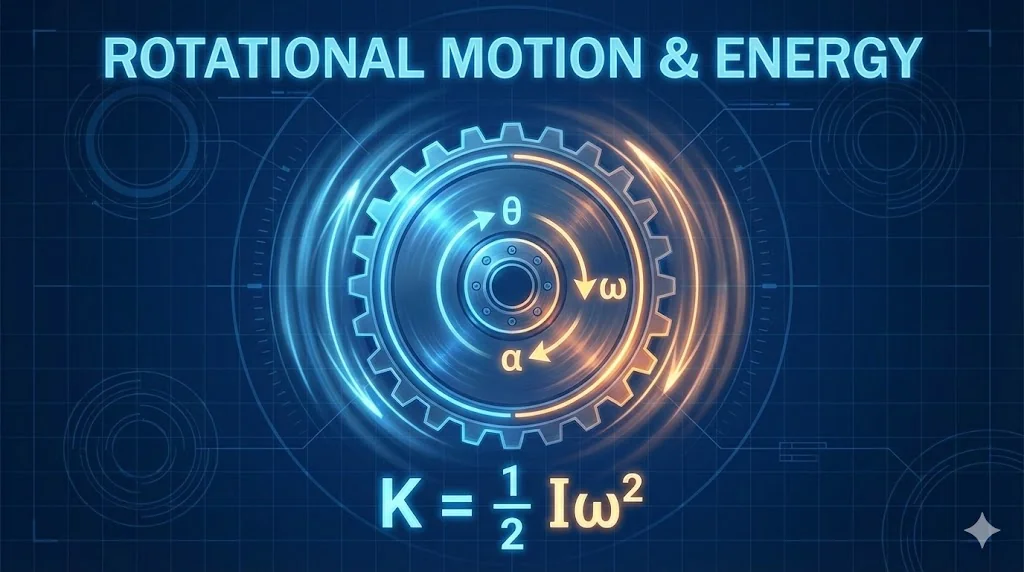
AP Physics 1 Unit 7: Rotational Motion & Energy
Topics 7.2–7.3 (10–15% exam weight): In Part 1, we learned that Torque causes rotation. Now we analyze the motion itself. Replace linear variables with angular ones using radius ( ).
).
1. Linear ↔ Angular Bridge
| Linear | Rotational | Bridge () |
|---|---|---|
 , ,  , ,  |
 , ,  , ,  |
 , ,  , ,  |
 |
 |
 → →  |
 |
 |
 → →  |
 rad). Degrees = wrong answer.
2. Rotational Inertia ( )
)
Mass ( ) resists linear acceleration. Rotational Inertia (
 ) resists angular acceleration. depends on mass and its distance from axis.
![\[I = \sum mr^2\]](https://i0.wp.com/physicsqanda.com/wp-content/ql-cache/quicklatex.com-a5f98bf53d3d13b6a2396171a7b014bb_l3.png?resize=93%2C25&ssl=1 "Rendered by QuickLaTeX.com")
 , Hoop
  , Sphere

Mass Farther = Harder to Spin: Hoop ( ) > Sphere (
 ).
).
3. Newton’s 2nd Law for Rotation
![\[\tau_{net} = I\alpha\]](https://i0.wp.com/physicsqanda.com/wp-content/ql-cache/quicklatex.com-d9f55c00c3c6e0f7550913f790b7dd5b_l3.png?resize=72%2C14&ssl=1 "Rendered by QuickLaTeX.com")
 .
.
4. Rotational Kinetic Energy & Rolling
![\[K_{total} = \frac{1}{2}mv^2 + \frac{1}{2}I\omega^2\]](https://i0.wp.com/physicsqanda.com/wp-content/ql-cache/quicklatex.com-cd114cade4b2f342ede7cfe0c932d671_l3.png?resize=175%2C36&ssl=1 "Rendered by QuickLaTeX.com")
. Hoop slower than sphere down ramps.

Rolling Condition: . Friction provides torque, no slipping.
5. Quick AP Practice
📚 AP Practice Problems
1. Sphere vs hoop (same  ,
,  ) roll down ramp. Which wins?
Answer
Sphere ( < Hoop ). Less energy to rotation = more to translation = faster.
2. 120 rpm wheel. Angular velocity (rad/s)?
Answer

3. Disk  , hoop . Which harder to spin?
Answer
Hoop. Higher = more torque needed for same ().
🔗 Related AP Physics Resources
Unit 7 Part 2 Complete!
You mastered rotational kinematics, inertia, and energy. Final piece: rotational momentum conservation.