
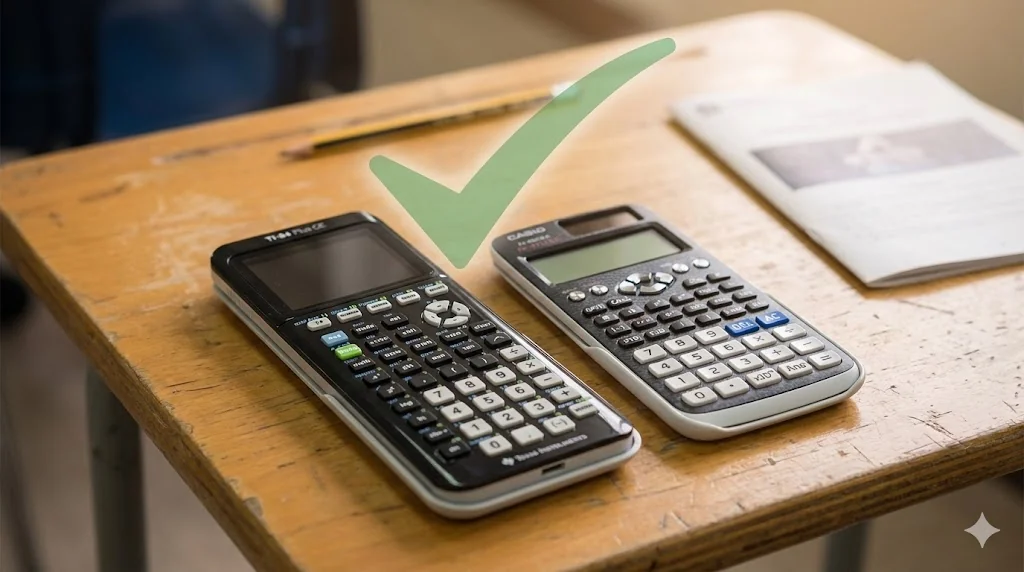
AP Physics 1 Calculator Policy (2025/26)
The Golden Rule: You are allowed to use a calculator on ALL sections of the AP Physics 1 exam (both Multiple Choice and Free Response).
You can bring up to two calculators. We strongly recommend bringing a backup in case batteries die.
You can use any 4-function, scientific, or graphing calculator that does not have prohibited features. Most standard high school calculators are fine.
Common Approved Models:
*Even calculators with CAS (Computer Algebra Systems) like the TI-89 or Nspire CAS are explicitly ALLOWED on AP Physics.
Do NOT bring these. You will be dismissed from the exam room.
- Phones & Smartwatches: Absolutely no devices with wireless/internet capability.
- QWERTY Keyboards: Calculators with typewriter-like keypads (e.g., TI-92) are banned.
- Touchscreens: Unless they are part of an approved graphing calculator (like HP Prime or TI-Nspire CX II).
- Laptops/Tablets: No iPads, no computers.
💡 3 Crucial Calculator Tips
Physics uses Degrees for angles (projectiles, ramps, torque). Calculus uses Radians.
Check your mode immediately when you sit down. If you calculate $\sin(30)$ and get $-0.98$ instead of $0.5$, you are in Radians.
While you can use the algebraic solver on a TI-Nspire, it is usually faster to solve simple algebra by hand. Use the calculator for the final arithmetic only. This saves time.
Proctors may ask you to clear your calculator memory before the test. Make sure you know how to backup or archive any custom programs you don’t want to lose (though you won’t need programs for the exam).