

 by
by Wave Optics: Question Bank
Practice Set: Huygens’ Principle, Interference, Diffraction & Polarization.
Part 1: Multiple Choice Questions (1 Mark)
1. The shape of the wavefront emerging from a point source of light at a finite distance is:
(a) Cylindrical
(b) Planar
(c) Spherical
(d) Elliptical
A point source emits waves in all directions, so the locus of points in the same phase is a sphere.
2. In Young’s Double Slit Experiment, if the separation between the slits ( ) is halved and the distance of the screen (
 ) is doubled, the fringe width (
 ) will:
(a) Remain same
(b) Be halved
(c) Be doubled
(d) Become four times
Formula:
 .
.New width
 .
.
3. Which of the following phenomena proves the transverse nature of light waves?
(a) Reflection
(b) Interference
(c) Diffraction
(d) Polarization
Polarization restricts vibrations to a single plane perpendicular to propagation, which is only possible for transverse waves.
4. Two coherent sources have intensity ratio 81:1. The ratio of maximum to minimum intensity in the interference pattern is:
(a) 9:1
(b) 10:8
(c) 25:16
(d) 100:64
 .
.Ratio =
 .
.
5. The phase difference  corresponding to a path difference of
  is:
is:
(a) 
(b) 
(c) 
(d) 
Phase difference
 .
. .
.
6. In a single slit diffraction experiment, the width of the central maximum is proportional to:
(a) 
(b) 
(c) 
(d) Independent of
Linear width
 . Thus, it is directly proportional to wavelength .
7. If unpolarized light of intensity  is incident on a polarizer, the intensity of transmitted light is:
(a)
(b) 
(c) 
(d) Zero
A perfect polarizer transmits half the intensity of incident unpolarized light (average value of
 is
is  ).
).
8. When light travels from air to glass, which property remains unchanged?
(a) Wavelength
(b) Velocity
(c) Frequency
(d) Amplitude
Frequency is a characteristic of the source and does not change with the medium.
 and change such that
  .
.
9. For destructive interference at a point, the path difference should be:
(a) 
(b) 
(c) 
(d) 
Destructive interference occurs when the crest of one wave falls on the trough of another, requiring a path difference of odd multiples of half wavelength.
10. At Brewster’s angle ( ), the angle between the reflected ray and the refracted ray is:
(a) 
(b) 
(c) 
(d) 
This is the defining condition of Brewster’s Law: reflected and refracted rays are perpendicular.
Part 2: Assertion-Reason Questions
(B) Both A & R are true, R does NOT explain A.
(C) A is true, R is false.
(D) A is false, R is true.
1. Assertion (A): No interference pattern is observed when two coherent sources are infinitely close to each other.
Reason (R): The fringe width is proportional to the distance between the slits.
Assertion is True. If
 , fringe width
  , meaning the whole screen is uniformly illuminated. Reason is False:
  , i.e., inversely proportional.
2. Assertion (A): Sound waves show diffraction more easily than light waves.
Reason (R): The wavelength of sound waves is comparable to the size of common obstacles.
Correct. Diffraction is significant when obstacle size
 . Sound (
 meters) diffracts around doors/windows, while light ( nm) requires tiny slits.
3. Assertion (A): Coloured spectrum is seen when white light passes through a prism, but also when it reflects from a thin oil film.
Reason (R): Both phenomena are due to dispersion of light.
A is True. R is False. Prism colors are due to dispersion, but oil film colors are due to interference.
4. Assertion (A): In YDSE, if the whole apparatus is immersed in water, the fringe width decreases.
Reason (R): The wavelength of light decreases in a denser medium.
Correct.
 . Since
  , the fringe width decreases.
5. Assertion (A): The wavefronts from a distant star are planar.
Reason (R): A small portion of a large spherical wavefront behaves like a plane wavefront.
Correct. As radius
 , the curvature
  , making it planar.
6. Assertion (A): Light from two independent candles cannot produce an interference pattern.
Reason (R): The phase difference between the waves from independent sources changes randomly with time.
Correct. Independent sources are incoherent.
7. Assertion (A): Diffraction fringes are of equal width.
Reason (R): In interference, all bright fringes have the same intensity.
A is False. The central maximum in diffraction is double the width of secondary maxima. R is True (for YDSE).
8. Assertion (A): Longitudinal waves cannot be polarized.
Reason (R): In longitudinal waves, the vibration is along the direction of propagation.
Correct. Polarization involves restricting vibrations to a specific transverse direction. This is impossible if vibrations are already along the propagation axis.
9. Assertion (A): According to Huygens’ principle, light travels faster in a rarer medium.
Reason (R): This contradicts Newton’s corpuscular theory which predicted light travels faster in denser media.
Both are true. Huygens’ wave theory correctly predicted
 , which was experimentally verified later (Foucault), disproving Newton’s corpuscular prediction. However, R is just a historical fact, not the *physical* explanation of A.
10. Assertion (A): At Brewster’s angle, the reflected light is completely polarized.
Reason (R): The tangent of the polarizing angle is equal to the refractive index ( ).
).
Both are true. R is the mathematical statement (Brewster’s Law) of the phenomenon described in A, but the physical reason involves the dipole radiation direction.
Part 3: Important Derivations & Theory
1. Using Huygens’ Principle, derive Snell’s Law of refraction.

 hits the interface
  at angle
  .
.Step 2: In time
 , point
  reaches
  (
( ). Simultaneously, secondary wavelet from
  travels into medium 2 a distance
  .
.Step 3: Tangent
 represents the refracted wavefront.
Step 4: In
 ,
,  .
.In
 ,
,  .
.Dividing:
 .
.
2. Derive the expression for fringe width in Young’s Double Slit Experiment (YDSE).

 (for
(for  ).
).Bright Fringes:
 .
.Fringe Width (
): Distance between consecutive bright fringes. .
.
3. Draw the intensity distribution graph for Diffraction due to a single slit and compare it with Interference.
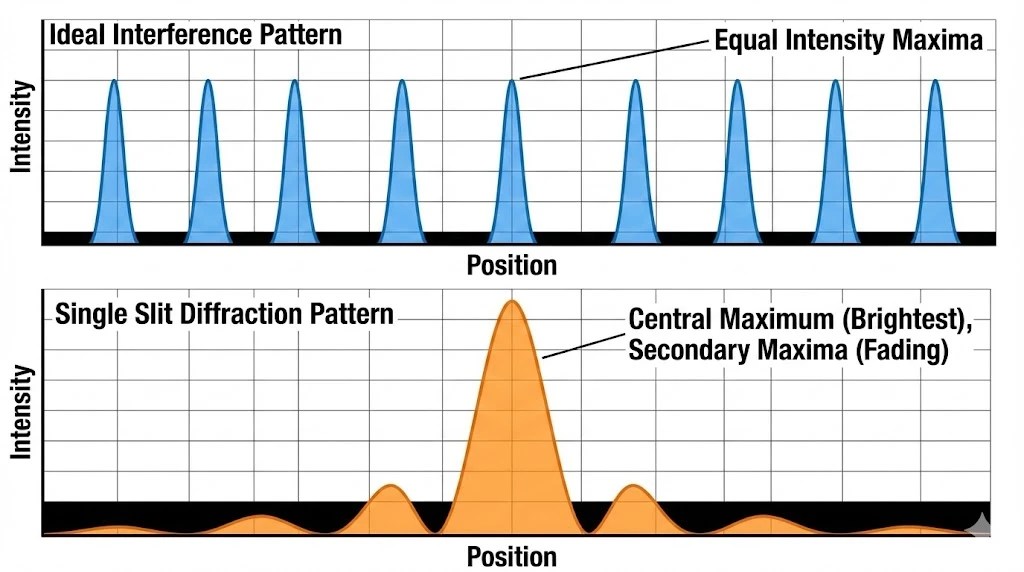
- Interference: All bright fringes are of equal width and equal intensity.
- Diffraction: The central maximum is the widest (double width) and brightest. Intensity of secondary maxima falls off rapidly.
Part 4: Numericals
1. In a YDSE setup, the slits are separated by 0.28 mm and the screen is placed 1.4 m away. The distance between the central bright fringe and the fourth bright fringe is measured to be 1.2 cm. Determine the wavelength of light used.
 m,
m,  m,
m,  m,
m,  .
.Formula:


 m.
m. nm.
nm.
2. Two polaroids are placed 90° to each other. A third polaroid is placed between them such that its axis makes an angle of 30° with the first. If intensity of unpolarized light incident on the first is , find the final intensity.
 .
.2. After 2nd polaroid (angle
 ):
):  .
.3. Angle between 2nd and 3rd polaroid: Since P1 and P3 are at
, angle between P2 and P3 is  .
.4. Final Intensity (
 ):
):  .
.
3. Light of wavelength 5000 Å falls on a plane reflecting surface. What are the wavelength and frequency of the reflected light? For what angle of incidence is the reflected ray normal to the incident ray?
 Å.
Å. Hz.
Hz.(b) If reflected ray is normal to incident ray, angle between them is
.From law of reflection (
 ):
):  .
.
Part 5: Case Study
Case Study: Coherent Sources in Nature
In Young’s Double Slit Experiment, we use a single source divided into two to create coherence. However, in nature, it is difficult to find two independent sources that are coherent. This is why we don’t see interference patterns from two headlights of a car. Interference effects are commonly seen in thin films, like soap bubbles or oil slicks on wet roads. Here, light reflected from the top surface interferes with light reflected from the bottom surface of the film.
- Why can two independent monochromatic sources never be coherent?
- What is the condition for constructive interference in terms of phase difference?
- If the oil film thickness is non-uniform, what kind of pattern will be observed?
- Does the law of conservation of energy hold during interference?
2. Phase difference
 (where
  ).
).3. Since the condition for constructive/destructive interference depends on path difference (which depends on thickness), varying thickness leads to visible colored fringes of irregular shapes.
4. Yes. Energy is not created or destroyed; it is merely redistributed from dark regions (minima) to bright regions (maxima). Average intensity remains constant.


