
The Human Eye & Colourful World
NCERT Chapter 10 • Vision, Prisms, and Atmospheric Effects

While the previous chapter dealt with light and lenses, this chapter explores how the human eye uses light to see and explains fascinating natural phenomena like rainbows, twinkling stars, and the blue sky.
1. The Human Eye
The human eye works like a camera. It forms an image on a light-sensitive screen called the retina.
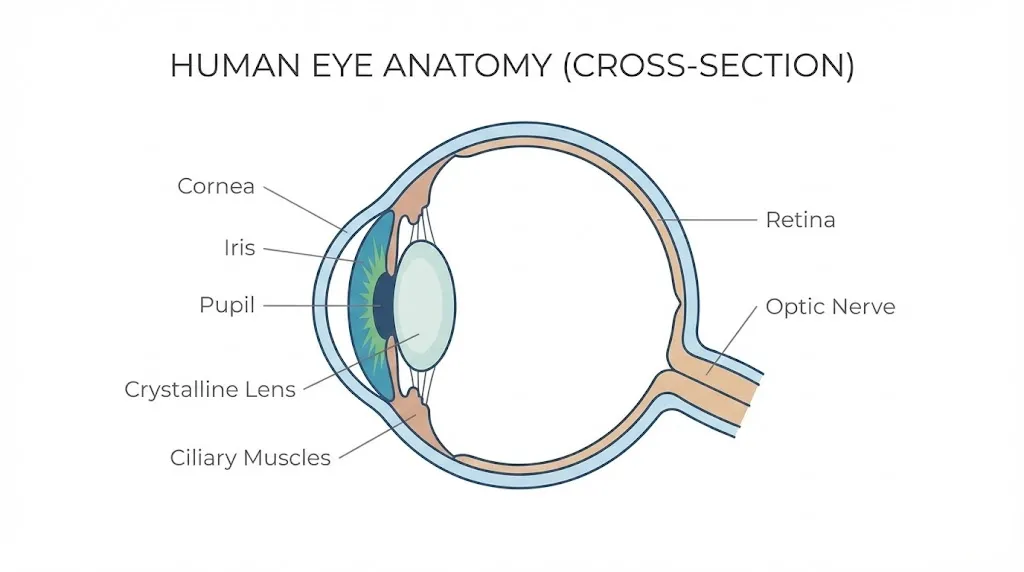
Key Parts and Functions
| Part | Function |
|---|---|
| Cornea | Thin membrane through which light enters. Most refraction occurs here. |
| Iris | Dark muscular diaphragm that controls the size of the pupil. |
| Pupil | Regulates the amount of light entering the eye. |
| Crystalline Lens | Provides finer adjustment of focal length to focus objects on the retina. |
| Retina | Light-sensitive screen with cells that generate electrical signals. |
| Optic Nerve | Transmits visual signals to the brain. |
2. Power of Accommodation
The ability of the eye lens to adjust its focal length is called accommodation. This is achieved by the Ciliary Muscles.
- Distant Objects: Muscles relax → Lens becomes thin → Focal length increases.
- Nearby Objects: Muscles contract → Lens becomes thick → Focal length decreases.
- Near Point (Least Distance of Distinct Vision): The minimum distance to see distinct objects without strain. For a normal adult, it is 25 cm.
- Far Point: The farthest point the eye can see clearly. For a normal eye, it is Infinity.
3. Defects of Vision and Their Correction
Sometimes the eye loses its power of accommodation, resulting in blurred vision. The three common refractive defects are:
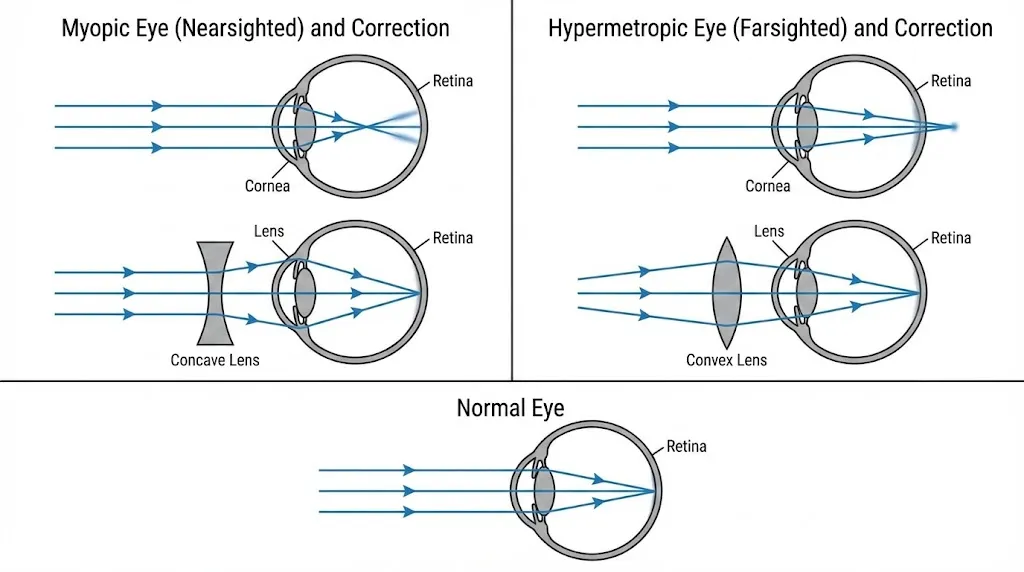
A. Myopia (Near-sightedness)
A person can see nearby objects clearly but cannot see distant objects distinctly.
- Cause: Excessive curvature of the eye lens or elongation of the eyeball.
- Result: Image forms in front of the retina.
- Correction: Concave Lens (Diverging lens).
B. Hypermetropia (Far-sightedness)
A person can see distant objects clearly but cannot see nearby objects distinctly.
- Cause: Focal length of the eye lens is too long or eyeball has become too small.
- Result: Image forms behind the retina.
- Correction: Convex Lens (Converging lens).
C. Presbyopia
An age-related defect where the power of accommodation decreases. The near point recedes.
- Cause: Weakening of ciliary muscles and diminishing flexibility of the eye lens.
- Correction: Bi-focal lenses (Upper part Concave for distance, Lower part Convex for reading).
Near Point: 25 cm.
Far Point: Infinity.
4. Refraction of Light Through a Prism
A triangular glass prism has two triangular bases and three rectangular lateral surfaces. The angle between two lateral faces is the Angle of Prism (A).
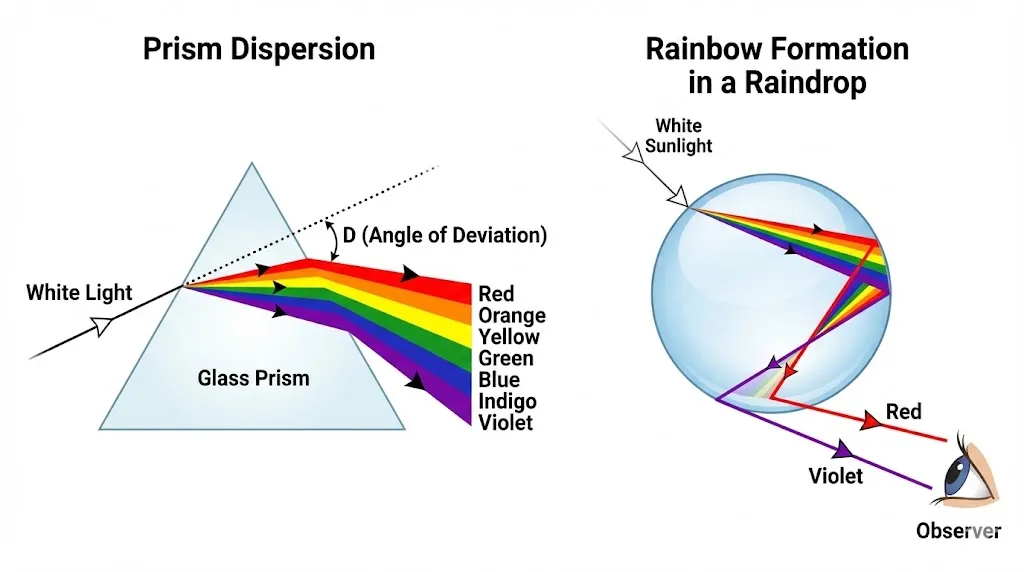
Unlike a glass slab, the emergent ray in a prism is not parallel to the incident ray. It bends towards the base. The angle between the incident ray and the emergent ray is called the Angle of Deviation (D).
5. Dispersion of White Light
Dispersion is the splitting of white light into its component colors.
- Spectrum: The band of colored components (VIBGYOR – Violet, Indigo, Blue, Green, Yellow, Orange, Red).
- Cause: Different colors bend at different angles. Red bends the least, Violet bends the most.
Rainbow Formation
A rainbow is a natural spectrum caused by dispersion of sunlight by tiny water droplets. The droplets act like small prisms. They refract and disperse the incident sunlight, then reflect it internally, and finally refract it again.
6. Atmospheric Refraction
The earth’s atmosphere is not uniform. When light enters the atmosphere, it undergoes refraction due to varying optical densities.
Twinkling of Stars
Stars are point-sized sources of light. As starlight passes through the atmosphere, its path varies due to air turbulence. The apparent position of the star fluctuates, and the amount of light entering the eye flickers, causing twinkling.
Note: Planets do not twinkle because they are extended sources; the variations average out.
Advance Sunrise and Delayed Sunset
Due to atmospheric refraction, the Sun is visible about 2 minutes before actual sunrise and 2 minutes after actual sunset.
7. Scattering of Light
The scattering of light involves the deflection of light by minute particles.
Tyndall Effect
When a beam of light strikes fine particles (like smoke or dust), the path of the beam becomes visible. This is the Tyndall effect.
Why is the Sky Blue?
The molecules of air are smaller than the wavelength of visible light. They scatter shorter wavelengths (Blue) more strongly than longer wavelengths (Red). This scattered blue light enters our eyes.
Colour of the Sun at Sunrise and Sunset
At sunrise/sunset, sunlight travels a longer distance through the atmosphere. Blue light is scattered away, leaving mostly red light (longer wavelength) to reach our eyes.
8. Chapter Exercises
Practice these NCERT exercise questions to master the chapter:
(a) presbyopia (b) accommodation (c) near-sightedness (d) far-sightedness
(a) cornea (b) iris (c) pupil (d) retina
(a) 25 m (b) 2.5 cm (c) 25 cm (d) 2.5 m
(a) pupil (b) retina (c) ciliary muscles (d) iris
 .
. (approx) or
  .
.(ii) Near Vision:
 .
. or
or  .
.
Object distance
 . Image distance
  (in front of lens).
Using Lens Formula:
 .
. .
.Power
 .
.Nature: Concave Lens.
 .
. .
. .
.Power
 .
.Nature: Convex Lens.