
Advanced Physics → Advanced Mechanics → Constraint Motion
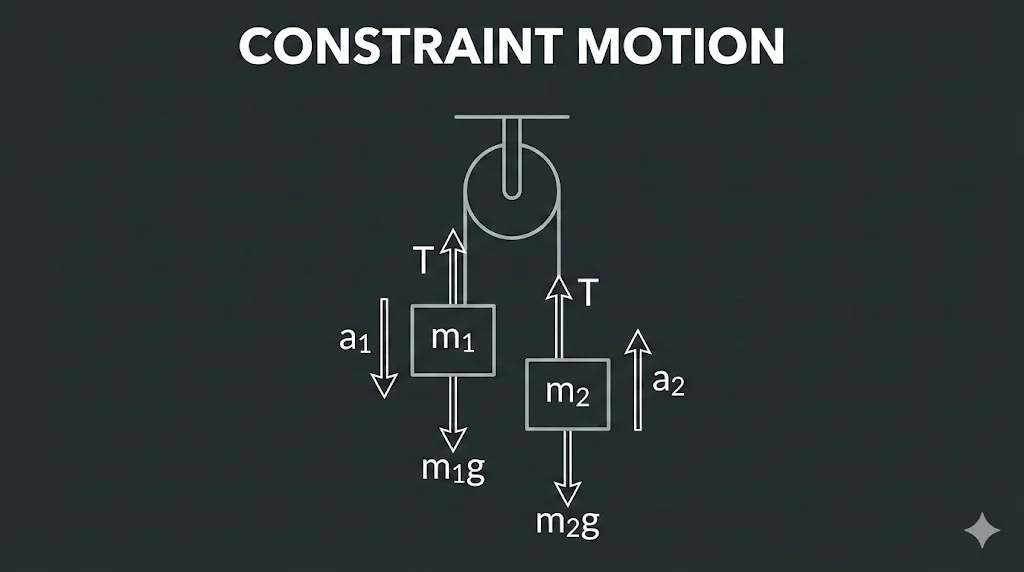
• Constraints impose relations between motions
• Velocities and accelerations are linked, not independent
• Geometry + calculus reveal hidden relations
This page is for learners who know basic dynamics and want physical insight into constrained systems, not rote pulley formulas.
1. Why Physics Needs Constraint Motion
Many real systems do not move freely. Their motion is restricted by strings, rods, surfaces, or mechanical connections.
In such systems, positions, velocities, and accelerations are no longer independent.
2. What Is a Constraint?
A constraint is a physical relation that limits how parts of a system can move relative to one another.
Constraints reduce the number of independent variables required to describe motion.
3. Fixed-Length String Constraint
Consider two blocks connected by a light, inextensible string over a smooth pulley. The total length of the string remains constant.
![\[ x_1 + x_2 = \text{constant} \]](https://i0.wp.com/physicsqanda.com/wp-content/ql-cache/quicklatex.com-18f8840ec814362a9b5baf89e5c3f839_l3.png?resize=145%2C14&ssl=1 "Rendered by QuickLaTeX.com")
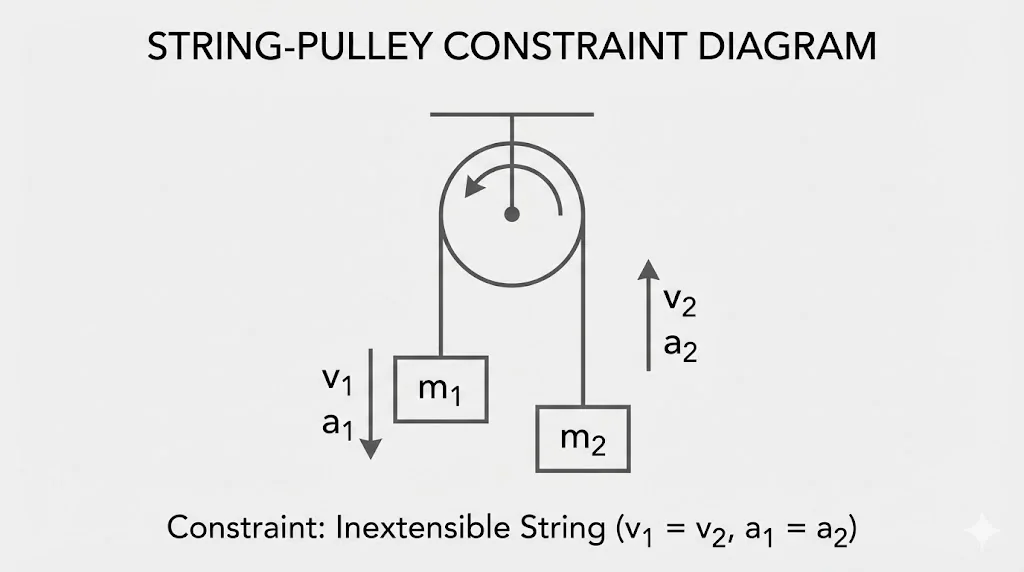
Differentiating with respect to time gives velocity and acceleration relations.
Since the constraint holds at all times, it must remain valid after differentiation.
![\[ v_1 + v_2 = 0,\quad a_1 + a_2 = 0 \]](https://i0.wp.com/physicsqanda.com/wp-content/ql-cache/quicklatex.com-99bb268180d3a2159f9425ef64f4df9a_l3.png?resize=200%2C16&ssl=1 "Rendered by QuickLaTeX.com")
4. Constraint Relations Using Calculus
Constraints are most powerful when combined with calculus.
Position relations lead to velocity relations, and velocity relations lead to acceleration relations.
5. Multiple Constraints
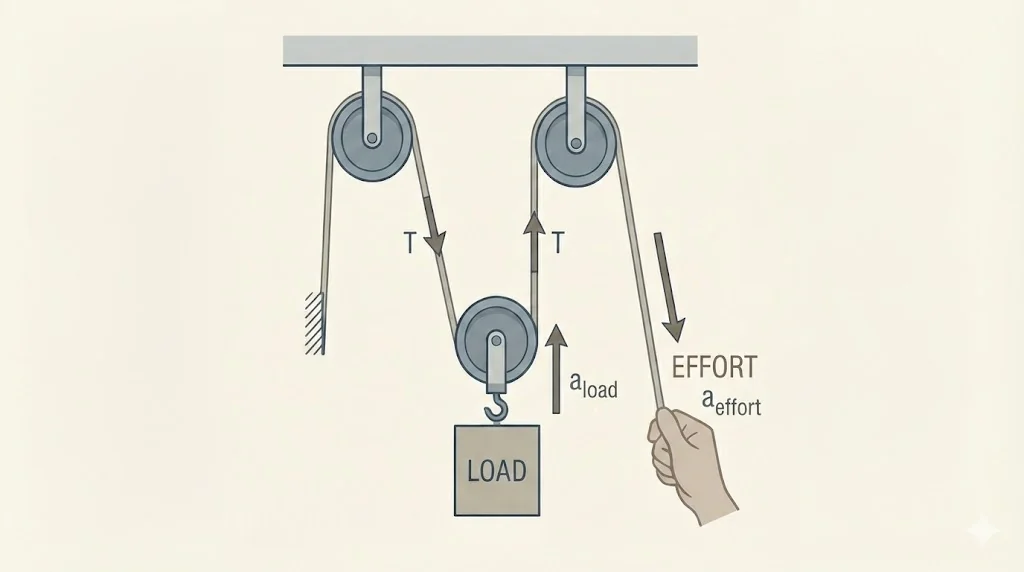
More complex systems may involve:
- Movable pulleys
- Multiple strings
- Geometric constraints
6. Common Mistakes
- Assuming equal accelerations without justification
- Ignoring geometry of string paths
- Treating constraints as forces
Practice Problems
Level 1 — Conceptual
Solution
Because total length cannot change, motion of one end must be compensated by the other.Solution
Tension is a force; the fixed length of the string is the constraint.Level 2 — Analytical (Relation Building)
Solution
They must have equal speeds in opposite directions. twice with respect to time.