
Advanced Physics → Advanced Mechanics → Variable Force
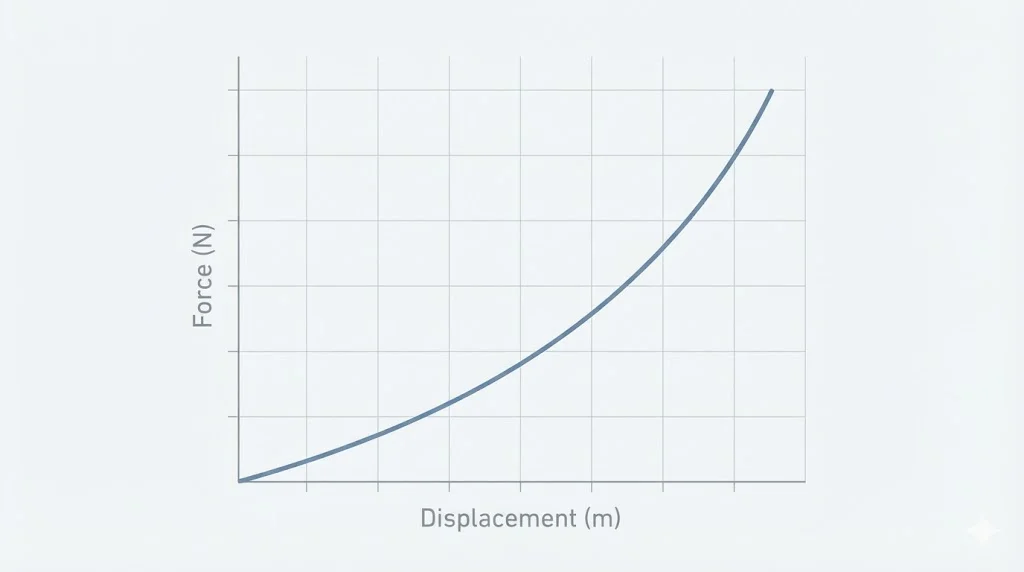
• Constant-force formulas do not apply
• Calculus replaces algebra
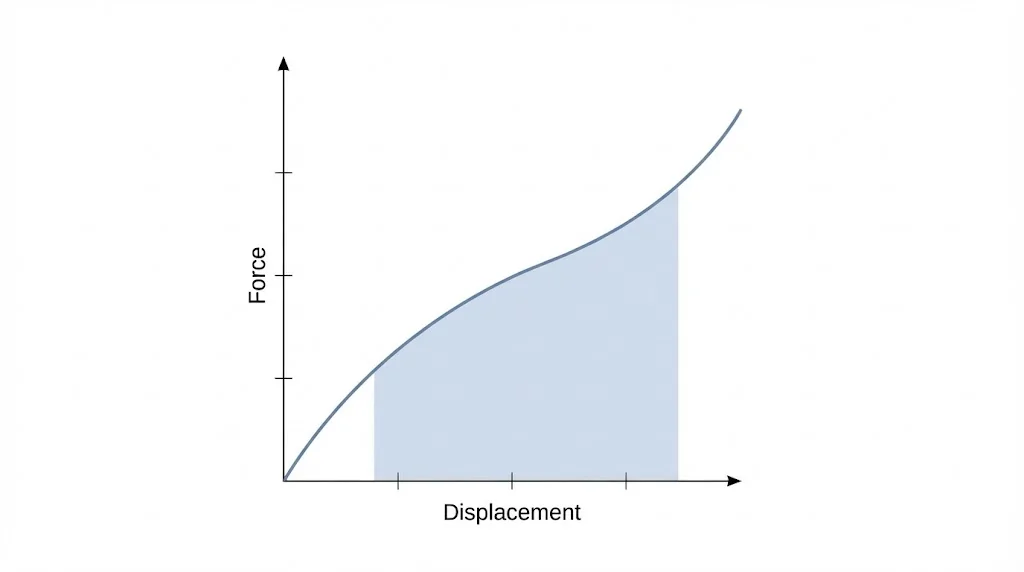
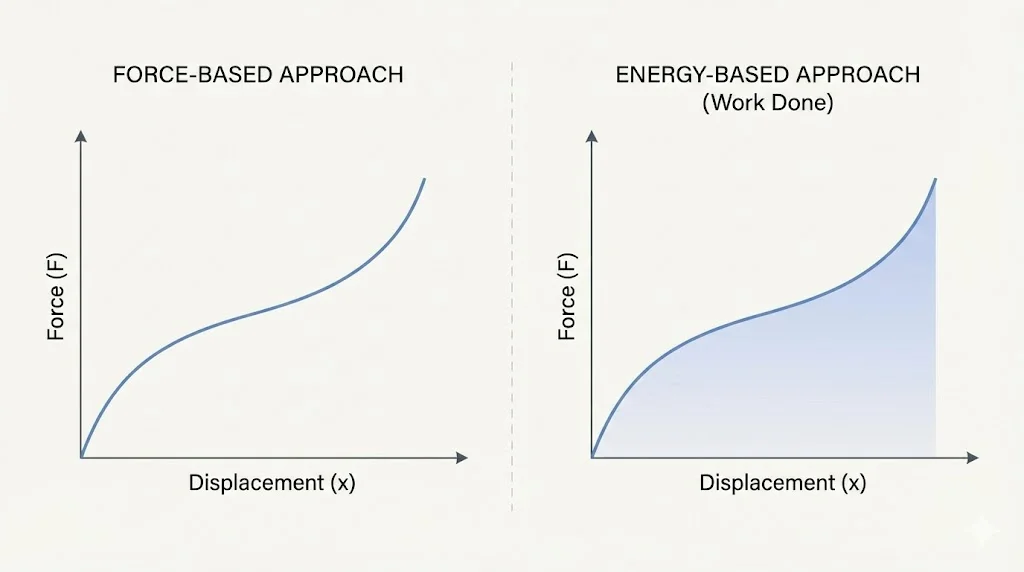
• Work is area under the force–displacement curve
This page is for learners comfortable with basic calculus who want physical insight into forces that change with position, time, or velocity.
1. Why Physics Needs Variable Force
In introductory mechanics, forces are often treated as constant. In reality, most forces vary continuously.
Spring forces increase with displacement, gravitational force changes with distance, and electric forces depend on separation.
2. What Is a Variable Force?
A variable force is one whose magnitude or direction changes with position, time, or velocity.
Such forces cannot be handled using constant-acceleration equations.
3. Work Done by a Variable Force
For a small displacement  , the work done is:
![\[ dW = F(x)\,dx \]](https://i0.wp.com/physicsqanda.com/wp-content/ql-cache/quicklatex.com-e5b0ba5f9c1e521743c34545a315bb88_l3.png?resize=112%2C19&ssl=1 "Rendered by QuickLaTeX.com")
Total work is obtained by accumulating these contributions.
![\[ W = \int_{x_1}^{x_2} F(x)\,dx \]](https://i0.wp.com/physicsqanda.com/wp-content/ql-cache/quicklatex.com-9f2e40b6db71307e7f9a4f74213898c8_l3.png?resize=139%2C43&ssl=1 "Rendered by QuickLaTeX.com")
4. Physical Meaning of the Integral
The integral is not just a mathematical operation. It represents the total effect of a force acting continuously.
Each infinitesimal force contributes a small amount of work, and the integral sums all contributions.
5. Example: Spring Force
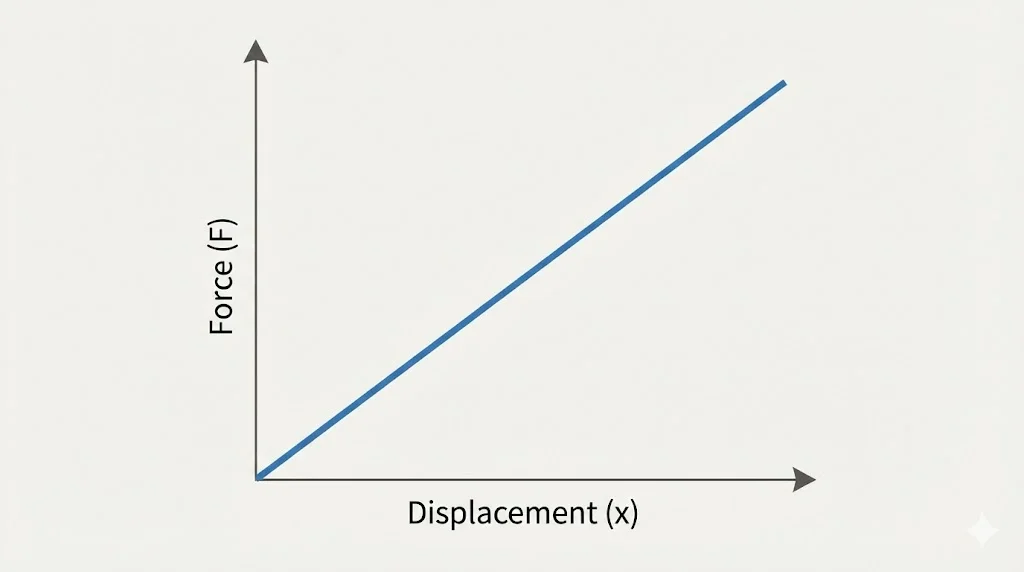
For a spring obeying Hooke’s law:
![\[ F(x) = kx \]](https://i0.wp.com/physicsqanda.com/wp-content/ql-cache/quicklatex.com-6fab3016e471a65574d86b2939b3e5f2_l3.png?resize=81%2C19&ssl=1 "Rendered by QuickLaTeX.com")
Work done in stretching the spring from 0 to  :
:
![\[ W = \int_0^x kx\,dx = \dfrac{1}{2}kx^2 \]](https://i0.wp.com/physicsqanda.com/wp-content/ql-cache/quicklatex.com-d67ca841fab4e207bfc85a64de40e368_l3.png?resize=177%2C41&ssl=1 "Rendered by QuickLaTeX.com")
6. Motion Under Variable Force
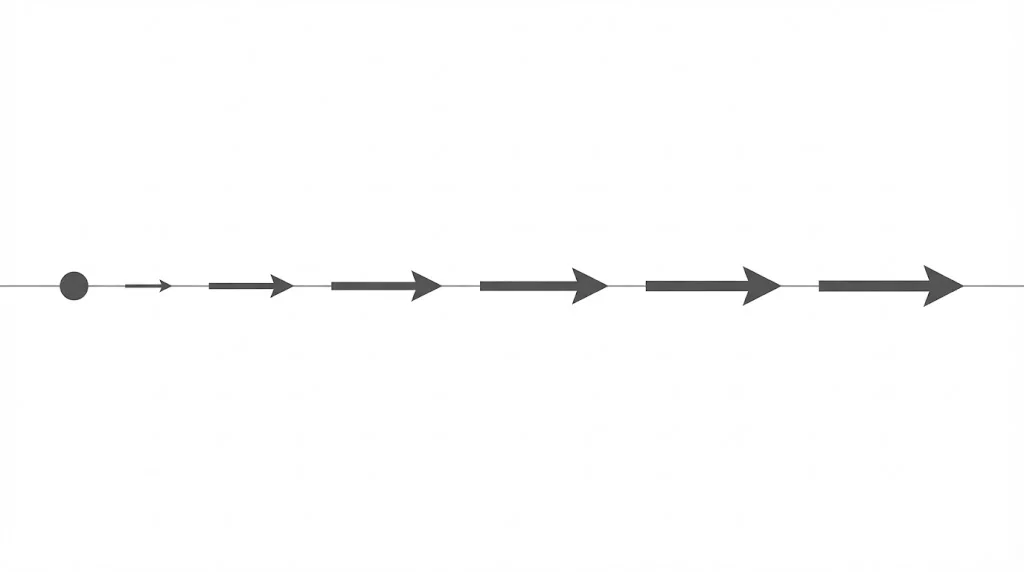
When force varies, acceleration varies as well.
When force depends on position or time, acceleration is no longer constant. Standard kinematic equations cannot be used.
Newton’s second law still applies:
![\[ F(x) = m a(x) \]](https://i0.wp.com/physicsqanda.com/wp-content/ql-cache/quicklatex.com-0c70dfbe10ac0f8e8af52cae21bf2f77_l3.png?resize=109%2C19&ssl=1 "Rendered by QuickLaTeX.com")
But solving motion now requires calculus and energy methods.
Energy Method for Variable Force Problems
Practice Problems
Level 1 — Conceptual
Solution
Because acceleration changes with position or time and is no longer constant. – graph represent?
Solution
Work done by the force.Level 2 — Analytical (Calculus)
 , find work done from
  to
to  .
.
Solution
![W = \int_0^2 3x^2 dx = [x^3]_0^2 = 8](https://i0.wp.com/physicsqanda.com/wp-content/ql-cache/quicklatex.com-efd7a9b9c52e661f58e5dbbaebce978d_l3.png?resize=203%2C24&ssl=1 "Rendered by QuickLaTeX.com") .
.