Multi-Body Systems

Multi-Body Systems – Advanced Physics

Advanced Physics → Advanced Mechanics → Multi-Body Systems
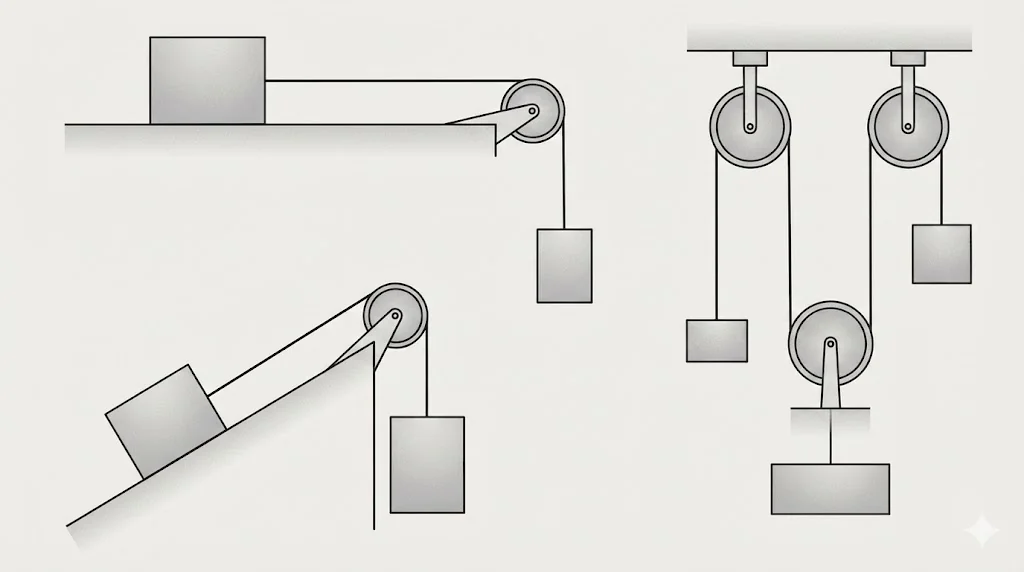
Multiple blocks connected by strings and pulleys forming a multi-body system
In multi-body systems, motion and forces are interconnected across bodies.
Quick reference
• Bodies interact through internal forces
• Acceleration may be common or related
• System-level analysis simplifies equations

This page is for learners comfortable with single-body dynamics who want insight into connected systems and system-level analysis.

1. Why Physics Needs Multi-Body Systems

Many physical situations involve more than one object interacting simultaneously. Analyzing such systems one body at a time often hides the underlying simplicity.

Multi-body systems reveal how forces transmit motion across connected bodies.

Multi-body mechanics is about understanding interactions, not isolated motion.

2. What Is a Multi-Body System?

A multi-body system consists of two or more bodies whose motions are dynamically linked through forces or constraints.

Examples include connected blocks, coupled masses, and pulley systems.

3. Internal and External Forces

Forces acting within the system are called internal forces. Forces acting from outside are external forces.
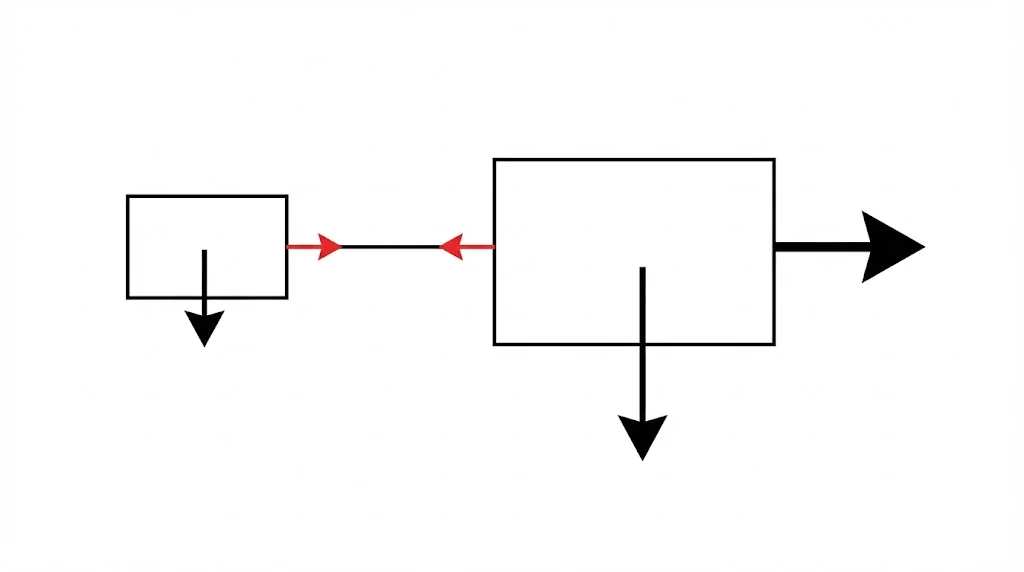
Internal forces cancel when the system is treated as a whole.
Diagram distinguishing internal and external forces in a multi-body system
Internal forces cancel in system-level analysis.

4. System-Level Approach

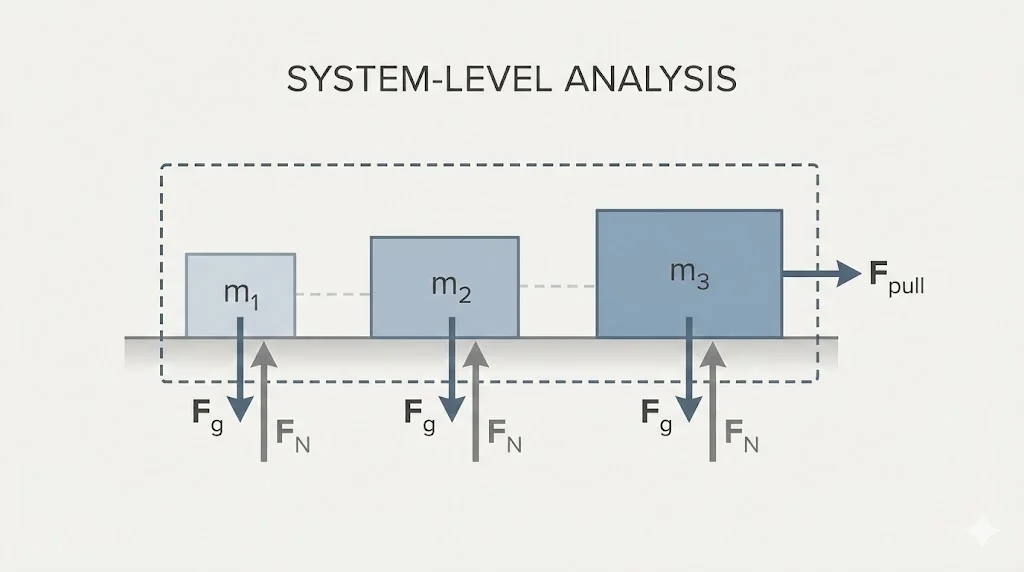
Instead of writing equations for each body separately, the entire system can be treated as a single object.

    \[ F_{\text{external}} = M_{\text{total}} a \]

Diagram showing multiple connected masses treated as a single system with only external forces shown, internal forces faded or omitted, clean schematic style, educational textbook illustration.
Multiple connected masses are treated as a single system.

This approach eliminates internal forces automatically.

5. Free Body Diagrams (FBDs)

Despite system analysis, individual free body diagrams remain essential for finding internal forces like tension or normal reaction.
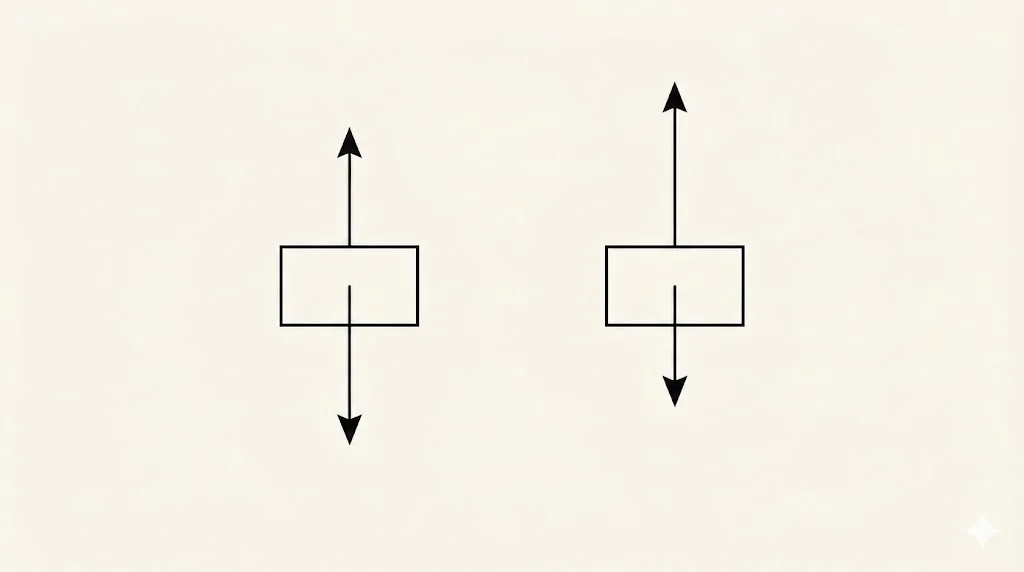
Free body diagrams of individual blocks in a connected system
Individual free body diagrams reveal internal force distributions.

6. Acceleration Relations

In many connected systems, bodies share the same magnitude of acceleration, though directions may differ.

Constraints and string geometry determine these relations.
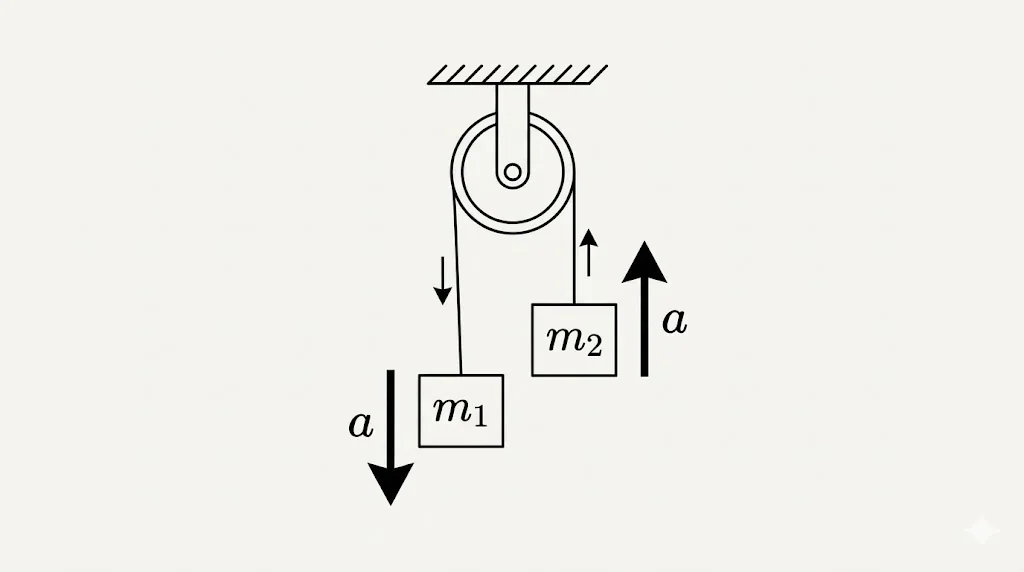
Pulley system diagram showing equal magnitude accelerations of connected bodies with opposite directions, string geometry emphasized, minimalist physics illustration.
Equal magnitude accelerations of connected bodies.
Acceleration relations come from geometry, not force balance.

7. Common Mistakes

  • Adding internal forces at system level
  • Assuming equal accelerations without constraints
  • Skipping free body diagrams

Practice Problems

Level 1 — Conceptual

Why do internal forces cancel in system-level analysis?
Solution Because they appear in equal and opposite pairs within the system.
Why is system analysis often simpler than body-wise analysis?
Solution Because internal forces are eliminated automatically.

Level 2 — Analytical (Force Relations)

Two blocks connected by a string accelerate together. What determines their common acceleration?
Solution The net external force divided by total mass.
Why must individual FBDs still be drawn after system analysis?
Solution To find internal forces like tension.

Level 3 — Advanced (Physical Reasoning)

Why does treating each body separately sometimes obscure the physics?
Solution Because internal forces complicate equations without affecting system motion.
How do constraints reduce degrees of freedom in multi-body systems?
Solution They impose relations between motions, reducing independent variables.
Advanced Physics → Multi-Body Systems
© PhysicsQandA