
Oscillations
NCERT Chapter 13 • Periodic Motion, Simple Harmonic Motion, Block-Spring Systems & Pendulums
1. Periodic and Oscillatory Motions
Periodic Motion: A motion that repeats itself at regular intervals of time (e.g., Earth orbiting the Sun).
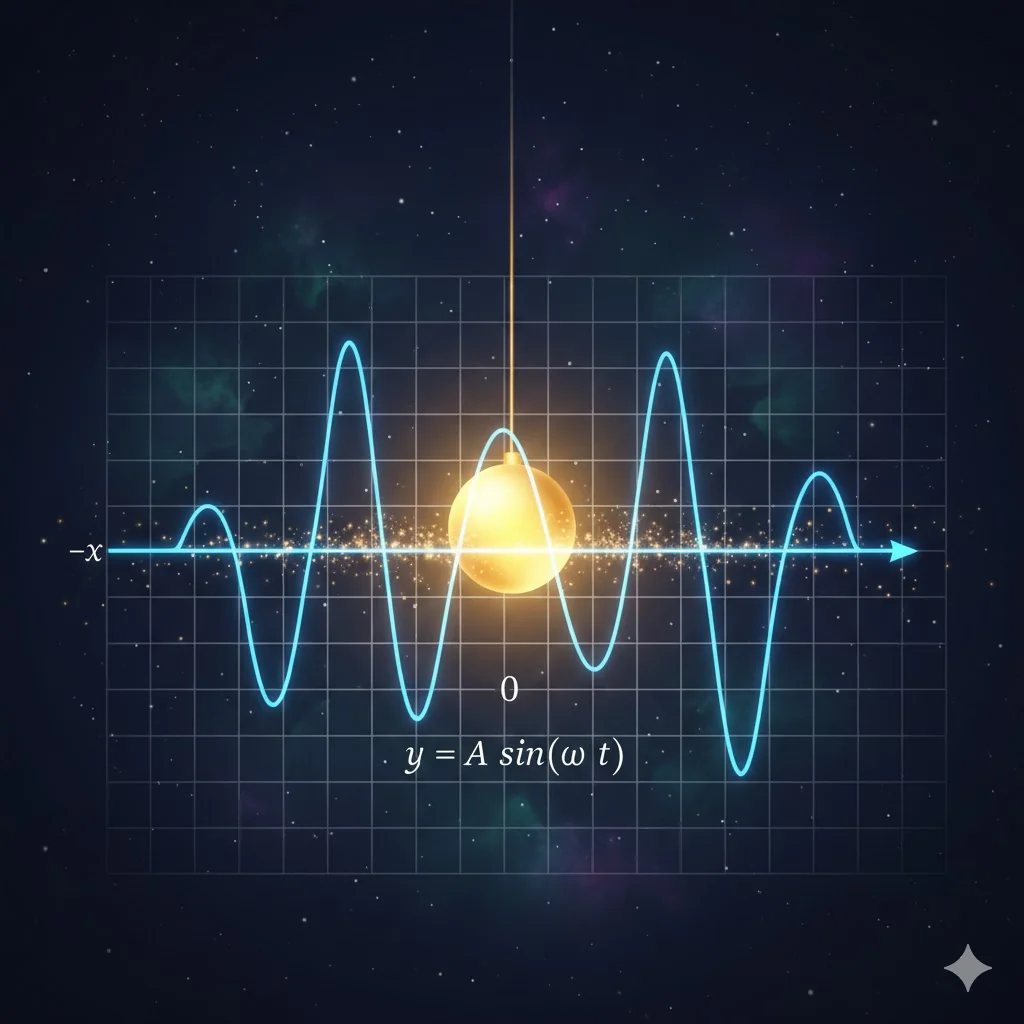
Oscillatory Motion: A to-and-fro periodic motion about a fixed point called the mean position (e.g., a swinging pendulum).
2. Simple Harmonic Motion (SHM)
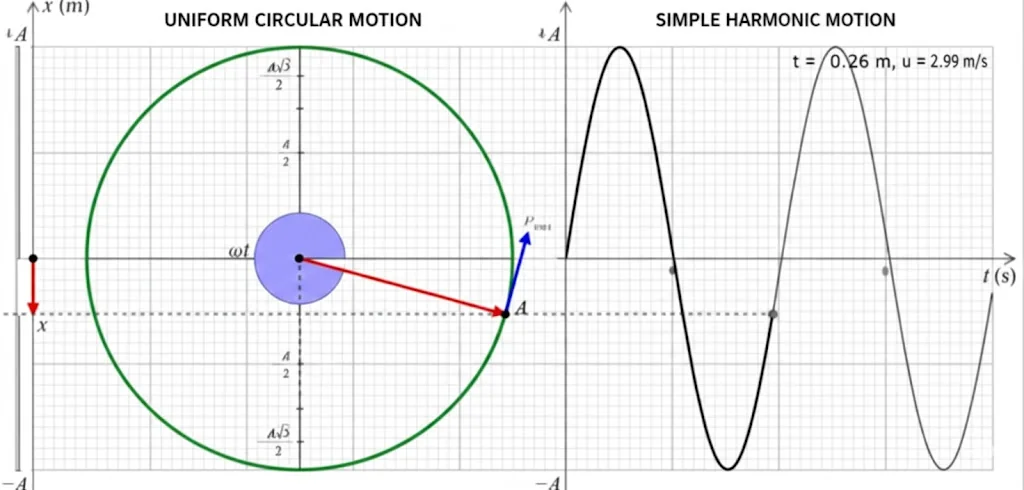
SHM is the simplest form of oscillatory motion where the restoring force is directly proportional to the displacement from the mean position and always directed towards it.

Displacement equation:

3. Velocity and Acceleration in SHM
Velocity (v)

Max velocity  (at mean position).
Acceleration (a)

Max acceleration  (at extreme positions).
Show Answer
A = 0.05 m, ω = 2π(10) = 20π rad/s. m/s.
m/s. m/s².
m/s².
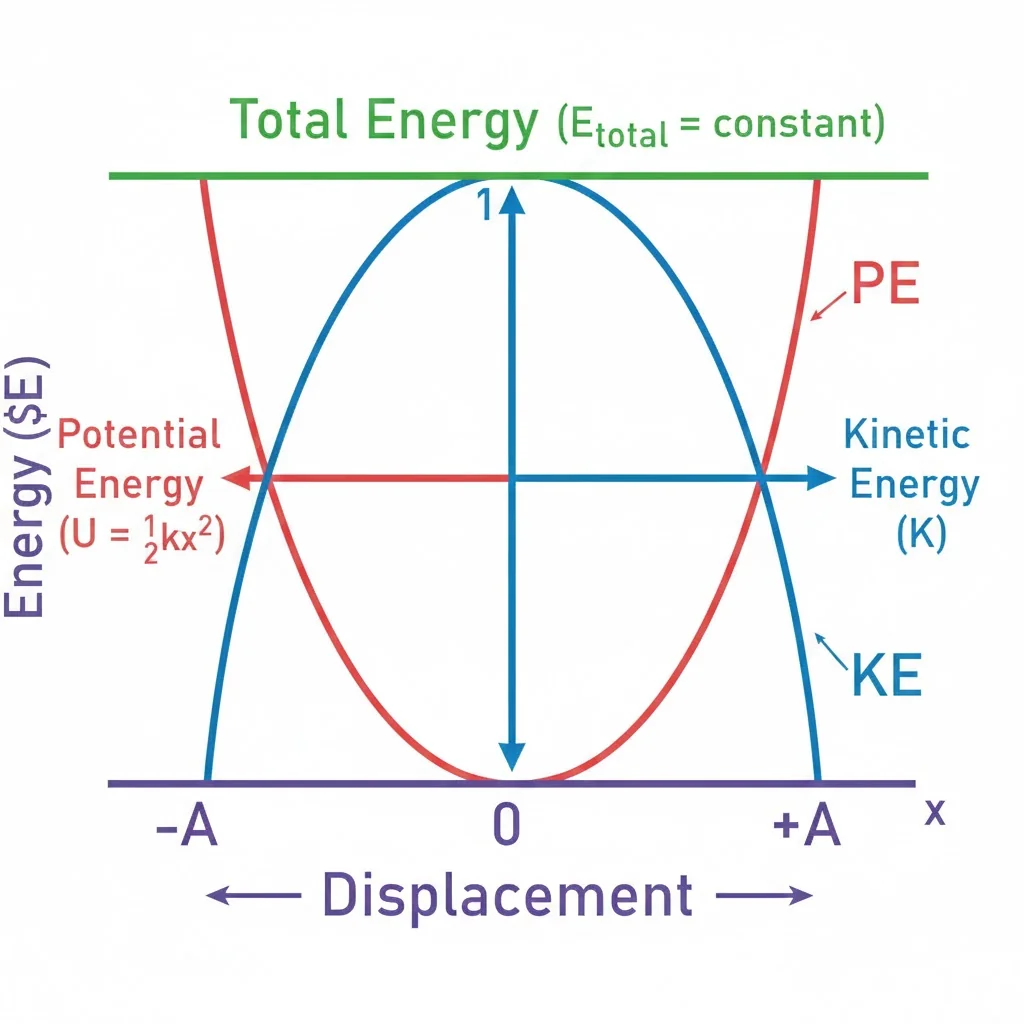
4. Energy in Simple Harmonic Motion
Total mechanical energy in SHM is conserved (ignoring friction).


5. Oscillations of a Spring (Block-Spring System)
A block of mass m attached to a massless spring of constant k executes SHM.

Combinations of Springs (JEE Essential)
- Series Combination: Springs connected end-to-end.
 ⇒
⇒ - Parallel Combination: Springs connected side-by-side to same mass.
⇒
 ⇒
⇒ 
 ⇒
⇒ 
 and
and  are connected in series to a mass
  . Find the time period.
Show Answer
 ⇒
⇒  .
. .
.
6. The Simple Pendulum
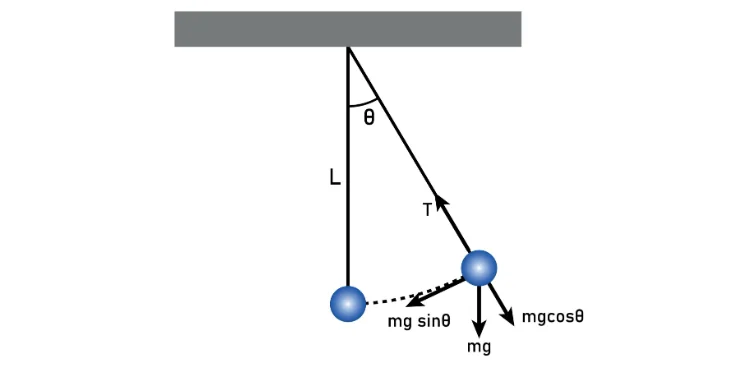

The period is independent of the mass of the bob.
Show Answer
 meter.
7. Damped Simple Harmonic Motion
Real systems lose energy to friction/drag, causing amplitude to decay exponentially.

Where b is the damping constant and  .
.
8. Forced Oscillations and Resonance
When an external periodic force drives the system, it oscillates at the driving frequency  .
.
Resonance
If the driving frequency equals the natural frequency ( ), the amplitude becomes very large. This is Resonance.