

• Velocity:

• Acceleration:

• Displacement:

• Work:

This page is for learners who know basic algebra and graphs and want a physics-first feel for derivatives and integrals, not drill problems in calculus.
1. Why Physics Needs Calculus
In real physical systems, quantities rarely remain constant. Velocity changes, forces vary, and motion evolves continuously with time.
Simple averages are not enough to describe such behavior. Physics requires a language that can describe instantaneous change and continuous accumulation.
2. Derivatives — Instantaneous Change
A derivative represents how fast one physical quantity changes with respect to another and is the mathematical tool for describing instantaneous change.
![\[ v = \dfrac{dx}{dt} \]](https://i0.wp.com/physicsqanda.com/wp-content/ql-cache/quicklatex.com-1743dc4c5c5a556e112d182d18b8e400_l3.png?resize=55%2C36&ssl=1 "Rendered by QuickLaTeX.com")

Velocity is not simply distance divided by time — it is the limit of average velocity as the time interval approaches zero.
![\[ a = \dfrac{dv}{dt} \]](https://i0.wp.com/physicsqanda.com/wp-content/ql-cache/quicklatex.com-5bf5d87aa34446e71a24a4e6a216e131_l3.png?resize=54%2C36&ssl=1 "Rendered by QuickLaTeX.com")

Acceleration measures how rapidly velocity itself changes.
3. Physical Meaning of a Derivative
Geometrically, a derivative is the slope of a curve. Physically, it tells how responsive a system is at a specific moment.
Two objects can have the same average velocity but very different instantaneous velocities.
4. Integrals — Accumulation of Change
If derivatives describe change, integrals describe accumulation.
![\[ x = \int v\,dt \]](https://i0.wp.com/physicsqanda.com/wp-content/ql-cache/quicklatex.com-4c9bc80a4d309cabf7f7831a39104589_l3.png?resize=81%2C40&ssl=1 "Rendered by QuickLaTeX.com")

Displacement is obtained by accumulating velocity over time.
![\[ W = \int \vec{F}\cdot d\vec{r} \]](https://i0.wp.com/physicsqanda.com/wp-content/ql-cache/quicklatex.com-6a983761c7f160379443ac0ef09da94b_l3.png?resize=111%2C40&ssl=1 "Rendered by QuickLaTeX.com")
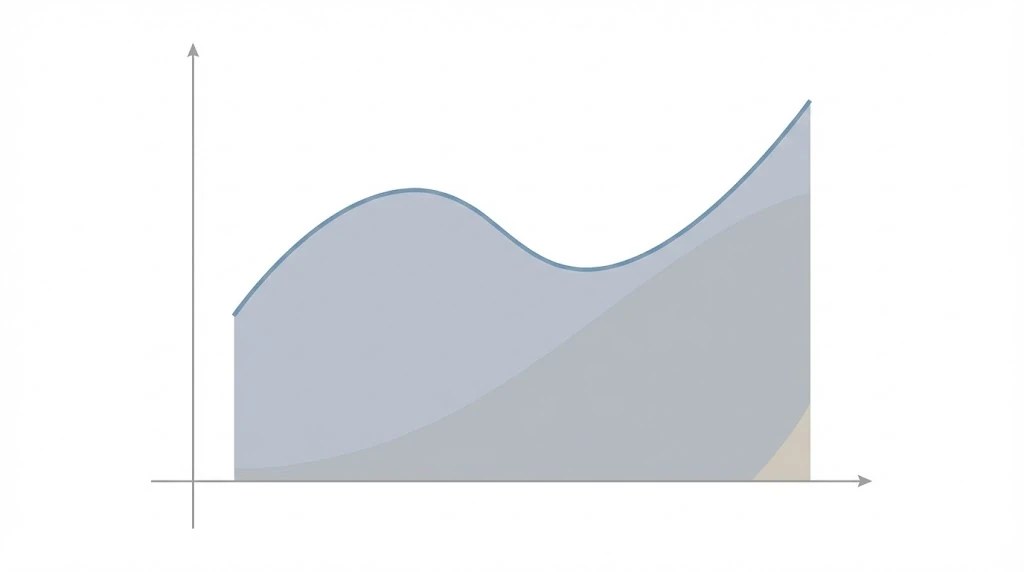
Work represents accumulated force along a path.
5. Physical Meaning of an Integral
An integral is not merely “area under a curve”. It represents the total physical effect produced by a continuously varying quantity.
In physics, integrals often answer the question, “How much effect builds up over time or space?”
6. Calculus as a Tool, Not a Goal
Calculus does not replace physical thinking. It sharpens it.
- Derivatives describe how systems respond
- Integrals describe how effects accumulate
- Graphs often reveal more than equations
7. Where Calculus Appears Next
Calculus is essential for:
- Variable force problems
- Energy methods
- Constraint motion
- Advanced mechanics and fields