
• Magnitude:

• Dot product:

• Cross product magnitude:

1. Why Physics Needs Vectors
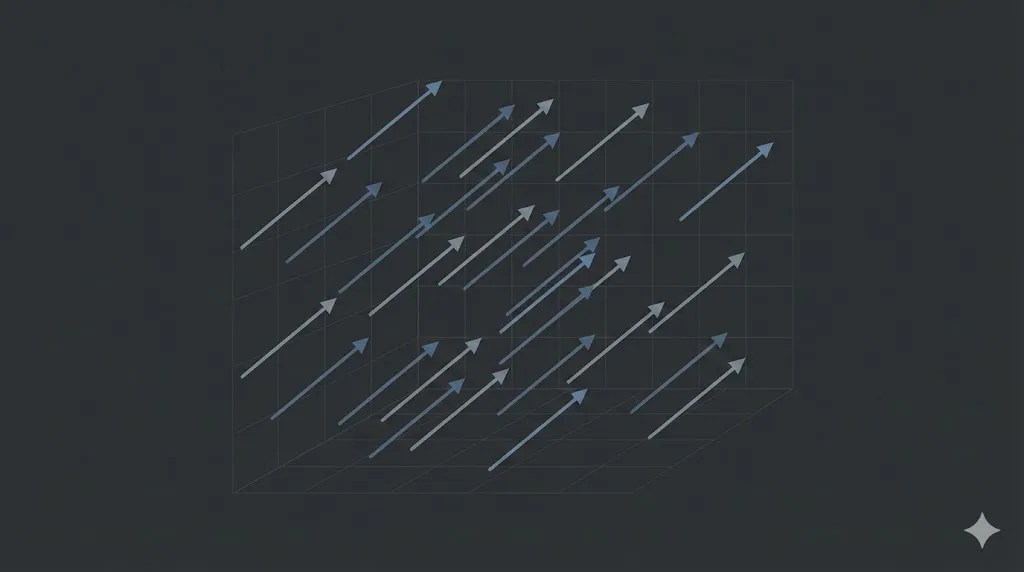
Physics describes nature in space. In space, direction matters. A single number is often insufficient to describe physical reality.
2. Scalars vs Vectors — A Deeper Meaning
Scalars remain unchanged under rotation. Vectors change components but preserve physical magnitude.
3. Representing a Vector
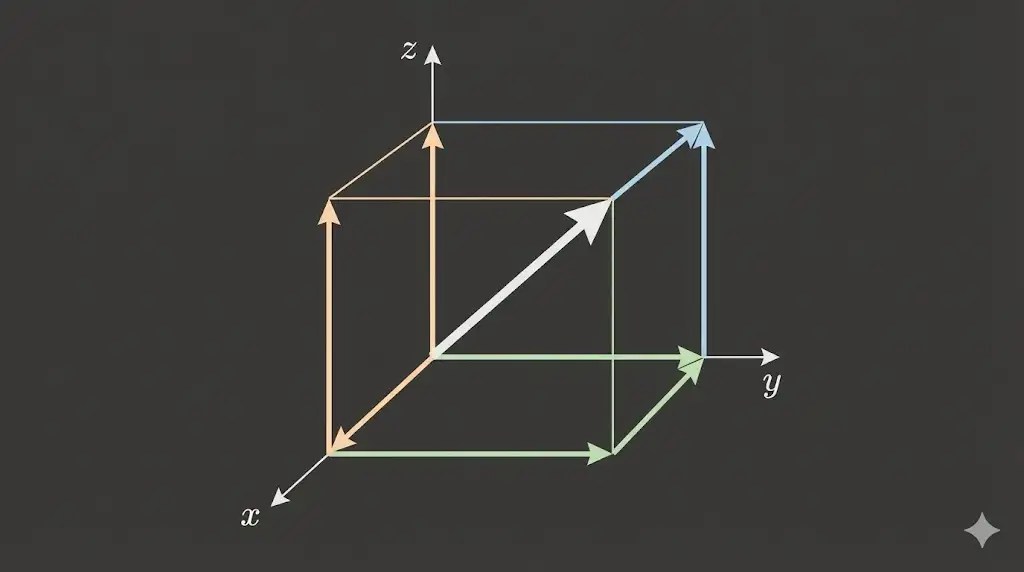
In calculations, a vector is usually represented by its components along three perpendicular axes. The components change under rotation, but the underlying geometric vector does not.
![\[ \vec{A} = A_x \hat{i} + A_y \hat{j} + A_z \hat{k} \]](https://i0.wp.com/physicsqanda.com/wp-content/ql-cache/quicklatex.com-41aed402727b7704cfa467f461c19bfa_l3.png?resize=168%2C23&ssl=1 "Rendered by QuickLaTeX.com")
4. Dot Product — Measuring Alignment
The dot product answers a simple but powerful question: how much of one vector actually contributes along another?
The dot product compresses two vectors into a scalar that tells how strongly they point in the same direction. It is maximised when vectors are parallel and zero when they are perpendicular.

![\[ \vec{A}\cdot\vec{B} = AB\cos\theta \]](https://i0.wp.com/physicsqanda.com/wp-content/ql-cache/quicklatex.com-8e77d8f5f03312ccc81aba58c790a7d7_l3.png?resize=130%2C18&ssl=1 "Rendered by QuickLaTeX.com")
5. Cross Product — Measuring Rotation
While the dot product measures alignment, the cross product measures rotation.
The cross product produces a new vector perpendicular to the plane of  and
and  ,
encoding both the axis and strength of a rotational effect.
,
encoding both the axis and strength of a rotational effect.
![\[ \vec{A}\times\vec{B} = AB\sin\theta\,\hat{n} \]](https://i0.wp.com/physicsqanda.com/wp-content/ql-cache/quicklatex.com-0db1add03231c5820c64d1bca8a6db9b_l3.png?resize=151%2C18&ssl=1 "Rendered by QuickLaTeX.com")
The direction of the cross product is perpendicular to the plane formed by the two vectors and is determined using the right-hand rule.

Direction alone is not the full story. The cross product exists because nature often responds through rotation.

6. Triple Products
Triple products combine dot and cross products to capture signed volume and mixed rotational–alignment effects in three dimensions.

![\[ \vec{A}\cdot(\vec{B}\times\vec{C}) \]](https://i0.wp.com/physicsqanda.com/wp-content/ql-cache/quicklatex.com-d100d5422855c63578c4b346d310ba81_l3.png?resize=89%2C23&ssl=1 "Rendered by QuickLaTeX.com")
Practice Problems
Level 1 — Conceptual
Solution
Because it selects the component of force along displacement.Solution
Because it measures the tendency to produce angular motion.Solution
No. Direction is an essential attribute of a vector.Solution
Because changing direction alone can completely change the physical effect, even if magnitude remains the same.Level 2 — Analytical (Component-Level)
 , what is the angle between them?
Solution
Zero degrees; vectors are parallel and aligned.Solution
When the line of action passes through the pivot.Solution
Let ,
,  ,
,  .
.Then
 .
.Grouping terms gives
 .
.So
 .
.
 .
.
Solution
 .
.