
« Back to AP Physics Guide / AP Physics 1 – Unit 3: Circular Motion
AP Physics 1 – Uniform Circular Motion: Centripetal Force, Banked Curves & Vertical Circles
1. Uniform Circular Motion: Velocity vs. Acceleration
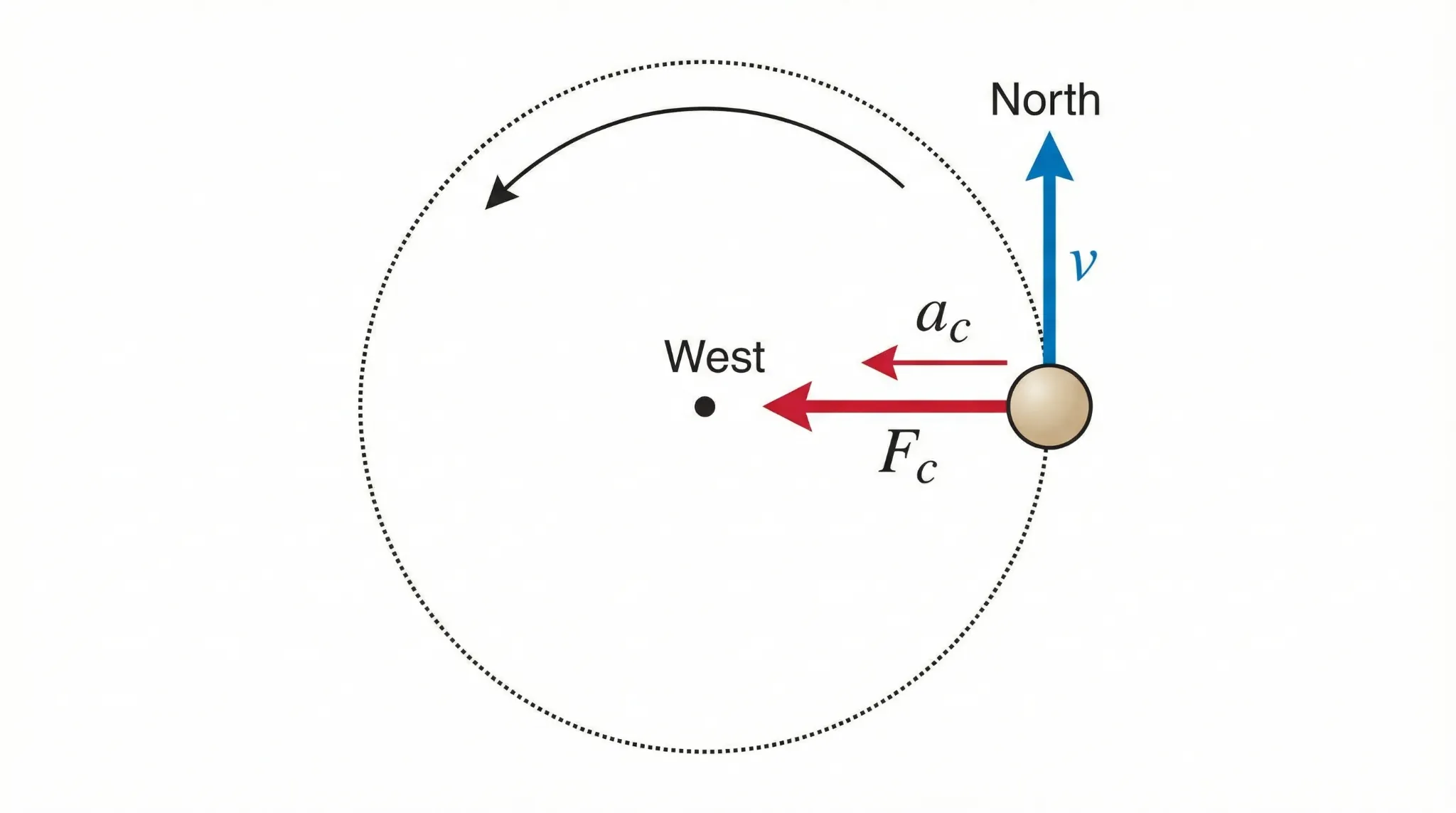
In uniform circular motion, the speed is constant, but the velocity keeps changing because its direction continuously changes toward the tangent of the circle. This changing direction is what creates a non‑zero acceleration even when the speed stays the same.


Always points toward the center of the circle.


The net inward force required to produce .

1.1 For the Nerds: Deriving 
Here is a quick geometric proof using similar triangles.

 and radius
  is similar to the triangle for
  and
and  .
.
The geometry gives the ratio

Divide both sides by  :
:

Since  and
and  , we obtain

1.2 Period, Frequency & Speed on a Circle
In many AP Physics 1 circular‑motion problems, it is easier to think in terms of how long one revolution takes instead of just meters per second.

Time for one full revolution (seconds).


Revolutions per second (Hz).

Speed in a circle:
If one revolution travels a distance  in time , then

2. Flat Curve: The “Car on a Curve” Problem
When a car turns a corner on level ground, the steering wheel only changes direction; the actual inward force is provided by static friction between the tires and the road. If friction disappears (ice), the car slides straight because no force points toward the center.

How to Solve Flat‑Curve Problems
Set the friction force equal to the required centripetal force:


(From Unit 2: on flat ground,  , so
, so 
2.5 Banked Turns (No Friction)
A classic AP Physics 1 question: “A car drives on a banked track. At what speed can it travel without relying on friction?” This has the same math as a conical pendulum.
The key is to resolve the Normal Force into vertical and horizontal components.

 supplies the centripetal force toward the center of the curve.
- Vertical (y): (balances gravity)
- Horizontal (x): (provides centripetal force)
 (balances gravity)
 (provides centripetal force)
Divide the x‑equation by the y‑equation; mass and  cancel:

2.6 Conical Pendulum
A small mass whirling in a horizontal circle on a string (the “flying pig”) looks scary but is mathematically identical to the banked‑curve problem.
 ; the components work out the same way.
Break Tension into components:
- Vertical: (balances gravity)
- Horizontal: (provides )
 (balances gravity)
 (provides
 Dividing gives the same result:  .
.
2.7 Banked Turn with Friction
Real roads have friction, which creates a range of safe speeds rather than just one speed. The direction of friction depends on whether the car tends to slide up or down the slope.

Car tends to slide OUT; friction points down the slope.

Car tends to slide IN; friction points up the slope.

3. Vertical Circles (Loops & Roller Coasters)
Vertical‑circle problems are harder because gravity can help or oppose the inward direction depending on where the object is on the path. Remember: centripetal force is always the sum of forces toward the center.
 and pay attention to signs at the top vs bottom of the loop.
Top of the Loop

Both Gravity and Normal Force point inward (toward the center).

Bottom of the Loop

Normal Force points inward (up), Gravity points outward (down).

Critical Speeds for a Loop‑the‑Loop
-
1. Minimum speed at the top:
Just enough to keep contact ():
-
2. Minimum speed at the bottom:
Using energy to get from bottom to top gives
(Derivation connects with conservation of energy in Unit 4.)
 ):
):


4. AP Physics 1 Circular Motion Practice Problems
Concept Check (MCQ Style)
Q1: A ball is swung in a horizontal circle of radius with speed . If the speed is doubled to  and radius stays the same, how does the required centripetal force change?
Click to see answer
Answer: It becomes four times larger.
Since  , doubling gives
  , so the force is
  .
.
Tip: This uses proportional reasoning from the kinematics equation sheet.
Mini‑FRQ: Car Over a Hill
Scenario: A 1000 kg car drives over the top of a hill that has a circular cross‑section with radius  .
.
(a) Derive an expression for the maximum speed the car can have without losing contact with the road.
(b) Calculate this speed.
Check solution
Part (a): At the top, inward direction is downward. Gravity is inward, Normal Force is outward.
 .
.
At the point of losing contact,  , so
, so  .
.
Thus  .
.
Part (b):  .
.
More Practice Problems
Flying Pig (Conical Pendulum): A toy plane on a string makes a horizontal circle. The string length is  and makes an angle of
  with the vertical. Calculate its speed.
See solution
Radius:  .
.
Use  .
.
 .
.
Vertical Loop Tension: A 2.0 kg bucket of water moves in a vertical circle of radius  at speed
  . Find the tension at the bottom.
See solution
At bottom:  .
.
 .
.
Friction on a Flat Curve: A car rounds a flat curve of radius  . If
. If  , what is the maximum safe speed?
See solution
Use  .
.
 .
.
What’s Next in Unit 3?
Now that you’ve mastered circular motion on Earth, move into “space physics” with gravity and orbits.
- 🪐 Next Lesson: Universal Gravitation (The Force) »
- 🔁 Review: AP Physics 1 – Newton’s Laws (Unit 2)
- 📚 Go back: AP Physics Guide (AP Physics 1, 2 & C)