
« Back to AP Physics Guide / AP Physics 1 – Unit 4: Conservation of Energy
AP Physics 1: Conservation of Energy
This is the single most powerful problem-solving tool in AP Physics 1. If you can define a system where energy is conserved, you can solve complex motion problems without ever calculating acceleration or time.
AP Physics 1 Unit 4 (Conservation): This topic appears in many free-response questions where you must justify your steps with energy bar charts or equations.
1. The Law of Conservation
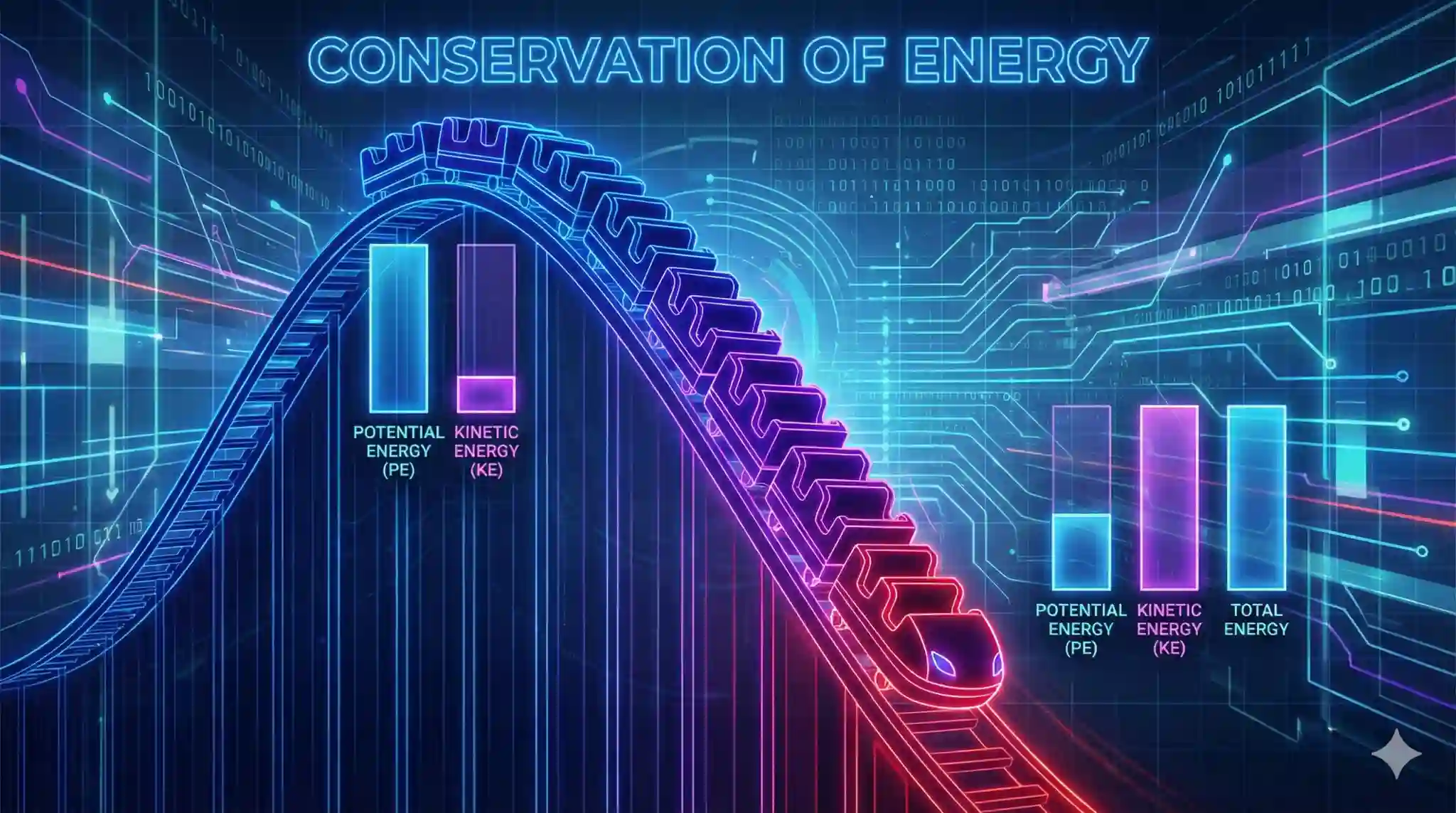
The law states that energy cannot be created or destroyed, only transferred or transformed. For a closed system (where no energy enters or leaves), the total mechanical energy remains constant.

This means if you drop a ball, the gravitational potential energy  it loses is perfectly converted into kinetic energy
  .
.

2. The “Master Equation” (Open Systems)
Real life has friction. Friction and air resistance are non-conservative forces. They take mechanical energy out of your system and turn it into heat (thermal energy).
When friction is present, we modify the conservation equation:

The Master Equation: Start with what you have  , add the work done by non-conservative forces
  , and that equals what you have at the end
  .
.


Here (work by non-conservative forces) is usually negative because friction acts opposite the motion.
3. How to Solve Rollercoaster Problems
The classic AP Physics problem involves a rollercoaster, pendulum, or skateboarder in a bowl. Follow these three steps to solve most conservation-of-energy questions.
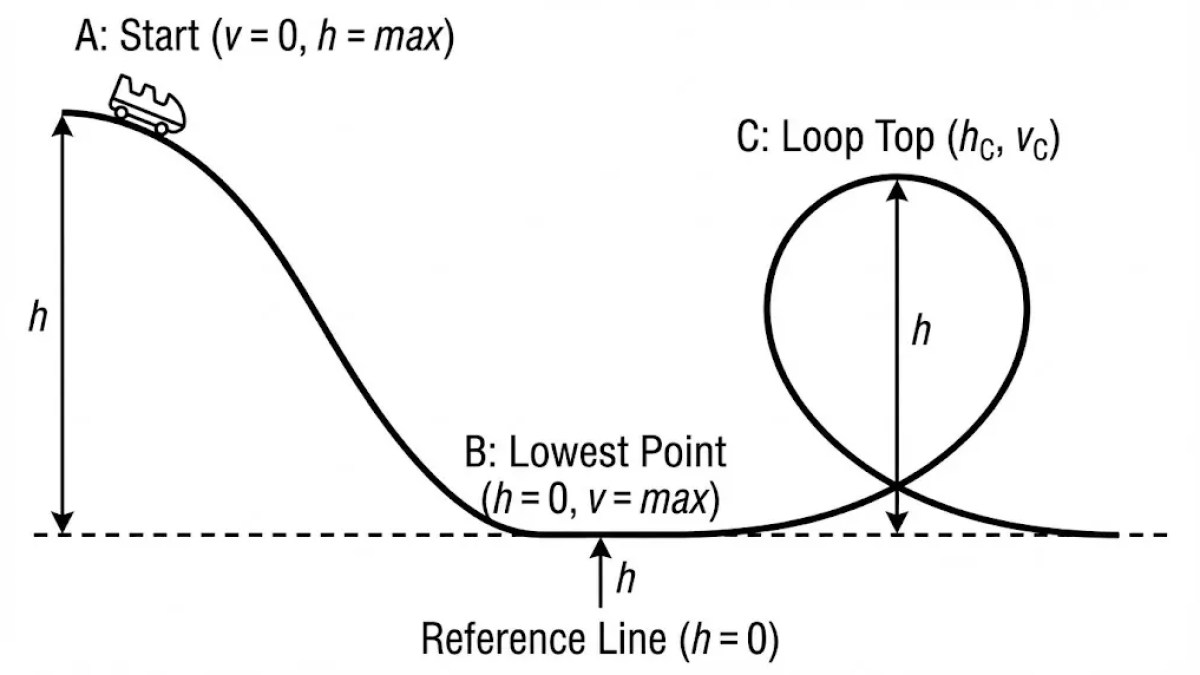
Setup is Key: Always define your zero-height line  at the lowest point (Point B) to simplify the math.
Step 1: Set the  Line
Line
Draw a horizontal dashed line at the lowest point the object reaches (Point B). At this line,  .
.
Step 2: Identify Energy at Each Point
- Point A (Top): If it starts from rest, energy is all . If it has speed, energy is .
- Point B (Bottom): Height is zero, so energy is all .
- Point C (Loop or crest): Has height and speed, so energy is .
 .
.Step 3: Write and Solve the Equation
If friction is negligible: Energy at A = Energy at B.

Notice mass  cancels out. The speed at the bottom does not depend on the mass of the cart.
Quick Example
Q: A 500 kg rollercoaster car starts from rest at height  (no friction). What is its speed at the bottom?
Solution:  .
.
 .
.
in your energy equation, or treat gravity as a force doing work, but not both.
Unit 4 Complete!
You have mastered Work, Power, and Conservation of Energy. Next up in AP Physics 1 is the other big conserved quantity in mechanics: Momentum.