
« Back to AP Physics Guide / AP Physics 1 – Unit 5: Conservation of Momentum
AP Physics 1: Conservation of Momentum
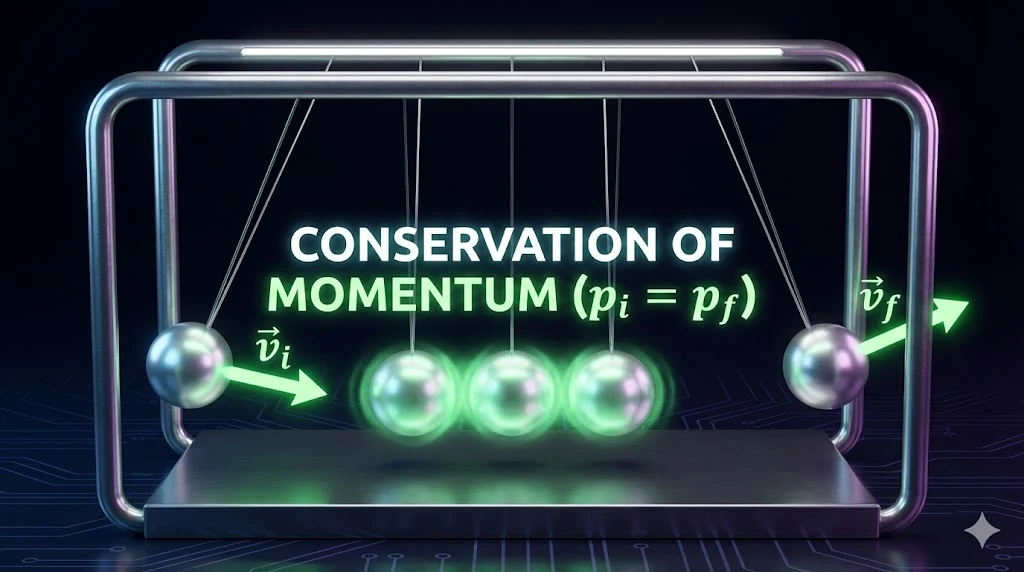
If you master one concept in Unit 5, make it this one. The Law of Conservation of Momentum is one of the most fundamental laws in the universe. It applies to everything from billiard balls to subatomic particles to colliding galaxies.
AP Physics 1 Unit 5 (Topics 5.3–5.4): One-dimensional and two-dimensional collisions, conservation of momentum in closed systems, and classifying elastic vs inelastic collisions.
1. The Law ( )
)
 )
)The law states: If there are no external forces acting on a system (like friction), the total momentum of that system remains constant.
![\[\sum \vec{p}_i = \sum \vec{p}_f\]](https://i0.wp.com/physicsqanda.com/wp-content/ql-cache/quicklatex.com-2a1be2f98d5d6a0285328df0f2ebb866_l3.png?resize=113%2C25&ssl=1 "Rendered by QuickLaTeX.com")
For a collision between two objects (A and B), the equation looks like this:
![\[m_A v_{Ai} + m_B v_{Bi} = m_A v_{Af} + m_B v_{Bf}\]](https://i0.wp.com/physicsqanda.com/wp-content/ql-cache/quicklatex.com-cf0e829e03f59d82ae432788870ad3f4_l3.png?resize=280%2C17&ssl=1 "Rendered by QuickLaTeX.com")
This is your starting point for almost every collision problem.
2. Types of Collisions
Not all collisions are the same. In AP Physics, we classify them based on what happens to the Kinetic Energy ( ).
).

Collision Types: Elastic collisions conserve Kinetic Energy. Inelastic collisions lose Kinetic Energy (usually to heat or deformation).
The Cheat Sheet:
- Elastic Collision: Objects bounce perfectly. Momentum is conserved. Kinetic Energy IS conserved. (Rare in real life, common with atoms/magnets).
- Inelastic Collision: Objects bounce or deform. Momentum is conserved. Kinetic Energy is LOST. (Most real-world car crashes).
- Perfectly Inelastic: Objects stick together. Momentum is conserved. Maximum possible kinetic energy is lost.
- Explosion (Recoil): Objects start together () and push apart. Momentum is conserved (total = 0). Energy is gained from chemical or spring potential.
 ) and push apart. Momentum is conserved (total = 0). Energy is gained from chemical or spring potential.
3. 2D Collisions (Glancing Blows)
Momentum is a vector. This means if objects collide at an angle, you must conserve momentum in the x-direction and the y-direction separately.

2D Collisions: Momentum is conserved in the x-direction and y-direction independently.
Step-by-Step Strategy:
- X-axis equation: Sum of momentum before (x) = sum of momentum after (x).
- Y-axis equation: Sum of momentum before (y) = sum of momentum after (y).
- Resolve vectors: Use for horizontal and for vertical components.
 for horizontal and
  for vertical components.
4. Quick AP Practice
📚 AP Practice Problems
1. A 1 kg cart moving at 3 m/s hits a 2 kg cart at rest and they stick. Final speed?
Answer

2. Two equal-mass carts collide elastically head‑on with speeds 2 m/s and −3 m/s. What are their speeds after?
Answer
They exchange speeds: .
.
3. An explosion breaks a 3 kg object at rest into 1 kg and 2 kg pieces. The 1 kg piece moves right at 6 m/s. Find the 2 kg piece’s velocity.
Answer
Total . So
. So  (left).
🔗 Related AP Physics Resources
Unit 5 Complete!
You have mastered Momentum, Impulse, and Collisions. Next, we move to Simple Harmonic Motion (SHM)—the physics of pendulums and springs.