
« Back to AP Physics Guide / Unit 7: Rotation Complete
AP Physics 1 Unit 8: Density & Pressure (NEW 2025+)
Topics 8.1–8.2 (10–15% exam weight): Welcome to the NEW Fluids unit! Before studying fluid motion, master hydrostatics—why ears pop underwater and hydraulic jacks lift cars.
1. Density (ρ = m/V)
Density measures “compactness.” Water floats icebergs because ice is less dense.
![\[\rho = \frac{m}{V}\]](https://i0.wp.com/physicsqanda.com/wp-content/ql-cache/quicklatex.com-c724e1dd51cf56872f19f859d9733f1c_l3.png?resize=50%2C32&ssl=1 "Rendered by QuickLaTeX.com")

Particle Model: Fewer particles per volume = lower density.
2. Hydrostatic Pressure (P = P₀ + ρgh)
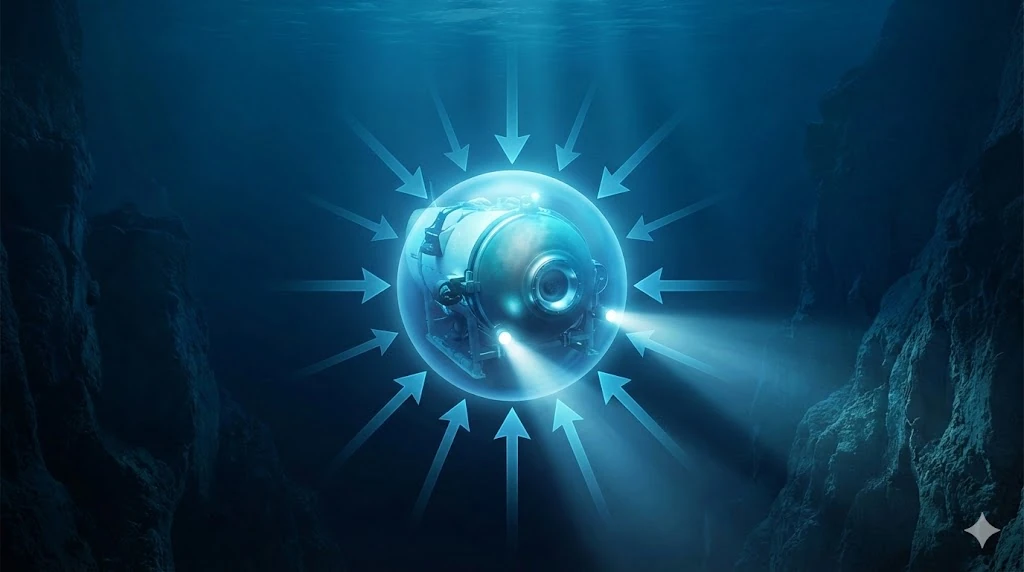
Deeper = more water weight above = higher pressure. Independent of container shape.
![\[P = P_0 + \rho g h\]](https://i0.wp.com/physicsqanda.com/wp-content/ql-cache/quicklatex.com-77f0d0f391da4ba79623e20c0c71377e_l3.png?resize=107%2C16&ssl=1 "Rendered by QuickLaTeX.com")

Key Insight: Pressure at same depth is identical regardless of path/shape.
3. Pascal’s Principle (Hydraulics)
Incompressible fluids transmit pressure equally in all directions.
![\[\frac{F_1}{A_1} = \frac{F_2}{A_2}\]](https://i0.wp.com/physicsqanda.com/wp-content/ql-cache/quicklatex.com-102f77a95ffc93085c74dbc54c252a7d_l3.png?resize=70%2C39&ssl=1 "Rendered by QuickLaTeX.com")
 >A₁ so F₂>>F₁.” width=”1200″ height=”675″>
Car Jack: 100N input lifts 10,000N car (100:1 area ratio).
4. Quick AP Practice
📚 AP Practice Problems
1. 8kg cube, side=0.4m. Density?
Answer
V=(0.4)³=0.064m³ρ=8/0.064=125 kg/m³
2. Diver at 10m (ρ=1000kg/m³). Gauge pressure?
Answer
P=ρgh=(1000)(9.8)(10)=98kPa3. Hydraulic: A₂=20A₁. Force ratio?
Answer
F₂/F₁=A₂/A₁=20x force amplification🔗 Unit 8 Progression
✅ Unit 8 Part 1 Complete!
Density & pressure mastered. Next: why ships float (Archimedes).