
« Back to AP Physics Guide / Unit 1: Kinematics
AP Physics 1: Projectile Motion & Vectors
1. Breaking Down Vectors
Before solving projectile problems, you must be able to split a diagonal velocity vector into its components. In AP Physics 1, we use trigonometry (SOH CAH TOA) to do this.

 ) into its horizontal (
 ) and vertical (
 ) components using trigonometry.
- Horizontal Component (vx):

- Vertical Component (vy):


Calculus Note: AP Physics 1 does not use unit vectors ( ) or dot products. Stick to x and y components.
2. The Two Rules of Projectile Motion
If you memorize nothing else, memorize this table. This is how you set up every FRQ.
| Axis | Acceleration | Velocity Behavior | Equation to Use |
|---|---|---|---|
| Horizontal (X) |  |
Constant Velocity |  |
| Vertical (Y) |  |
Changing (Free Fall) | Use “Big 3” Kinematics Equations |
The Bridge: The only variable that is the same for both X and Y sides is Time (t).

 ).
).3. Three Scenarios You Will See

A. Horizontal Launch
Object thrown straight off a cliff.
- Initial
- Initial
- Time depends only on height!

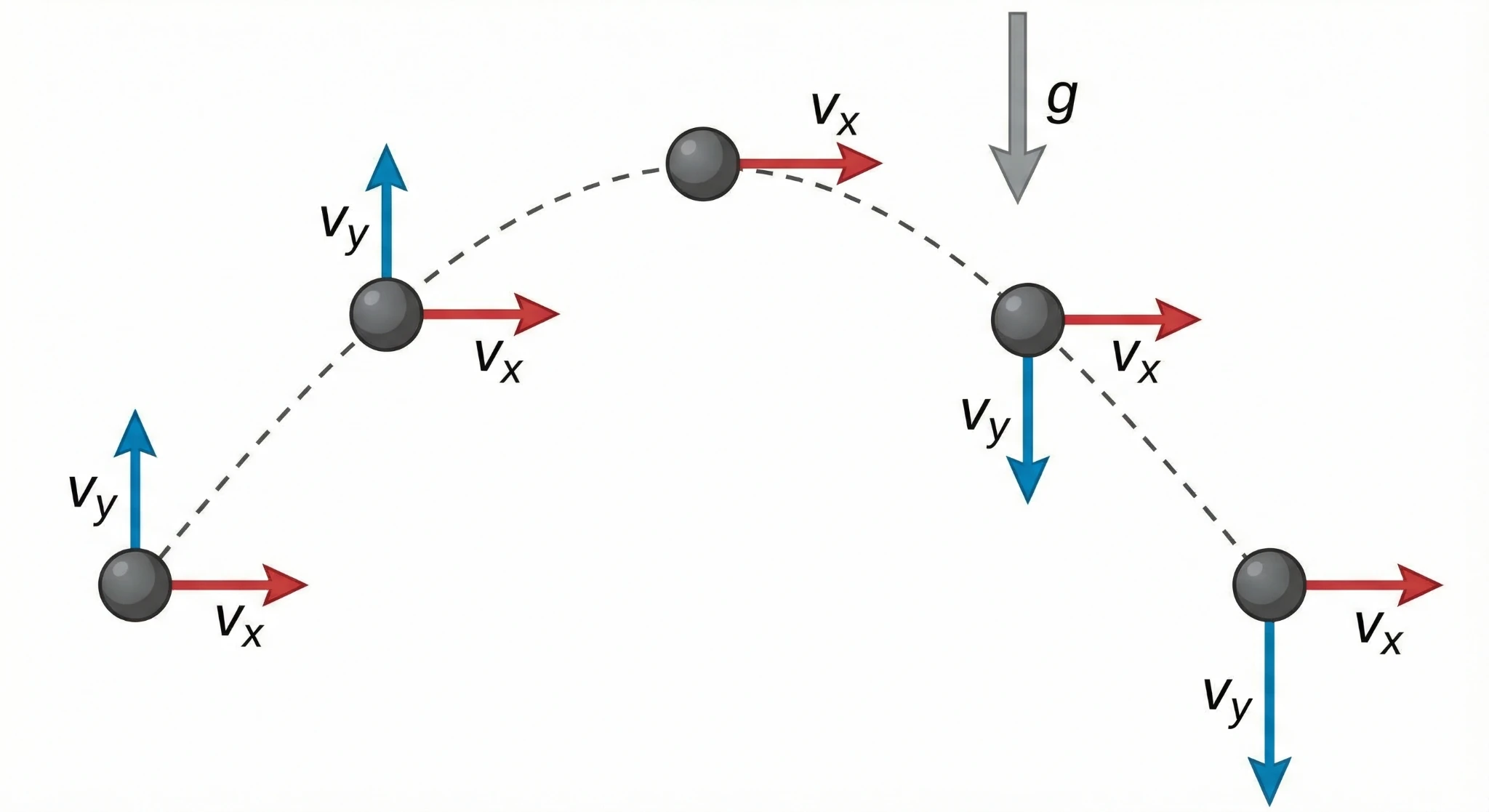
B. Angled Launch (Ground-to-Ground)
Object kicked like a soccer ball.
- At the peak height, (but is still there!)
- Time up = Time down (if landing at same height).
4. AP-Style Concept Check
Try this “Paragraph Length Response” style question. No numbers allowed!
Question: Two identical balls are released from the top of a cliff at the same time. Ball A is dropped from rest. Ball B is thrown horizontally outward with speed . Which ball hits the ground first? Justify your answer.
Click to see the Answer
Answer: They hit at the same time.
Reasoning: The vertical motion of an object is independent of its horizontal motion. Both balls start with an initial vertical velocity of zero ( ) and fall the same vertical distance (
 ) under the same acceleration due to gravity (). Therefore, according to the equation
  , the time
  to fall must be identical for both.
5. AP-Style Derivation Practice
On the AP Exam, you are often asked to derive equations using only variables. Practice these three common scenarios. Do not memorize the final answers; memorize the steps!
Derivation 1: Total Horizontal Range ( )
)
Find the horizontal distance derived in terms of  ,
,  , and .
Click to see Step-by-Step Derivation
Step 1: Horizontal Motion
 (Eq 1)
Step 2: Vertical Motion (Find Time)
Total displacement  .
.
 (Eq 2)
Step 3: Substitute and Solve

Derivation 2: Maximum Height ( )
)
Find the peak height derived in terms of , , and .
Click to see Step-by-Step Derivation
The Key Concept:
At the very peak of the flight, the vertical velocity () is zero.
Step 1: Choose the Right Equation
We don’t know time, so use the time-independent equation:

Step 2: Substitute Variables
Final vertical velocity 
Initial vertical velocity 
Acceleration 
Displacement 
Step 3: Solve for


Derivation 3: Equation of Trajectory (Path)
Prove that the path is a parabola by finding  as a function of
  .
.
Click to see Step-by-Step Derivation
Goal: Eliminate time () from the equations.
Step 1: Solve for using Horizontal Equation

 (Eq A)
Step 2: Plug into the Vertical Equation


Step 3: Simplify
Use the identity  :
:

Notice that this follows the form  , which is mathematically a downward-opening parabola.
6. Don’t Lose Easy Points!
❌ The “Velocity at Peak” Trap
Mistake: Saying velocity is zero at the peak.
Truth: Only the vertical velocity () is zero. The horizontal velocity () is still there!
❌ The “Acceleration” Trap
Mistake: Saying acceleration is zero at the peak.
Truth: Acceleration is always  downwards, even at the very top.
Ready for the next step?
Go to Unit 2: Forces »