
« Back to AP Physics Guide / Unit 6: Oscillations Complete
AP Physics 1 Unit 7: Torque & Equilibrium
Topics 7.1–7.2 (10–15% exam weight): Welcome to Unit 7, where we take everything you learned in dynamics and make it spin. The most important concept to master first is the “turning force” known as Torque ( ).
).
1. What is Torque?
Torque is not a force; it is the measure of a force’s ability to rotate an object. It is a vector quantity, and its direction is either Clockwise (negative) or Counter-Clockwise (positive).
![\[\tau = r F \sin\theta = r F_\perp\]](https://i0.wp.com/physicsqanda.com/wp-content/ql-cache/quicklatex.com-6c8978dd90747093d79f3b16c33fb646_l3.png?resize=146%2C15&ssl=1 "Rendered by QuickLaTeX.com")

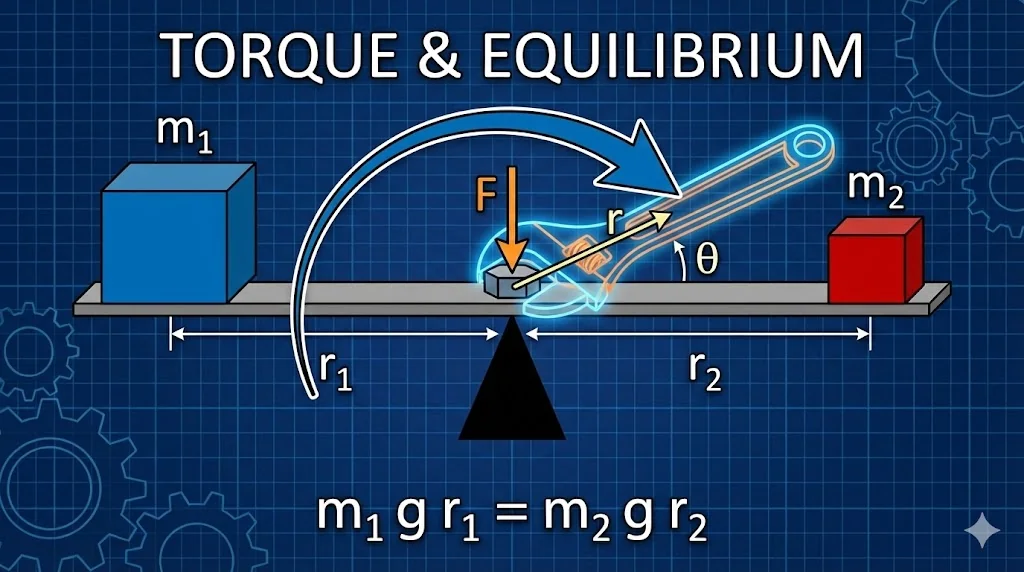
The Anatomy of Torque: To maximize torque, you want your force to be perpendicular ( ) to the radius. The “Lever Arm” is the effective perpendicular distance from the pivot.
2. Static Equilibrium ( )
)
 )
)If an object is not rotating (or rotating at constant speed), it is in Rotational Equilibrium. Net torque = zero, just like ΣF = 0 for linear equilibrium.
![\[\sum \tau_{CCW} = \sum \tau_{CW}\]](https://i0.wp.com/physicsqanda.com/wp-content/ql-cache/quicklatex.com-7157431f9d76679d19290904b73533bd_l3.png?resize=159%2C25&ssl=1 "Rendered by QuickLaTeX.com")

Balancing Act: For the beam to remain stationary, total Counter-Clockwise Torque = total Clockwise Torque.
Solving Seesaw Problems (3 Steps):
- Pick Pivot: Usually fulcrum (eliminates unknown reaction forces, r=0)
- List Torques: CCW (positive) vs CW (negative)
- Balance:

3. Quick AP Practice
📚 AP Practice Problems
1. 50 N force on 0.2 m wrench at 30°. Calculate torque.
Answer

2. Seesaw balanced. 60 kg at 2 m. Where does 40 kg sit?
Answer

3. Force parallel to lever arm (0°). Torque value?
Answer
 . No rotation.
🔗 Related AP Physics Resources
Unit 7 Part 1 Complete!
You can calculate torque and balance objects. Next: what happens with unbalanced torques?