
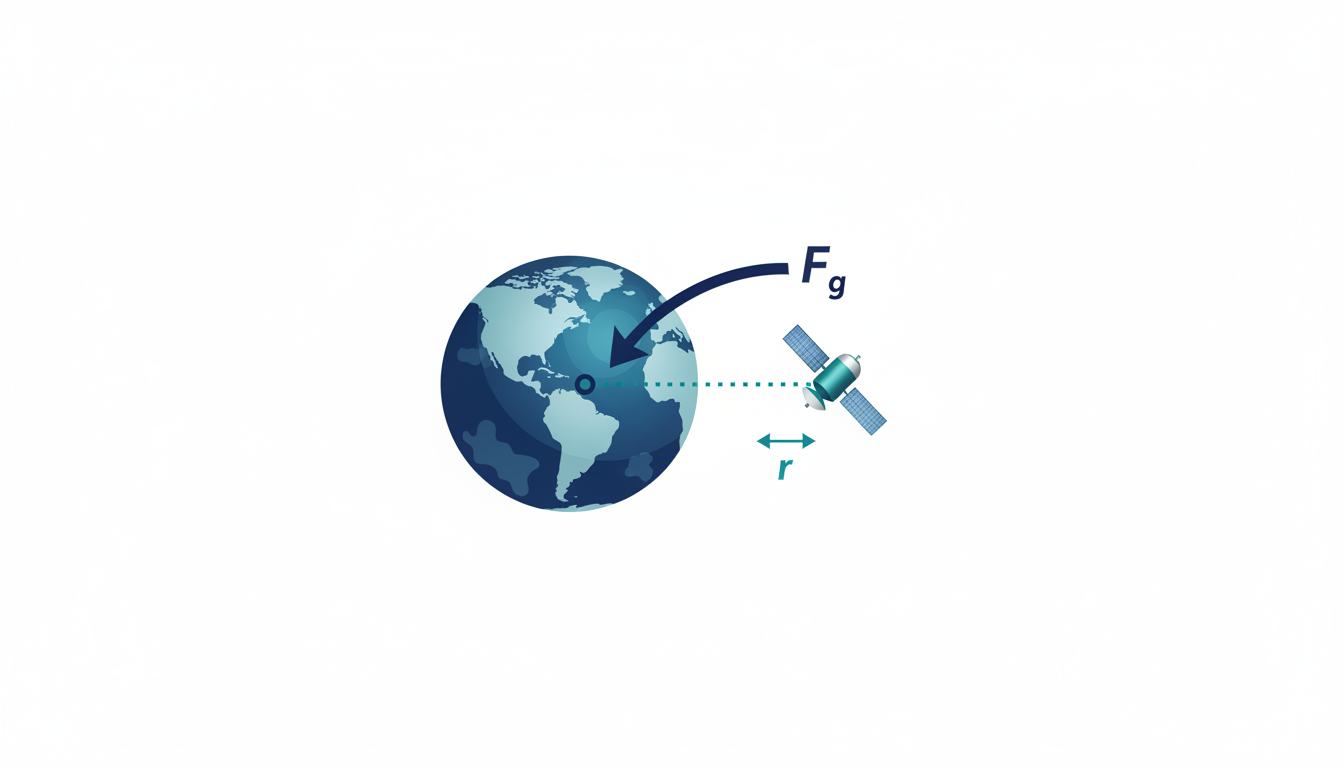

AP Physics C: Gravitational Force
Every pair of objects with mass attracts gravitationally. Newton’s law of universal gravitation predicts the force magnitude from the masses and the distance between their centers.
AP Exam Tip
Identify the interacting objects and the selected system before applying the governing law.
Quick Check: Gravitational Force
If the distance between two masses doubles while both masses remain unchanged, the gravitational force becomes:
- Twice as large
- Half as large
- One-fourth as large
- One-eighth as large
Check answer
Answer: C. Gravitational force follows an inverse-square law: F ∝ 1/r².
G = 6.67 × 10⁻¹¹ N·m²/kg². The force acts along the line joining the two centers and is attractive. The distance r is measured center-to-center, not from the nearest surfaces.
1. The inverse-square relationship
Gravitational force is proportional to each mass and inversely proportional to the square of separation. Doubling one mass doubles the force. Doubling the separation makes the force one-fourth as large. Tripling the separation makes it one-ninth as large.
Worked example 1: Scaling the distance
Two masses attract with force F when their center-to-center separation is r. If the distance becomes 3r with masses unchanged, then F′ = Gm₁m₂/(3r)² = F/9.
Worked example 2: Earth and an object
For an object of mass m near Earth’s surface, Fg = GMEm/RE². This is written as mg, so g = GME/RE². The approximation g ≈ 9.8 m/s² applies near Earth’s surface; g decreases with altitude.
2. Gravitational field strength
The gravitational field strength created by a spherical mass M at an external distance r is g = GM/r², directed toward M. It is force per unit test mass. Do not confuse the field strength g with the universal constant G.
Worked example 3: Field at twice the radius
At distance R from a spherical planet, field strength is g₀ = GM/R². At 2R from the planet’s center, g = GM/(2R)² = g₀/4. The phrase “twice the radius” means the new center distance is 2R.
3. Multiple gravitational forces
If several masses attract an object, calculate each force vector and add the vectors. Forces in opposite directions subtract; perpendicular forces combine using vector components. Gravitational forces do not cancel simply because the masses are equal—the geometry determines the net force.
Common mistakes
- Using surface-to-surface distance rather than center-to-center distance.
- Using r instead of r² in the denominator.
- Confusing G with g.
- Forgetting that gravitational force is attractive and points toward the other mass.
Practice questions
- If separation doubles, what fraction of the original gravitational force remains?
- What is the gravitational force between 2.0 kg and 3.0 kg masses separated by 0.50 m? Use G = 6.67 × 10⁻¹¹ SI units.
- How does g change from distance R to distance 4R from a spherical planet’s center?
Answers
- One-fourth.
- F = G(2.0)(3.0)/(0.50)² = 1.60 × 10⁻⁹ N.
- It becomes 1/16 as large.
AP exam tip
State what r measures and identify the source mass. For scaling questions, ratios often save time: F₂/F₁ = (m₂/m₁)(r₁/r₂)² when the other mass is unchanged.
AP-Style Free-Response Question: Satellite in Circular Orbit
Original practice question • 10 points • Suggested time: 12–15 minutes
A satellite of mass m orbits a spherical planet of mass M in a circular orbit of radius r measured from the planet’s center. Ignore other gravitational sources.
- (2 points) Draw or describe the forces on the satellite and derive its orbital speed in terms of G, M, and r.
- (2 points) Derive the satellite’s orbital period T in terms of G, M, and r.
- (2 points) If the orbital radius is increased from r to 4r, determine the ratios of the new speed and period to their original values.
- (2 points) Derive the magnitude of the planet’s gravitational field at orbital radius r and explain why it is independent of satellite mass.
- (2 points) For M = 6.0 × 10²⁴ kg and r = 8.0 × 10⁶ m, estimate orbital speed. Use G = 6.67 × 10⁻¹¹ SI units.
Reveal worked solution
(a) Gravity points toward the planet’s center and supplies the centripetal force: GMm/r² = mv²/r. Cancel m to obtain v = √(GM/r).
(b) T = 2πr/v, so T = 2π√(r³/GM).
(c) v ∝ r−1/2, so v′/v = 1/2. T ∝ r3/2, so T′/T = 43/2 = 8.
(d) Field magnitude is g = F/m = GM/r². The satellite mass cancels because gravitational force is proportional to m.
(e) v = √[(6.67×10⁻¹¹)(6.0×10²⁴)/(8.0×10⁶)] ≈ 7.07 × 10³ m/s.
Scoring rubric (10 points)
- 2 points: gravitational force as centripetal force and correct speed.
- 2 points: correct period derivation.
- 2 points: correct speed and period ratios.
- 2 points: field expression and mass-independence explanation.
- 2 points: numerical orbital speed with units.
Exam skill: Use a center-to-center orbital radius and show the cancellation of satellite mass.
Continue learning
Use these related lessons to reinforce this topic:
- Circular Motion — connect gravity to centripetal acceleration.
- Newton’s Second Law — relate net force to acceleration.