
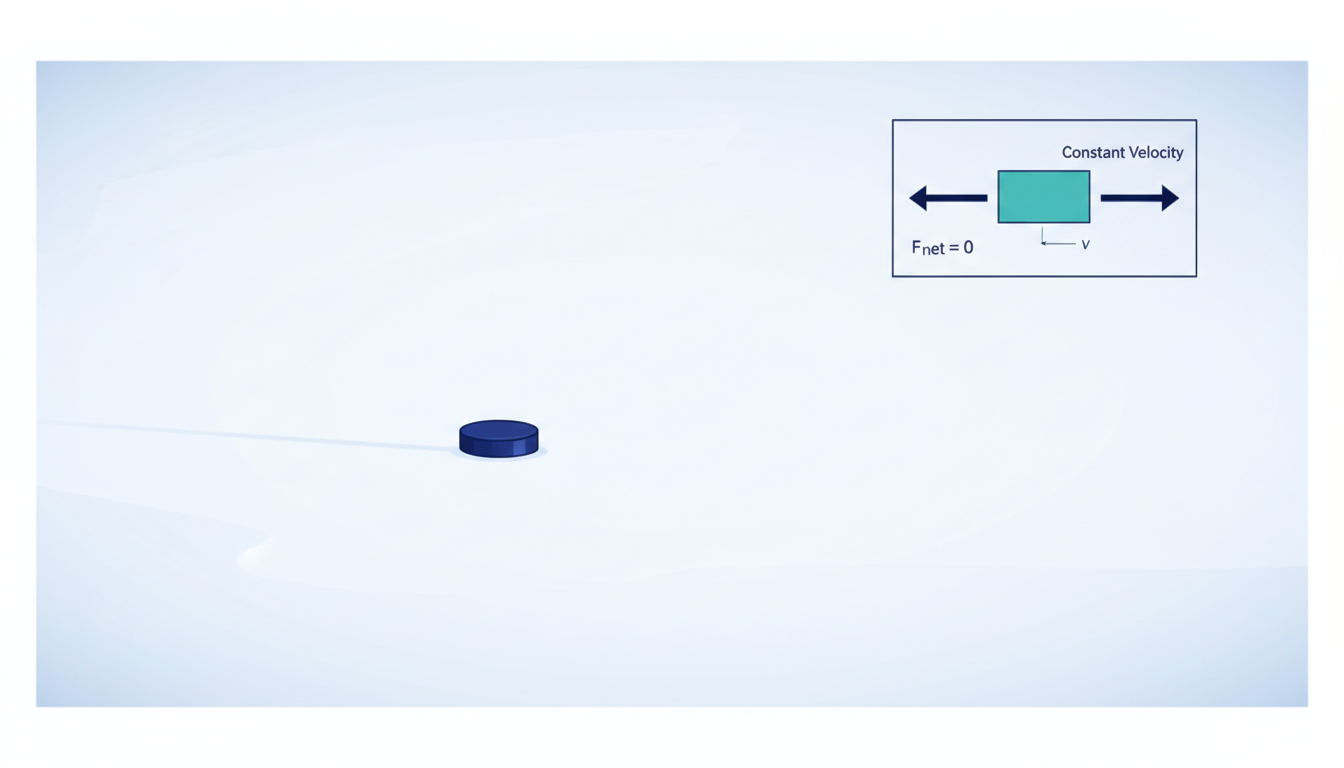

AP Physics C: Newton’s First Law
Newton’s first law says that an object remains at rest or moves with constant velocity unless acted on by a nonzero net external force. The law connects motion to the net force, not to any single force.
AP Exam Tip
Identify the interacting objects and the selected system before applying the governing law.
Quick Check: Newton’s First Law
A puck slides across nearly frictionless ice in a straight line at constant velocity. What is the net force on it?
- Forward and nonzero
- Backward and nonzero
- Zero
- Equal to its weight
Check answer
Answer: C. Constant velocity means zero acceleration, so the net force is zero. Individual forces can still act and balance.
1. The law of inertia
Inertia is an object’s resistance to a change in velocity. Mass measures inertia: for the same net force, a more massive object has a smaller acceleration. A moving object does not need a continuing net force to keep moving at constant velocity; friction often hides this fact in everyday life.
Constant velocity includes both rest and motion at steady speed in a straight line. It does not include motion along a curved path, because changing direction means changing velocity and therefore acceleration.
2. Equilibrium
An object is in translational equilibrium when the vector sum of all external forces is zero. In components, ΣFx = 0, ΣFy = 0, and, when needed, ΣFz = 0. Individual forces can be large; they simply balance as vectors.
Worked example 1: A book at rest
A 1.5 kg book rests on a level table. Its weight is mg = (1.5)(9.8) = 14.7 N downward. Since the book has no vertical acceleration, the normal force is 14.7 N upward. The net force is zero, so the book remains at rest.
Worked example 2: Constant velocity
A 10 kg cart moves right at a steady 2.0 m/s. A 12 N push acts to the right. For the cart’s velocity to remain constant, the total opposing force must be 12 N left, making ΣF = 12 − 12 = 0 N and a = 0 m/s².
3. Inertial reference frames
Newton’s first law also helps define an inertial reference frame: a frame in which an object with zero net force has constant velocity. In a vehicle that accelerates, passengers may feel as if they are pushed backward; explaining motion from that accelerating frame requires extra care. For introductory problems, use the inertial frame specified or implied by the question.
Common mistakes
- Assuming a force is required to maintain constant velocity.
- Thinking zero net force means no forces act.
- Confusing constant speed with constant velocity when direction changes.
- Using ΣF = 0 when the object is accelerating.
Practice questions
- A 4.0 kg object has a net force of zero. What is its acceleration?
- A 6.0 kg sled moves at constant velocity while a 15 N pull acts forward. What is the net opposing force?
- Can an object move while the net force is zero? Explain.
Answers
- 0 m/s².
- 15 N backward, so the forces balance.
- Yes. It can move with constant velocity.
AP exam tip
Use a free-body diagram and add force components with signs. State that equilibrium means zero acceleration, not necessarily zero velocity.
AP-Style Free-Response Question: Equilibrium and a Changing Force
Original practice question • 10 points • Suggested time: 12–15 minutes
A 4.0 kg object rests on a horizontal surface. A horizontal applied force F(t) increases from zero according to F(t) = 3t N. Static friction can reach a maximum of 8.0 N. Once the object begins sliding, kinetic friction has magnitude 6.0 N. Take right as positive.
- (2 points) Determine the time at which the object first begins to move.
- (2 points) Before it moves, describe the net horizontal force and acceleration.
- (2 points) Immediately after motion begins, write the net force and acceleration as functions of time.
- (2 points) Find the acceleration at t = 4.0 s.
- (2 points) Explain how this situation illustrates Newton’s first law and why “an object needs a net force to keep moving” is incorrect.
Reveal worked solution
(a) Motion begins when the applied force reaches maximum static friction: 3t = 8.0, so t = 8/3 s ≈ 2.67 s.
(b) Before slipping, static friction matches the applied force, so net force is zero and a = 0.
(c) Once sliding, fk = 6.0 N left. Net force is Fnet(t) = 3t − 6.0 N and a(t) = (3t − 6.0)/4.0 m/s², for the sliding phase under the stated model.
(d) At t = 4.0 s, a = (12 − 6)/4 = 1.5 m/s² right.
(e) With zero net force, an object remains at rest or continues at constant velocity. A net force is needed to change velocity, not to maintain constant velocity; friction explains why everyday moving objects slow down when the net force is not zero.
Scoring rubric (10 points)
- 2 points: threshold condition and t = 2.67 s.
- 2 points: static-friction balance and zero acceleration before motion.
- 2 points: correct net-force and acceleration functions after sliding.
- 2 points: numerical acceleration with direction and units.
- 2 points: accurate explanation of inertia and net force.
Exam skill: Distinguish the condition of static equilibrium from the force model after slipping begins.
Continue learning
Use these related lessons to reinforce this topic:
- Forces and Free-Body Diagrams — identify balanced forces.
- Newton’s Second Law — connect net force to acceleration.