
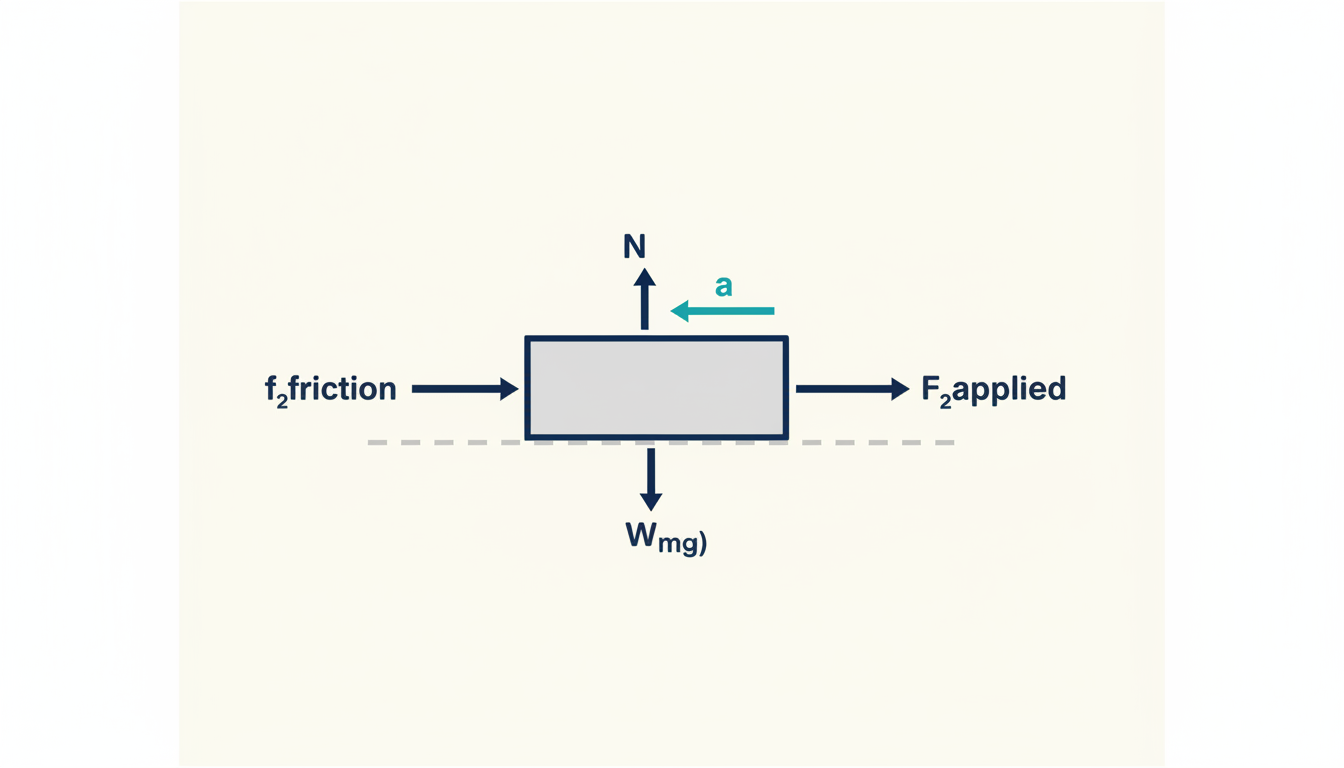

AP Physics C: Newton’s Second Law
Newton’s second law states that the net external force on an object equals its mass multiplied by its acceleration. Because force and acceleration are vectors, direction and signs matter.
AP Exam Tip
Identify the interacting objects and the selected system before applying the governing law.
Quick Check: Newton’s Second Law
The same net force acts first on a 2 kg object and then on a 4 kg object. Compared with the first acceleration, the second acceleration is:
- Twice as large
- Half as large
- Four times as large
- Unchanged
Check answer
Answer: B. From a = F/m, doubling the mass while holding net force fixed halves the acceleration.
1. Force, mass, and acceleration
Acceleration points in the direction of the net force. If the net force doubles while mass stays constant, acceleration doubles. If mass doubles while net force stays constant, acceleration halves. The SI unit of force is the newton: 1 N = 1 kg·m/s².
2. Apply the law in components
For motion in two dimensions, write ΣFx = max and ΣFy = may. A zero acceleration along one axis means the forces along that axis balance; it does not mean forces along the other axis must balance.
Worked example 1: Net horizontal force
A 4.0 kg cart is pushed with 18 N right while friction is 6.0 N left. Net force: 18 − 6.0 = 12 N right. Acceleration: a = 12/4.0 = 3.0 m/s² right.
Worked example 2: Pulling upward
A 5.0 kg bucket accelerates upward at 2.0 m/s². Let upward be positive. Tension minus weight equals ma: T − mg = ma. Thus T = m(g + a) = 5.0(9.8 + 2.0) = 59 N.
Worked example 3: Two-dimensional force
A 2.0 kg object has net force components Fx = 6.0 N and Fy = 8.0 N. Its acceleration components are ax = 3.0 m/s² and ay = 4.0 m/s². The acceleration magnitude is √(3² + 4²) = 5.0 m/s².
3. Variable forces and calculus
In calculus-based mechanics, Newton’s second law can be combined with a = dv/dt and, for constant mass, ΣF = m dv/dt. If force varies with position or time, this differential form may be more useful than a constant-acceleration equation. Always check whether mass is constant before using this form.
Common mistakes
- Using a single force instead of the net force.
- Adding perpendicular force magnitudes as ordinary numbers instead of vector components.
- Forgetting that acceleration may be negative relative to the chosen axis.
- Setting ΣF = 0 when acceleration is nonzero.
Practice questions
- A 3.0 kg object experiences a net force of 15 N. Find its acceleration.
- A 2.0 kg elevator object accelerates downward at 1.5 m/s². Find the supporting tension, taking g = 9.8 m/s².
- A net force has components (12 N, 5 N) and acts on a 2.0 kg object. Find acceleration magnitude.
Answers
- 5.0 m/s² in the direction of the net force.
- T − mg = −ma, so T = m(g − a) = 2.0(9.8 − 1.5) = 16.6 N.
- Force magnitude = 13 N; acceleration = 13/2.0 = 6.5 m/s².
AP exam tip
Show the signed force sum before dividing by mass. On free-response questions, a correct diagram and component equations can earn credit even if arithmetic slips occur later.
AP-Style Free-Response Question: A Time-Dependent Net Force
Original practice question • 10 points • Suggested time: 12–15 minutes
A particle of mass m = 2.0 kg moves along the x-axis. Its net force is F(t) = 6t N in the positive x-direction, and its initial velocity is v(0) = 1.0 m/s.
- (2 points) Use Newton’s second law to derive the acceleration as a function of time.
- (2 points) Integrate to find velocity v(t).
- (2 points) Integrate again to find position x(t), given x(0) = 0.
- (2 points) Find v and x at t = 2.0 s.
- (2 points) Explain why the acceleration is not constant and identify the calculus relationship used in each integration.
Reveal worked solution
(a) a(t) = F/m = 6t/2.0 = 3t m/s².
(b) Since a = dv/dt, v(t) = ∫3t dt = 1.5t² + C. Using v(0) = 1.0 gives v(t) = 1.0 + 1.5t² m/s.
(c) Since v = dx/dt, x(t) = ∫(1.0 + 1.5t²)dt = t + 0.5t³ + C. Using x(0) = 0 gives x(t) = t + 0.5t³ m.
(d) At t = 2.0 s, v = 1.0 + 1.5(4) = 7.0 m/s; x = 2.0 + 0.5(8) = 6.0 m.
(e) The net force increases with time, so a = F/m also increases with time. The integrations use a = dv/dt and v = dx/dt.
Scoring rubric (10 points)
- 2 points: a(t) = 3t with units.
- 2 points: integration and correct initial condition for v(t).
- 2 points: integration and correct initial condition for x(t).
- 2 points: correct numerical v and x at 2.0 s.
- 2 points: explanation of variable acceleration and derivative relationships.
Exam skill: Integrate with respect to the correct variable and use the initial conditions to determine constants.
Continue learning
Use these related lessons to reinforce this topic:
- Forces and Free-Body Diagrams — set up net-force equations.
- Systems and Center of Mass — apply force laws to a system.