

AP Physics C: Resistive Forces
Resistive forces oppose relative motion through a medium or between surfaces. Unlike idealized constant forces, drag often depends on speed and may change as an object accelerates.
AP Exam Tip
Choose a sign convention and identify the physical source of each force before substituting values.
1. Common drag models
At relatively low speeds in some flow regimes, drag may be approximated as linear: Fd = −bv. At higher speeds in many everyday situations, quadratic drag is often modeled as Fd = −cv² along the direction opposite motion. The constants b and c depend on the object and fluid; the correct model should be stated or supplied.
2. Falling with drag
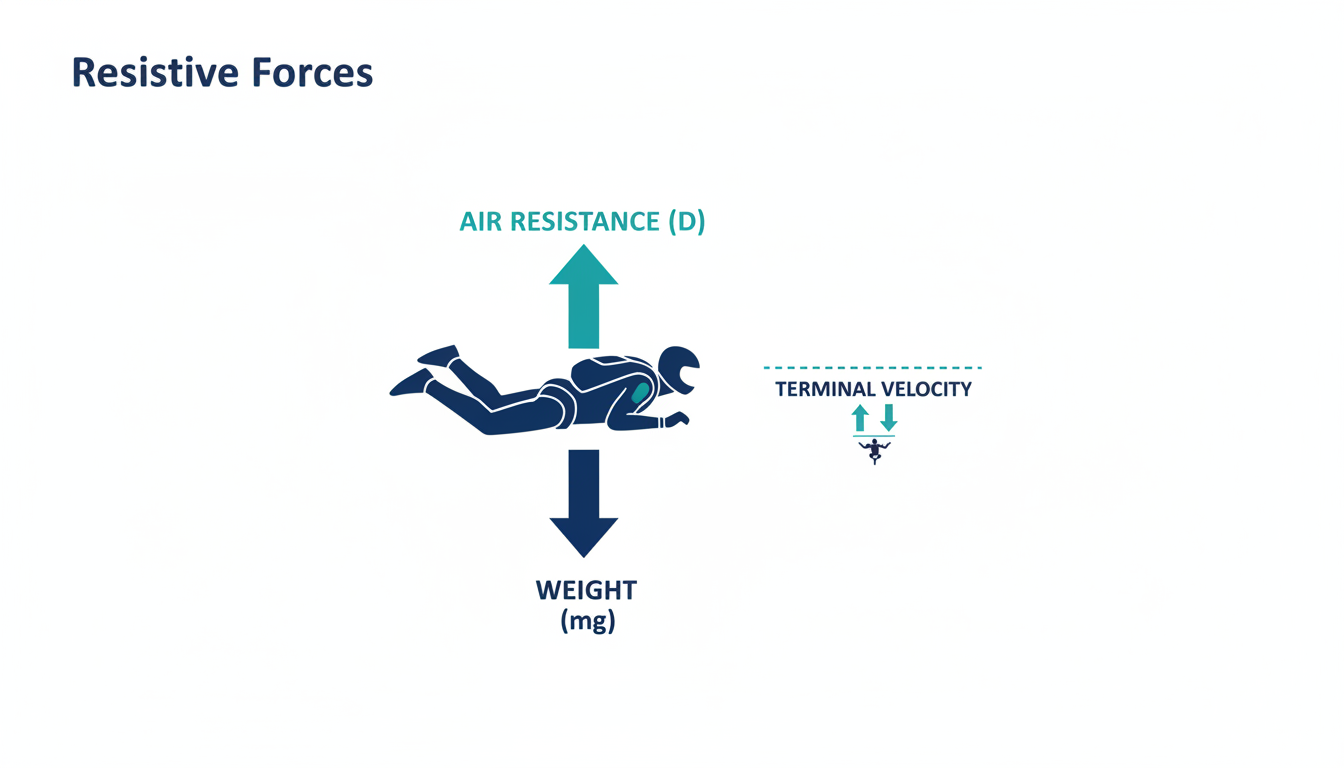
Take downward as positive for a falling object. Then mg − D(v) = ma. As speed increases, drag generally increases, so acceleration decreases. Terminal speed is reached when D(vt) = mg.
Worked example 1: Linear drag at terminal speed
A 0.20 kg object falls in a medium modeled by D = bv, where b = 0.40 kg/s. At terminal speed, mg = bvt, so vt = mg/b = (0.20)(9.8)/0.40 = 4.9 m/s downward.
Worked example 2: Quadratic drag
If D = cv², terminal speed satisfies mg = cvt². Thus vt = √(mg/c). For m = 0.50 kg and c = 0.10 kg/m, vt = √(4.9/0.10) = 7.0 m/s.
3. Terminal velocity is not zero velocity
At terminal velocity, the object is still moving, but its velocity is constant. The net force and acceleration are zero. This is an example of Newton’s first law, not a state where all forces disappear.
4. Differential-equation connection
With linear drag and downward-positive motion, m dv/dt = mg − bv. The terminal speed is mg/b. The velocity approaches terminal speed over time; it does not jump instantly to that value. AP Physics C may ask you to interpret this differential equation or its qualitative behavior.
Common mistakes
- Drawing drag in the same direction as velocity.
- Assuming drag is always proportional to v²; the model depends on conditions.
- Setting the net force to zero before terminal speed is reached.
- Confusing terminal speed with zero speed.
Practice questions
- A 1.0 kg object falls with linear drag D = 2.0v. Find terminal speed.
- At terminal speed, what is the acceleration?
- If quadratic drag coefficient c increases while mass stays constant, what happens to terminal speed?
Answers
- vt = mg/b = 9.8/2.0 = 4.9 m/s.
- Zero.
- It decreases, since vt = √(mg/c).
AP exam tip
Write a sign convention first. Then express drag with the correct sign and use the terminal condition only when velocity is constant.
Quick Check: Resistive Forces
An object falls downward and has reached terminal velocity. Which statement is correct?
- Its velocity is zero.
- Its acceleration is zero and drag balances weight.
- Drag is zero.
- Its acceleration is g downward.
Check answer and explanation
Answer: B. Terminal velocity is constant velocity, not zero velocity. The net force is zero because drag balances weight.
AP-Style Free-Response Question: Falling with Linear Drag
Original practice question • 10 points • Suggested time: 12–15 minutes
A small object of mass m is released from rest and falls vertically. Take downward as positive and model drag as D = bv, where b is positive. The equation of motion is m dv/dt = mg − bv.
- (2 points) Derive terminal speed.
- (2 points) Rearrange the equation as a differential equation for v(t).
- (2 points) Separate variables and integrate to show v(t) = (mg/b)(1 − e−bt/m) for v(0) = 0.
- (2 points) Determine acceleration as a function of time and describe its long-time limit.
- (2 points) For m = 0.20 kg and b = 0.40 kg/s, calculate terminal speed and time constant m/b.
Reveal worked solution
(a) At terminal speed dv/dt = 0, so mg − bvt = 0 and vt = mg/b.
(b) Divide by m: dv/dt = g − (b/m)v.
(c) Separate variables: dv/(g − bv/m) = dt. Integrating with v(0) = 0 gives v(t) = (mg/b)(1 − e−bt/m).
(d) Differentiate: a(t) = g e−bt/m. Initially a = g; as t becomes large, a → 0 while v approaches terminal speed.
(e) vt = (0.20)(9.8)/0.40 = 4.9 m/s downward. Time constant τ = m/b = 0.20/0.40 = 0.50 s.
Scoring rubric (10 points)
- 2 points: terminal condition and terminal speed.
- 2 points: correct differential equation.
- 2 points: valid separation/integration and initial condition.
- 2 points: acceleration expression and limit.
- 2 points: correct terminal speed and time constant with units.
Exam skill: Apply the terminal condition only when acceleration is zero, and interpret the solution’s limiting behavior.
Continue Learning
- Newton’s Second Law — set up the differential equation.
- Gravitational Force — compare gravity with other forces.