
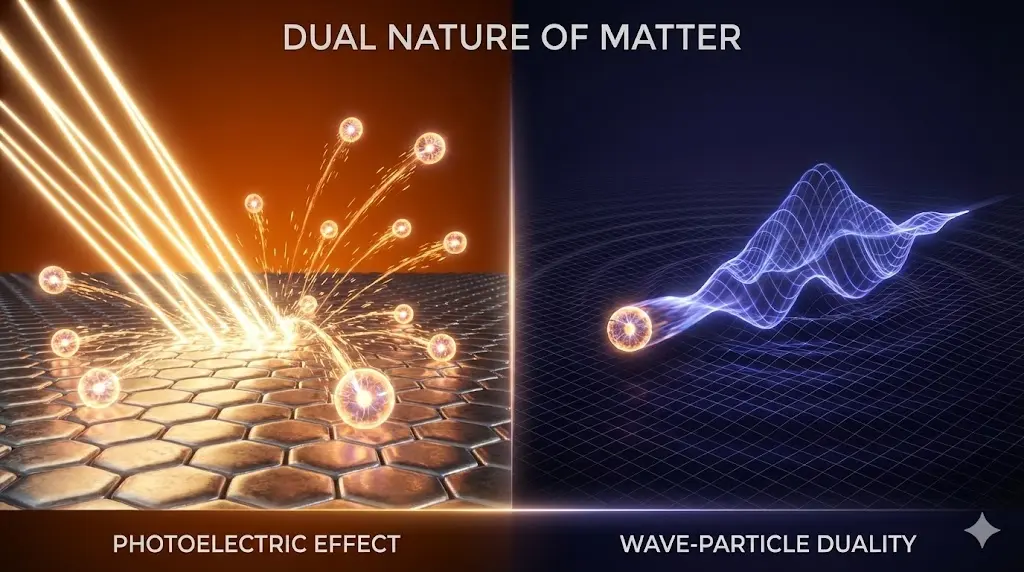
Dual Nature of Radiation and Matter
NCERT Chapter 11 • Photoelectric Effect & de Broglie Wavelength
1. Electron Emission
Free electrons in metals require minimum energy to escape the surface. This energy can be supplied via:
- Thermionic Emission: By heating the metal (e.g., filament in vacuum tubes).
- Field Emission: By applying a strong electric field (~10⁸ V/m).
- Photoelectric Emission: By irradiating with light of suitable frequency.
2. Photoelectric Effect
Discovered by Hertz (1887) and studied in detail by Hallwachs & Lenard.

- Work Function (
 ): Minimum energy to eject an electron (unit: eV).
 - Threshold Frequency (): Minimum frequency for photo-emission: .
- Photoelectrons: Electrons emitted due to light incidence.
 ): Minimum energy to eject an electron (unit: eV).
3. Experimental Study
Key observations from Lenard’s experiments:
- Photocurrent ∝ Intensity (for ).
- Stopping potential independent of intensity.
- increases linearly with frequency .
- No emission if (even for high intensity).
- Emission is instantaneous (< 10⁻⁹ s).
 (even for high intensity).
A. Effect of Intensity

 Intensity (if
  ).
).B. Effect of Potential & Frequency

 ) to stop the electrons.
4. Why Wave Theory Failed
- KE should increase with intensity (but it depends only on ).
- No threshold frequency should exist (but is observed).
- Time lag for emission at low intensity (but emission is instantaneous).
5. Einstein’s Photoelectric Equation
Albert Einstein (1905) explained the effect using light quanta (photons). Awarded Nobel Prize in 1921.

 .
.Energy Conservation:
Photon energy = Work function + Max KE of electron.


Since
 :
:
For
 :
:  →
→  vs
vs  Graph:
From  , the slope is
  . Millikan verified this experimentally.

The graph of vs is plotted for a single photosensitive material.
Different metals give different parallel lines (same slope  , different threshold frequencies
  ).
The x-intercept gives , which is unique to each metal.
).
The x-intercept gives , which is unique to each metal.
From Einstein’s equation:
⇒
- Slope = → used to experimentally determine Planck’s constant.
- X-intercept = threshold frequency .
- Y-intercept = → depends on work function of the material.
- All metals give parallel lines (same slope, different intercepts).
 .
. → depends on work function of the material.
6. Particle Nature of Light: Photons
- Energy:
- Momentum:
- Speed: (in vacuum)
- Electrically neutral (not deflected by E/B fields)
- In collisions: Energy & momentum conserved, but photon number may change (absorption/emission).


 (in vacuum)
7. Wave Nature of Matter
Louis de Broglie (1924) proposed that moving particles exhibit wave-like behavior.
 (from
(from  and ).
de Broglie hypothesized this applies to all matter.
 and velocity
  :
:Momentum


 :
: →
→ 

8. Davisson-Germer Experiment
First experimental proof of matter waves (1927).

- Electron beam accelerated by voltage directed at nickel crystal.
- Scattered electrons detected at various angles.
- Peak intensity observed at specific angle (e.g., 50° for 54V).
- Bragg’s law applied: .
- Calculated matched de Broglie’s formula.
 .
. matched de Broglie’s formula.
Solve numericals on Work Function and de Broglie Wavelength: Chapter 11 Important Questions →