
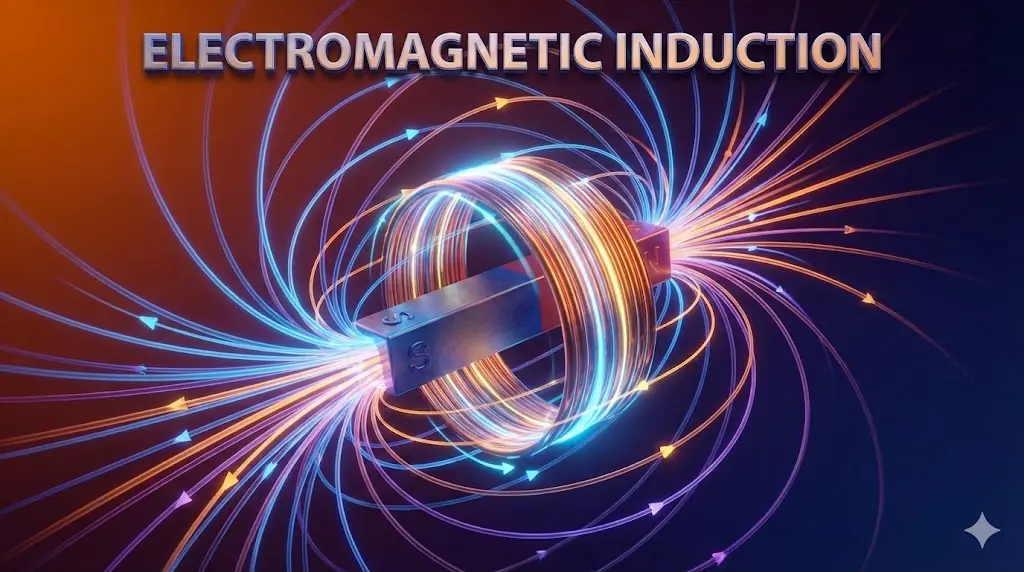
Electromagnetic Induction
NCERT Chapter 6 • Faraday’s Law, Lenz’s Law & Inductance
1. Magnetic Flux
Magnetic flux is a measure of the number of magnetic field lines passing through a surface. It is analogous to electric flux.

2. Faraday’s Law of Induction
Michael Faraday discovered that a changing magnetic flux through a circuit induces an electromotive force (EMF).

 (for N turns)
Lenz’s Law
The polarity of the induced EMF is such that it tends to produce a current which opposes the change in magnetic flux that produced it.

Lenz’s Law is a consequence of the law of conservation of energy. Mechanical work done in moving the magnet against the repulsive force is converted into electrical energy (induced current).
3. Motional Electromotive Force
When a conductor moves in a magnetic field, the Lorentz force on charge carriers causes charge separation, creating an EMF.

Consider a loop with a movable arm PQ of length
 at position
  .
.Area
 . Flux
  .
.
As the rod moves with speed
 (since x decreases), the flux changes.
 .
.
Using Faraday’s Law:
 .
. .
.
4. Eddy Currents
When bulk pieces of conductors are subjected to changing magnetic flux, induced currents flow in closed loops within the conductor, resembling eddies in water.

- Magnetic Braking in trains.
- Induction Furnace (Heat generated by eddy currents melts metal).
- Electric Power Meters.
5. Inductance
Electric current produces a magnetic field. If the current changes, the field changes, inducing an EMF. This phenomenon is Inductance.
A. Mutual Inductance
The phenomenon where a changing current in one coil induces an EMF in a neighboring coil.

Current
 in outer solenoid
  produces field
  .
.
Flux through one turn of
 is
is  . Total flux
  .
. .
.
Since
 , we have:
 .
.
B. Self Inductance
The phenomenon where a changing current in a coil induces a “back EMF” in the same coil.

Consider a long solenoid of length
and area  , with
  turns per unit length.
Current
 produces a field inside:
  .
.
The flux through one turn is
 .
.Total number of turns
 .
.
Total flux
 .
. .
.
By definition,
 . Comparing this with the result above:
 .
.


6. AC Generator
A device that converts mechanical energy into electrical energy based on electromagnetic induction.

 changes, changing the flux.
Flux
 .
.Induced EMF
 .
. .
.
This produces an alternating voltage with maximum value  .
.
Ready to test your knowledge? Try 10 solved numericals on EMI: Click here →
Also practice the Question Bank