
Electromagnetic Waves
NCERT Chapter 8 • Displacement Current & The EM Spectrum
1. Displacement Current
Maxwell found an inconsistency in Ampere’s Circuital Law when applied to a capacitor charging circuit. To resolve this, he introduced the concept of **Displacement Current**.
For a deep dive into how this current “flows” through the gap between capacitor plates, read our detailed guide: What is Displacement Current? (Concepts Explained).

Consider a parallel plate capacitor with area
 and charge
  .
.The electric field between plates is
 .
.Flux
 .
.
Differentiating with respect to time:
 .
.
We know
 (the conduction current).
Rearranging the equation:
 .
.
This missing current term is called Displacement Current (
 ).
). .
.
The generalized Ampere’s Law uses the sum of conduction and displacement currents:
 .
.
2. Maxwell’s Equations
Maxwell unified electricity and magnetism into a set of four equations. These are the fundamental laws of electromagnetism.

 (No magnetic monopoles)


3. Nature of Electromagnetic Waves
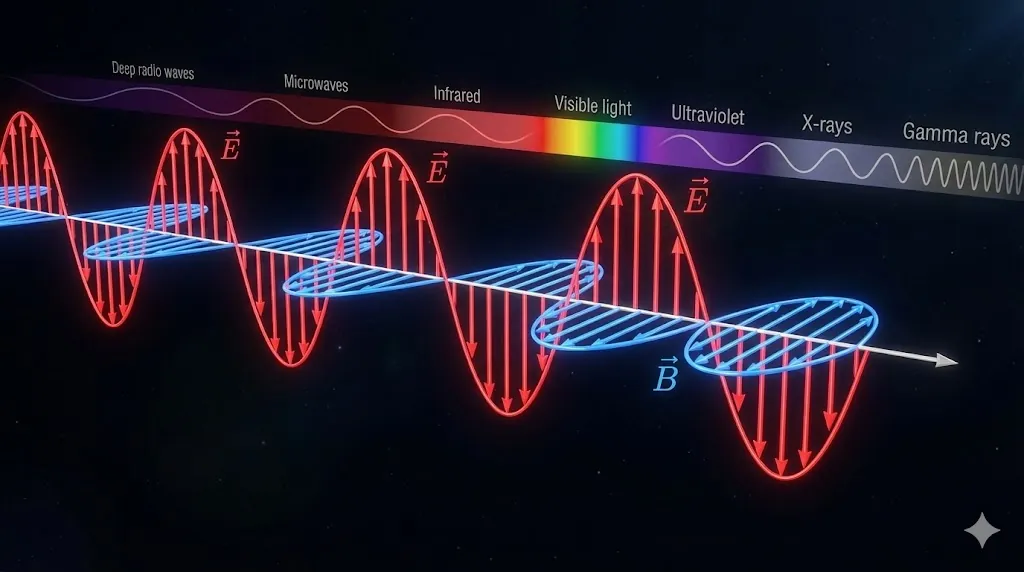
Electromagnetic waves are self-sustaining oscillations of electric and magnetic fields in free space. They are transverse in nature.

 and
and  oscillate in phase, perpendicular to each other and the direction of wave motion.

The energy in EM waves is shared equally between electric and magnetic fields.

4. The Electromagnetic Spectrum
EM waves are classified by frequency or wavelength. The order from lowest to highest frequency is:

| Type | Wavelength Range | Production & Application |
|---|---|---|
| Radio Waves | > 0.1 m | Rapid acceleration of charges in conducting wires. Used in Radio/TV communication. |
| Microwaves | 0.1 m to 1 mm | Klystron/Magnetron valves. Used in Radar, Microwave ovens. |
| Infrared (IR) | 1 mm to 700 nm | Hot bodies, molecular vibrations. Used in Remotes, Physical therapy. |
| Visible Light | 700 nm to 400 nm | Electrons in atoms. It stimulates the human eye. |
| Ultraviolet (UV) | 400 nm to 1 nm | Inner shell electrons, Sun. Used in Water purification, LASIK eye surgery. |
| X-rays | 1 nm to  nm nm |
Bombarding metal target with high energy electrons. Used in Medical imaging. |
| Gamma Rays | < nm |
Radioactive decay of nuclei. Used in Cancer treatment. |