
Laws of Motion
NCERT Chapter 4 • Newton’s Laws, Friction & Circular Dynamics
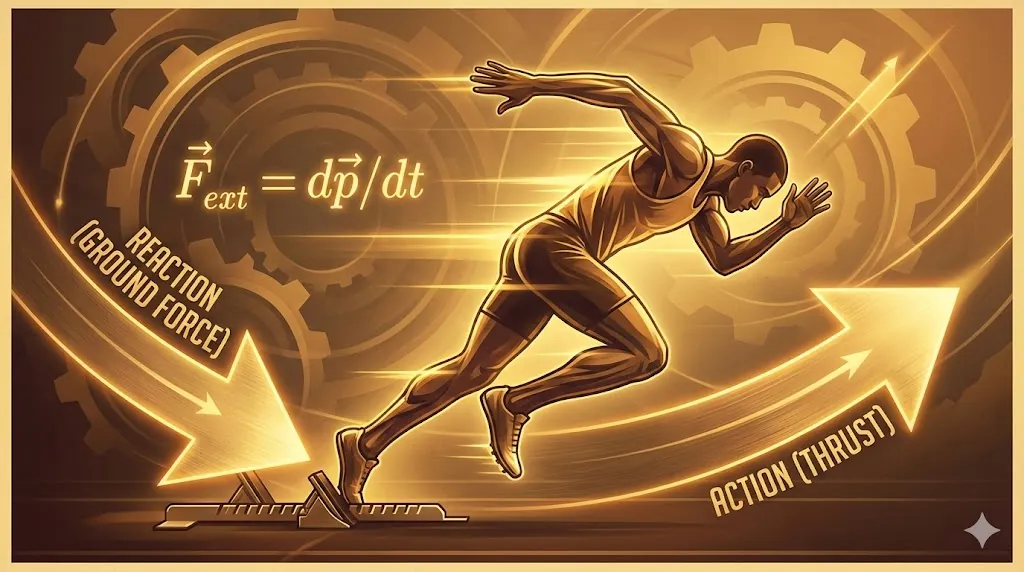
1. Aristotelian vs. Galilean Law
Historically, Aristotle believed that an external force is required to keep a body in motion. This is the Aristotelian Fallacy.
Galileo corrected this by stating the Law of Inertia: If the net external force is zero, a body at rest continues to remain at rest and a body in motion continues to move with a uniform velocity.
2. Newton’s First Law of Motion
Every body continues to be in its state of rest or of uniform motion in a straight line unless compelled by some external force to act otherwise.
The resistance of a body to change its state of motion. Mass is the measure of inertia.
Types of Inertia
Inertia manifests in three observable forms:
- Inertia of Rest: A body resists change from rest.
Example: Dust falls off a carpet when beaten; passengers jerk backward when a bus starts suddenly. - Inertia of Motion: A moving body resists change in its state of motion.
Example: Passengers lurch forward when a moving bus stops abruptly. - Inertia of Direction: A body resists change in its direction of motion.
Example: Mud flies off tangentially from a rotating wheel; a dog chasing a hare must curve gradually due to inertia of direction.
3. Newton’s Second Law of Motion
Before stating the law, we define a key physical quantity: linear momentum.
Linear Momentum
Linear momentum ( ) of a particle is defined as the product of its mass (
 ) and velocity (
 ):
):

It is a vector quantity with SI unit kg·m/s. While mass is scalar, velocity is vector—so momentum inherits direction from velocity.
The rate of change of momentum of a body is directly proportional to the applied force and takes place in the direction in which the force acts.


This is the fundamental equation of classical mechanics. If mass is constant,  .
.
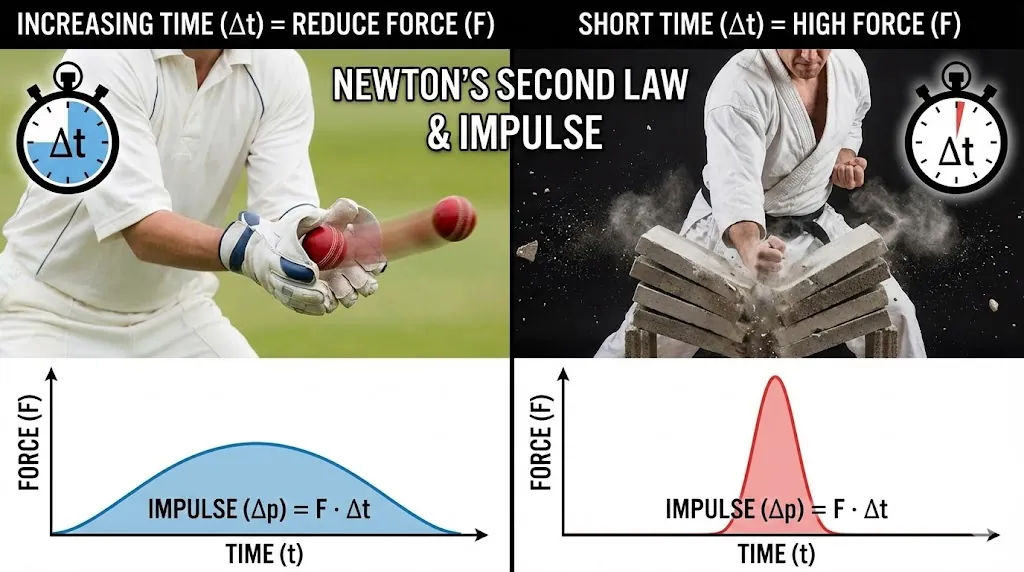
 ): Increasing time (
 ) reduces the impact Force (
 ).
).Impulse
Impulse is the change in momentum produced by a large force acting for a short time.

Show Answer
Impulse = Change in Momentum =

 N·s. Magnitude is 4.8 N·s.
4. Newton’s Third Law of Motion
To every action, there is always an equal and opposite reaction.
- Forces always occur in pairs (
 ).
). - Action and Reaction act on different bodies, so they do not cancel each other out.
 ).
).
Show Answer
Action and reaction act on different bodies. The horse pushes the ground backward (Action), and the ground pushes the horse forward (Reaction). If this forward friction exceeds the backward tension from the cart, the horse-cart system accelerates forward.5. Conservation of Momentum
If the net external force on an isolated system is zero, the total momentum of the system remains conserved.


 and bullet of mass . Initially, both are at rest (
 ).
and gun recoils with velocity
).
and gun recoils with velocity  .
.


Show Answer

 m/s. Recoil speed is 1.6 cm/s.
System of Particles: Internal vs External Forces
A system is a collection of particles. Forces between particles within the system are called internal forces; they always occur in action-reaction pairs and cancel out in total momentum calculations.
Forces exerted by agents outside the system are external forces. Only external forces can change the total momentum of the system.
Example: In a two-cart explosion on a frictionless track, the spring force between them is internal. Total momentum remains zero even though individual carts move apart.
6. Equilibrium of a Particle
A particle is in equilibrium when the net external force acting on it is zero. It is either at rest or moving with uniform velocity.
- For two forces:
- For three concurrent forces:


These forces can be represented as sides of a closed triangle (vector addition).
• Static equilibrium: Body at rest (e.g., book on a table).
• Dynamic equilibrium: Body moving with constant velocity (e.g., skydiver at terminal velocity, or block sliding at uniform speed on a rough surface).
In both cases, net external force = 0.
 m/s²)
m/s²)Show Answer
Vertical tension N.
N.Horizontal:
 , Vertical:

7. Common Forces in Mechanics
All contact forces arise from electromagnetic interactions at microscopic level:
- Normal Reaction (): Perpendicular to surface of contact.
- Tension (): Force transmitted through string/rope (assumed massless → constant tension).
- Spring Force: (Hooke’s Law; = force constant).
- Buoyant Force: Upward force = weight of displaced fluid.
- Viscous Drag / Air Resistance: Opposes motion in fluids.
 ): Perpendicular to surface of contact.
 ): Force transmitted through string/rope (assumed massless → constant tension).
 (Hooke’s Law;
  = force constant).
8. Friction
Friction opposes relative motion (or its tendency) between surfaces in contact.
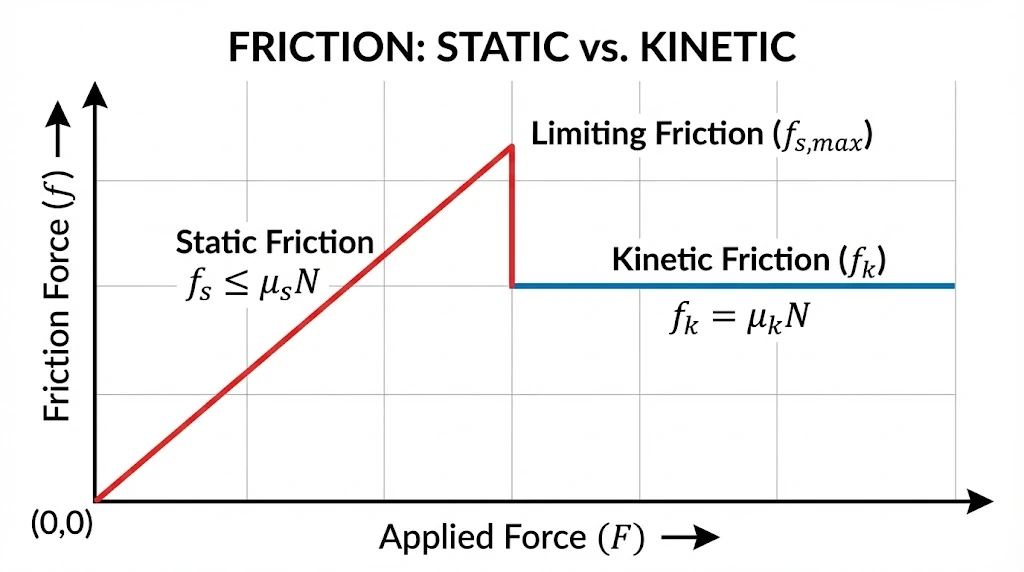
 ) is reached.
- Static Friction (): Self-adjusting,
- Kinetic Friction (): Constant, , where
- Rolling Friction: Much smaller than sliding friction; enables wheels to roll efficiently.
 ): Self-adjusting,
 ): Constant,
  , where
Friction is essential for walking, driving, and holding objects. Lubricants, ball bearings, and air cushions reduce unwanted friction.
Factors Affecting Friction
- Independent of apparent area of contact.
- Depends on nature and smoothness of surfaces.
- Proportional to normal reaction ().
Advantages & Disadvantages of Friction
| Advantages | Disadvantages |
|---|---|
| Walking, gripping, writing | Wear and tear of machine parts |
| Braking in vehicles | Energy loss as heat |
| Nails holding wood | Reduced efficiency |
Methods to Reduce/Increase Friction
- Reduce: Lubrication, polishing, ball bearings, streamlining.
- Increase: Roughening surfaces (e.g., tyre treads, sand on icy roads).
Limiting Friction & Angle of Repose
The maximum value of static friction is called limiting friction:

When a block just begins to slide down an inclined plane, the angle of inclination ( ) is called the angle of repose. At this point:

This principle is used in designing conveyor belts and sand piles.
 ). What is the friction force if a horizontal force of 10 N is applied? (
 m/s²)
m/s²)Show Answer
Limiting Friction N.
N.Since Applied Force (10 N) < Limiting Friction, block doesn’t move.
Static friction = Applied Force = 10 N.
9. Circular Motion
For a body to move in a circle of radius  with speed
  , a net force directed towards the center is required. This is the Centripetal Force.

Motion of a Car on a Curved Road
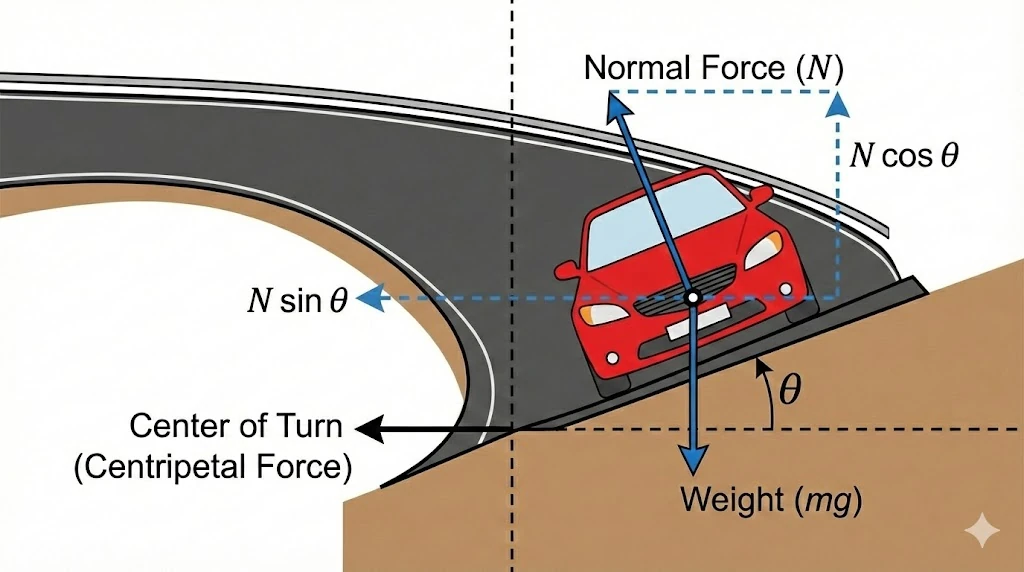
1. Level Road: Centripetal force is provided solely by friction.
Max speed:  .
.
2. Banked Road (Angle ): Normal force contributes to centripetal force.
Optimum speed (no friction):  .
.
Max speed (with friction):
![\[v_{\text{max}} = \sqrt{Rg \cdot \dfrac{\mu_s + \tan \theta}{1 - \mu_s \tan \theta}}\]](https://i0.wp.com/physicsqanda.com/wp-content/ql-cache/quicklatex.com-49fb4c2600baca31ac1d461be502197b_l3.png?resize=205%2C54&ssl=1 "Rendered by QuickLaTeX.com")
Vertical Circular Motion (JEE Insight)
When a body (e.g., a stone tied to a string) moves in a vertical circle, tension varies due to gravity:
- At the bottom:
- At the top:


For the body to complete the loop, tension at the top must be ≥ 0. This gives the minimum speed at the top:

Corresponding minimum speed at the bottom (using energy conservation):  .
.
 , find max safe speed. (
 ,
,  )
)Show Answer
 m/s.
m/s.
10. Solving Problems in Mechanics
Follow these steps systematically:
- Draw a clear diagram of the system.
- Select a system (single object or group).
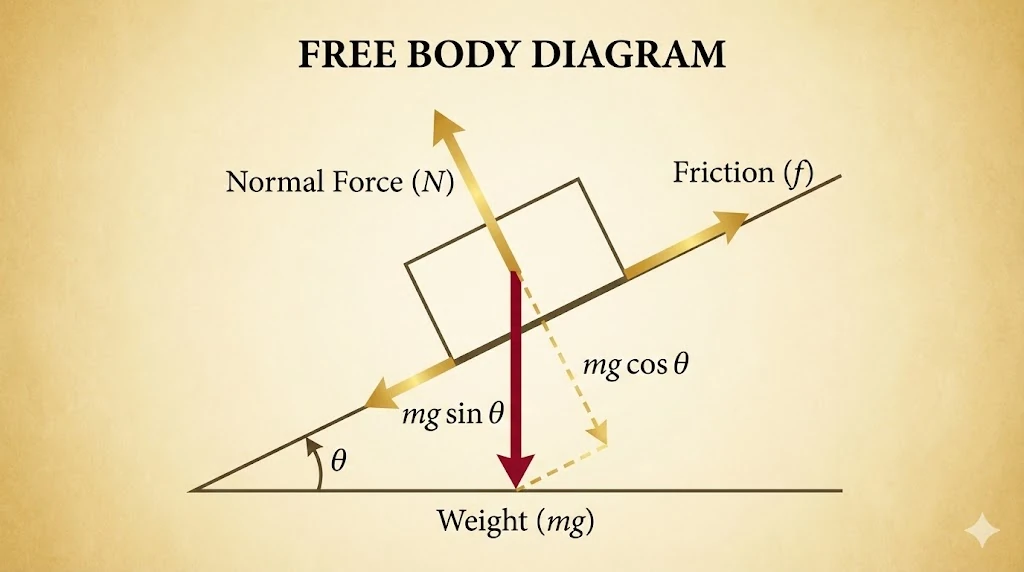
- Draw a Free-Body Diagram (FBD) showing all external forces on the system.
- Apply Newton’s Second Law () component-wise.
- Use constraints (e.g., inextensible string → same acceleration).
- Apply Newton’s Third Law when switching systems.
 ) component-wise.
Only include forces on the system, not forces by the system. Internal forces cancel in multi-body systems.
In a non-inertial frame (e.g., accelerating car), Newton’s laws appear violated unless we introduce a pseudo force  .
.
Example: When a car accelerates forward, you feel “pushed back” — this is the effect of a backward pseudo force in the car’s frame.