
Light – Reflection & Refraction
NCERT Chapter 9 • Mirrors, Lenses, and Optical Laws

Light travels in straight lines. This fundamental property leads to phenomena like shadows, reflection, and refraction. In this chapter, we explore how light behaves when it strikes mirrors or passes through transparent media like glass and water.
1. Reflection of Light
Reflection is the bouncing back of light when it strikes a polished surface. It follows two specific laws:
- First Law: The angle of incidence equals the angle of reflection (
 ).
). - Second Law: The incident ray, the normal, and the reflected ray all lie in the same plane.
 ).
).Spherical Mirrors
Mirrors whose reflecting surfaces are spherical are called spherical mirrors.
- Concave Mirror: Reflecting surface curved inwards. It converges light.
- Convex Mirror: Reflecting surface curved outwards. It diverges light.
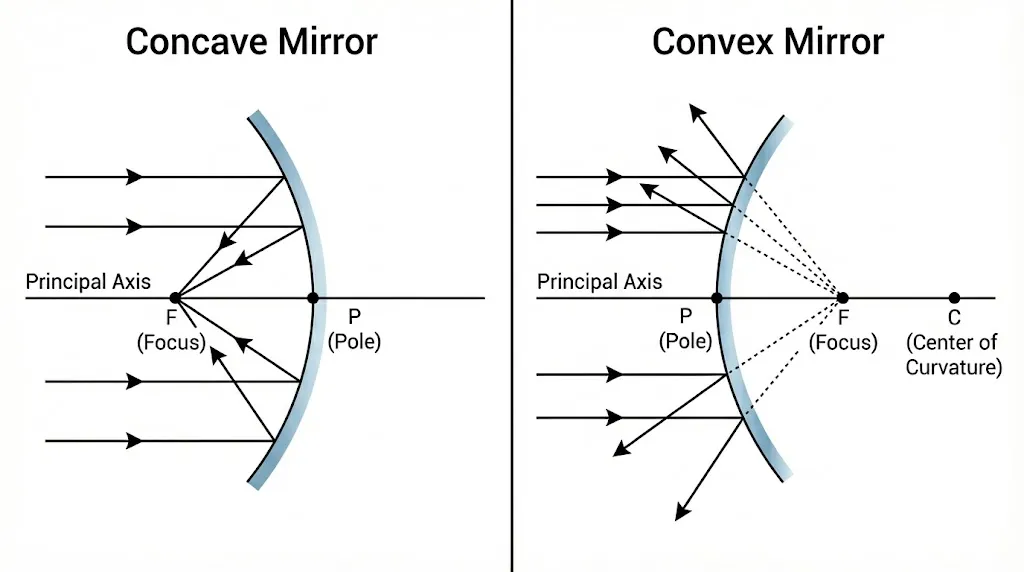
The distance between the Pole (P) and the Principal Focus (F) is the Focal Length (f). For small apertures, the radius of curvature  is twice the focal length:
 .
.
Image Formation by Concave Mirror
Concave mirrors can form real or virtual images depending on the object’s position.
| Object Position | Image Position | Nature of Image |
|---|---|---|
| At Infinity | At Focus F | Real, Inverted, Point-sized |
| Beyond C | Between F and C | Real, Inverted, Diminished |
| At C | At C | Real, Inverted, Same Size |
| Between C and F | Beyond C | Real, Inverted, Enlarged |
| Between P and F | Behind Mirror | Virtual, Erect, Enlarged |
Image Formation by Convex Mirror
Convex mirrors always form virtual, erect, and diminished images regardless of object position.
| Object Position | Image Position | Nature of Image |
|---|---|---|
| At Infinity | At Focus F (behind mirror) | Virtual, Erect, Point-sized |
| Anywhere in front | Between P and F (behind mirror) | Virtual, Erect, Diminished |
- Concave: Shaving mirrors, headlights, solar furnaces.
- Convex: Rear-view mirrors in vehicles (wider field of view).
.Given
 .
.So,
 .
.
(2) They have a wider field of view because they are curved outwards, allowing the driver to see more traffic behind them.
2. Mirror Formula and Magnification
To solve numerical problems, we use the New Cartesian Sign Convention. The pole (P) is the origin. Distances measured in the direction of incident light are positive; distances against it are negative.
Mirror Formula

Where:
- = Object distance (always negative)
- = Image distance
- = Focal length (Negative for Concave, Positive for Convex)
 = Object distance (always negative)
 = Image distance
 = Focal length (Negative for Concave, Positive for Convex)
Magnification (m)
Magnification determines how much larger or smaller the image is compared to the object.
Magnification

Note: If  is negative, the image is Real and Inverted. If is positive, the image is Virtual and Erect.
 .
.Given
 (convex mirror → positive R),
 .
.
 (real image → negative magnification),
  .
.Using
 :
: .
.The image is 30 cm in front of the mirror (real).
3. Refraction of Light
Refraction is the bending of light when it passes from one transparent medium to another due to a change in its speed.
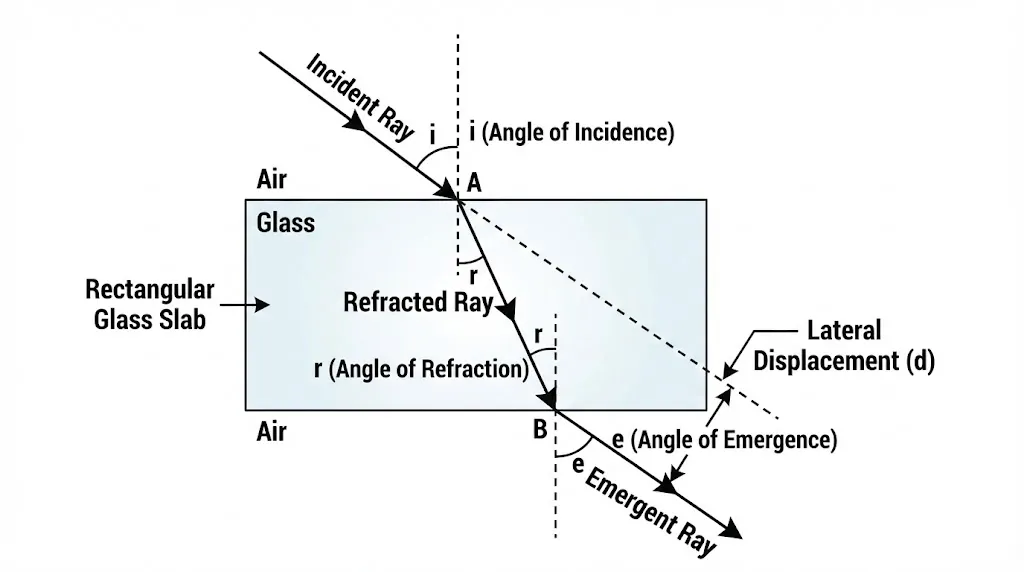
Refraction through a Glass Slab
When light passes through a rectangular glass slab, it bends twice. The emergent ray is parallel to the incident ray but laterally displaced.
Laws of Refraction
- The incident ray, refracted ray, and normal lie in the same plane.
- Snell’s Law: The ratio of sine of angle of incidence to sine of angle of refraction is constant.

4. Refractive Index
The refractive index ( ) represents the speed of light in medium 1 divided by the speed of light in medium 2.
- Absolute Refractive Index (): Speed of light in air (c) / Speed in medium (v).
 ): Speed of light in air (c) / Speed in medium (v).
Reason: Water is optically denser than air. When light travels from a rarer medium (air) to a denser medium (water), its speed decreases, causing it to bend towards the normal.
 .
. ,
,  .
.Formula:

 .
.
Highest Optical Density: Diamond (
 ).
).Lowest Optical Density: Air (
 ).
).
Since speed
 , speed is inversely proportional to refractive index.
Light travels fastest in Water because it has the lowest refractive index among the three.
 times the speed of light in vacuum. (It effectively indicates that light travels very slowly in diamond compared to vacuum).
5. Spherical Lenses
A transparent material bound by at least one spherical surface is a lens.
- Convex Lens (Converging): Thicker at the middle. Converges light to a focus.
- Concave Lens (Diverging): Thicker at the edges. Diverges light.

6. Lens Formula, Magnification & Power
Similar to mirrors, lenses have a formula relating object distance, image distance, and focal length.
Lens Formula: 
Magnification: 
Caution: Notice the negative sign in the lens formula and the positive sign in the magnification formula (opposite of mirrors).
Power of a Lens (P)
Power is the degree of convergence or divergence. It is the reciprocal of focal length.

Unit: Dioptre (D). Focal length must be in meters.
Convex lens has Positive Power (+D). Concave lens has Negative Power (-D).
When lenses are in contact, total power is additive:

 ).
).
 . Image size = Object size means
  (Real/Inverted).
Since
 .
.Using lens formula:
 .
.So
 .
.Power
 .
.
 (concave lens → negative).
Power
 .
.
7. Chapter Exercises
Practice these NCERT exercise questions to master the chapter:
(a) Water (b) Glass (c) Plastic (d) Clay
(a) Between F and C
(b) At C
(c) Beyond C
(d) Between P and F
(a) At F
(b) At 2F
(c) At infinity
(d) Between O and F
(a) both concave.
(b) both convex.
(c) mirror concave, lens convex.
(d) mirror convex, lens concave.
(a) only plane.
(b) only concave.
(c) only convex.
(d) either plane or convex.
(a) Convex lens, f = 50 cm
(b) Concave lens, f = 50 cm
(c) Convex lens, f = 5 cm
(d) Concave lens, f = 5 cm
Image is virtual, erect, and enlarged.
(a) Headlights of a car.
(b) Side/rear-view mirror of a vehicle.
(c) Solar furnace.
(b) Convex mirror — wider field of view, erect image.
(c) Concave mirror — concentrates sunlight to produce heat.
 .
.Lens formula:
 .
.Magnification:
 .
.Image height:
 .
.Image is real, inverted, diminished, 16.67 cm on the other side.
 (virtual image).
Lens formula:
 .
.
 .
.Mirror formula:
 .
.Image is virtual, erect, and diminished, 6 cm behind the mirror.
 .
.Mirror formula:
 .
.Magnification:
 .
.Image height:
 .
.Image is virtual, erect, diminished.
 .
.Mirror formula:
 .
.Magnification:
 .
.Image height:
 .
.Screen at 54 cm in front; image is real, inverted, enlarged.
 .
.It is a concave (diverging) lens.
 .
.It is a convex (converging) lens — used for hypermetropia.