
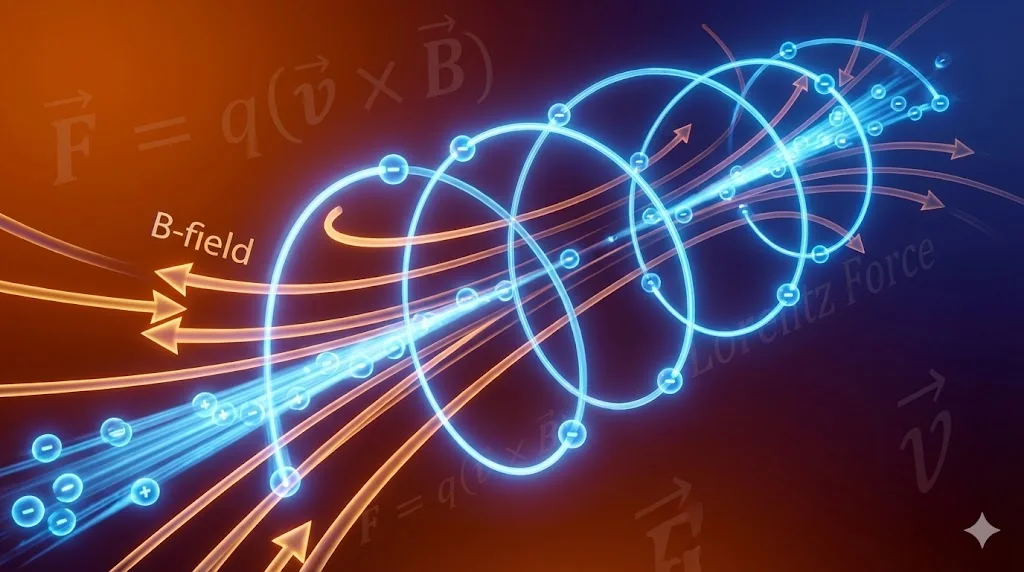
Moving Charges & Magnetism
NCERT Chapter 4 • Full Notes, Derivations & Diagrams
1. Magnetic Force (Lorentz Force)
Oersted discovered that moving charges or currents produce a magnetic field. The force on a charge  moving with velocity
  in a magnetic field
  and electric field
  is given by the Lorentz Force.
![\vec{F} = q[\vec{E} + (\vec{v} \times \vec{B})]](https://i0.wp.com/physicsqanda.com/wp-content/ql-cache/quicklatex.com-63e0d3aba5ffc752f1932505058e6b46_l3.png?resize=149%2C22&ssl=1 "Rendered by QuickLaTeX.com")


- It depends on
 and . Force is zero if charge is at rest ().
 - It is zero if is parallel or antiparallel to ().
- It acts perpendicular to , so no work is done by the magnetic force. Kinetic energy and speed remain constant.
 and
and  ).
). ).
).For a rod of length
 carrying current
  :
:

2. Motion in a Magnetic Field
Since the magnetic force is perpendicular to velocity, it acts as a centripetal force, causing the particle to undergo circular or helical motion.

 (Circular Motion)
The magnetic force provides centripetal force:
 .
.
- Radius:
- Frequency (Cyclotron Frequency): (Independent of speed!)

 (Independent of speed!) at angle
  to (Helical Motion)
Velocity has two components:
 (circular motion) and
  (linear motion).
- Pitch (p): Distance moved along B in one rotation.

3. Biot-Savart Law
This law gives the magnetic field produced by a current element  .
.


Where  is the permeability of free space.
4. Derivation: Field on Axis of Circular Loop
Consider a circular loop of radius  carrying current . We wish to find the field at point P on the axis at distance
  .
.

The distance
 from element to P is
  .
.Since
 , the magnitude is
  .
.
 has an axial component
  and a perpendicular component
  .
.By symmetry,
 . Only
  survives.
From the figure,
 .
.
Total Field
 .
.Since
is constant for the loop,  (Circumference).
 .
.At centre (
 ):
):  .
.
5. Ampere’s Circuital Law
The line integral of magnetic field around any closed loop is equal to  times the net current threading through the loop.

Application: Field of a Solenoid

Consider a rectangular loop of length
 . Field inside is parallel to axis; field outside is approx zero.
 . (Sides perpendicular to B give 0, outside is 0).
If
 is turns per unit length, total turns in length is
  . Total current
  .
.

 .
.
6. Force Between Two Parallel Currents
Two parallel wires carrying currents exert magnetic force on each other. This phenomenon is used to define the SI unit “Ampere”.
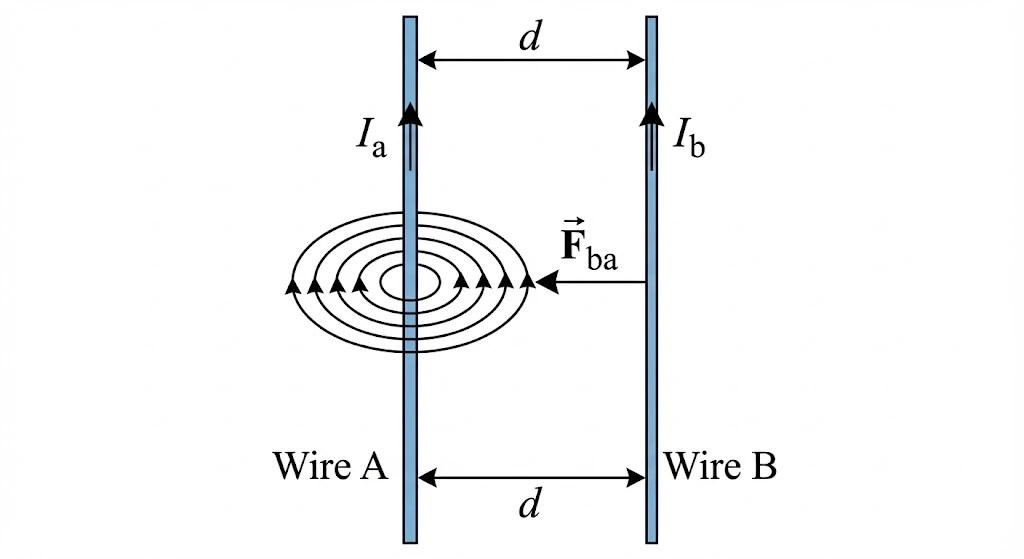
Field at distance
 due to current
  :
:  .
.
Wire B carries
 in field
  . Force on length
  :
: .
.
 .
.
One ampere is that steady current which, when maintained in two very long, parallel conductors 1m apart in vacuum, produces a force of  N per metre of length.
7. Torque on Current Loop & Magnetic Dipole
A rectangular loop carrying current placed in a uniform magnetic field does not experience a net force, but it experiences a torque. This behavior is analogous to an electric dipole in an electric field.
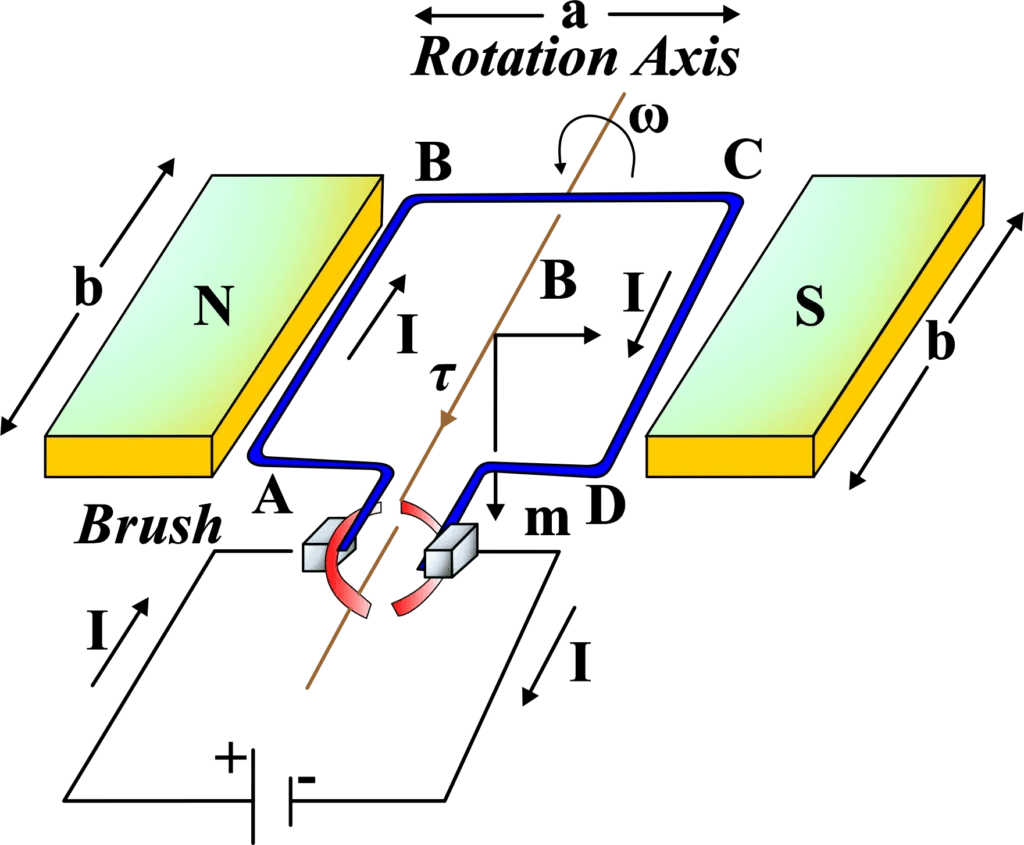
Consider a rectangular loop of sides
 and
and  , carrying current . Area
  .
.The loop is placed in a uniform magnetic field
 . Let the normal to the area of the coil make an angle with the field .
- Arms BC and DA (length ): The forces on these arms are equal and opposite and act along the same axis (the axis of the coil). They cancel each other out, resulting in no net torque from these sides.
- Arms AB and CD (length ): These arms are perpendicular to . The force on each arm is .
 .
.The forces
 on arms AB and CD are equal, opposite, and act along different lines of action. They form a couple.
The perpendicular distance (lever arm) between these two forces is
 .
.Torque
 .
.

Rearranging terms:
 .
.Since
(Area of the loop): .
.
If the coil has
 closely wound turns, the torque increases by a factor of :
 .
.
Magnetic Dipole Moment
The magnetic moment ( ) of a current loop is defined as the product of the current and the area vector.

 is given by Right-Hand Thumb Rule.
The current loop behaves like a magnetic dipole.
- Electric Dipole:
- Magnetic Dipole:

- Stable: (). Torque is zero.
- Unstable: ( antiparallel to ). Torque is zero.
 (
( ). Torque is zero.
 (
(8. Moving Coil Galvanometer
A sensitive instrument to detect currents. It uses a radial magnetic field to ensure the torque is maximum and constant at any deflection.

Magnetic torque = Restoring torque of spring.

Where
 is deflection and
  is torsional constant.
Deflection per unit current:
 .
.
Deflection per unit voltage:
 .
.
- To Ammeter: Connect a low resistance (shunt) in parallel.
- To Voltmeter: Connect a high resistance in series.
Ready to test your knowledge? Try 10 solved numericals on Electrostatic Potential & Capacitance: Click here →
Also practice the Question Bank