
Ray Optics & Optical Instruments
NCERT Chapter 9 • Reflection, Refraction, Lenses & Microscopes
1. Reflection by Spherical Mirrors
In ray optics, spherical mirrors (concave and convex) form images by reflecting light. Real or virtual, inverted or erect — the nature of the image depends on the object’s position and the mirror’s curvature. The focal point and radius of curvature are geometrically linked, leading to the mirror equation — the foundation of all mirror problems.

 2 Marks
Consider a concave mirror with center of curvature
 and pole
  . A ray parallel to the principal axis strikes the mirror at
  .
.After reflection, it passes through focus
 .
.


Consider object
 at distance
  from pole of a concave mirror. Image
  is formed at distance
  .
.Draw ray
 parallel to axis → reflects through .
Draw ray
 through center → reflects back on itself.
Let the two reflected rays meet at
 .
.
 and
and  :
: (vertically opposite)
So
 →
→  …(1)
…(1)
 and
and  :
:
 (vertically opposite)
So
 →
→ 
But
 , and for small aperture
  , so:
, so: …(2)
…(2)

Cross-multiply:
 →
→ 
Divide both sides by
 :
: 
Rearranged:

(Use sign convention:
negative, negative for real image,  negative for concave mirror.)
Magnification is defined as the ratio of image height to object height:
![\[ m = \frac{\text{Height of Image }(A'B')}{\text{Height of Object }(AB)} = \frac{h'}{h} \]](https://i0.wp.com/physicsqanda.com/wp-content/ql-cache/quicklatex.com-14b288f3039e44a69a272ed792f18fa4_l3.png?resize=264%2C43&ssl=1 "Rendered by QuickLaTeX.com")
and (Step 2): ![\[ \frac{AB}{A'B'} = \frac{PB}{PB'} \Rightarrow \frac{h}{h'} = \frac{-u}{-v} = \frac{u}{v} \]](https://i0.wp.com/physicsqanda.com/wp-content/ql-cache/quicklatex.com-7d09906d9f9846a4976d52973f351487_l3.png?resize=233%2C37&ssl=1 "Rendered by QuickLaTeX.com")
 is taken as positive; image height
  is negative for inverted image in sign convention.)
![\[ \frac{h'}{h} = -\frac{v}{u} \]](https://i0.wp.com/physicsqanda.com/wp-content/ql-cache/quicklatex.com-2bbef7856aac880ac346919821a1fba1_l3.png?resize=67%2C38&ssl=1 "Rendered by QuickLaTeX.com")
Magnification formula for spherical mirrors:

– If
 is negative → image is inverted (real).
– If
is positive → image is erect (virtual).– If
 → image is magnified.
– If
 → image is diminished.
Sign Convention Summary: Mirrors and Lenses
In the Cartesian sign convention (used in CBSE/NCERT):
- All distances are measured from the pole (P) of mirror or optical center (O) of lens.
- Direction of incident light is taken as the positive X-axis.
- Distances measured against incident light → negative.
Distances measured along incident light → positive.
| Optical Element | Focal Length (f) | Type | Focus is… | Nature |
|---|---|---|---|---|
| Concave Mirror | –ve | Converging | Real (in front) | Converges parallel rays to a real focus |
| Convex Mirror | +ve | Diverging | Virtual (behind) | Diverges parallel rays as if from virtual focus |
| Convex (Converging) Lens | +ve | Converging | Real (on opposite side) | Converges parallel rays to a real focus |
| Concave (Diverging) Lens | –ve | Diverging | Virtual (on same side) | Diverges parallel rays as if from virtual focus |
2. Refraction and Total Internal Reflection
When light crosses the boundary between two transparent media, it bends — a phenomenon called refraction. This bending explains everyday effects like a straw appearing bent in water or a swimming pool looking shallower than it is. The extent of bending is governed by Snell’s Law and the media’s refractive indices.
A. Snell’s Law & Refractive Index


Also,

B. Apparent Depth
When an object is placed in a denser medium (like water) and viewed from a rarer medium (like air), it appears at a smaller depth than its real depth.

Object
 is at real depth in denser medium (index
  ).
).Observer is in rarer medium (index
 ).
).Consider two rays from
:1. Normal ray
 passes straight.
2. Ray
 incident at angle
  , refracts at angle
  away from normal.
The backward extension of the refracted ray meets normal
at  (Apparent position). Apparent depth
  .
.
For near-normal viewing, angles
and are small.

Substituting approximations:

 implies
  .
.If observer is in air (
 ) and object in medium
  :
:Apparent Depth


C. Total Internal Reflection (TIR)
When light travels from a denser to a rarer medium, it bends away from the normal. If the angle of incidence exceeds a certain value — the critical angle — no refraction occurs. Instead, 100% of the light reflects back into the denser medium. This is Total Internal Reflection (TIR), the principle behind optical fibers and brilliant diamond sparkle.

 where
where 
D. Optical Fibers: Application of TIR
An optical fiber is a flexible, transparent strand of glass (silica) or plastic, slightly thicker than a human hair, that transmits light signals over long distances with minimal loss. It works on the principle of Total Internal Reflection.

– Core: Central part made of high-refractive-index material (
).– Cladding: Outer layer with slightly lower refractive index (
 ).
).– Buffer Coating: Protective plastic layer (not involved in light guidance).
Light enters the core at the acceptance angle (
 ).
).At the core–cladding boundary, the angle of incidence is greater than the critical angle (
 ), so TIR occurs repeatedly, guiding light along the fiber—even around gentle curves.
The maximum angle of incidence at the fiber’s entrance for which TIR is possible is called the acceptance angle.
It is given by:
![\[ \sin \theta_a = \sqrt{n_1^2 - n_2^2} \]](https://i0.wp.com/physicsqanda.com/wp-content/ql-cache/quicklatex.com-c27ff6a784e28091ff2665cc51a4115a_l3.png?resize=142%2C32&ssl=1 "Rendered by QuickLaTeX.com")
The term
 is called the Numerical Aperture (NA) — a measure of light-gathering ability.
- Low Loss: Signals can travel 100+ km without amplification.
- High Bandwidth: Carry thousands of phone calls or HD video streams simultaneously.
- No EMI: Immune to electromagnetic interference (unlike copper wires).
- Security: Light doesn’t leak; hard to tap without detection.
3. Refraction at Spherical Surfaces & Lenses
Lenses are transparent optical devices that refract light to converge or diverge rays, enabling magnification, focusing, and vision correction. A lens’s power is determined by its curvature and material. The Lens Maker’s Formula connects these physical properties to its focal length — essential for designing camera lenses, eyeglasses, and microscopes.
 (object side) and (image side), radius
  .
.Object at
(dist. ), image at (dist. ).Ray from
strikes surface at , refracts to .Normal is
 (C = center of curvature).
 : exterior angle
In
 : exterior angle
For paraxial rays:
 ,
,  ,
, 
(Use sign convention:
negative, positive for convex surface).

So:

Substitute angles:

Divide by
: 

 , second
  .
.Refractive index of lens material =
, surrounding =  (air).
Object at infinity → image at first focus
 .
.Apply refraction formula to each surface.
 ,
,  ,
, 
 →
→  …(1)
…(1)
The image from Surface 1 acts as virtual object for Surface 2.
So
 ,
,  (final image at focus),
  (since center is on left)
 →
→  …(2)
…(2)


Formulas for Lenses

Magnification:

Power of a Lens:
 (Unit: Dioptre, D)
Combination of Thin Lenses in Contact

Consider two thin lenses L₁ and L₂ placed in close contact (separation ≈ 0).
Let their focal lengths be
 and
and  respectively.
An object is placed at a distance
from the combination.
The first lens L₁ forms an intermediate image
 at a distance
  , given by the lens formula:
 ![\[ \frac{1}{v_1} - \frac{1}{u} = \frac{1}{f_1} \quad \text{...(1)} \]](https://i0.wp.com/physicsqanda.com/wp-content/ql-cache/quicklatex.com-8249577268ecec87cd7f0c4082f7eaa2_l3.png?resize=153%2C40&ssl=1 "Rendered by QuickLaTeX.com")
Since the lenses are in contact, the intermediate image
acts as the virtual object for the second lens L₂.Object distance for L₂ =
Let the final image be formed at distance
.Applying lens formula to L₂:
![\[ \frac{1}{v} - \frac{1}{v_1} = \frac{1}{f_2} \quad \text{...(2)} \]](https://i0.wp.com/physicsqanda.com/wp-content/ql-cache/quicklatex.com-7b1e7b238b046a52c5657c879e1fd863_l3.png?resize=151%2C40&ssl=1 "Rendered by QuickLaTeX.com")
Add equations (1) and (2):
![\[ \left( \frac{1}{v_1} - \frac{1}{u} \right) + \left( \frac{1}{v} - \frac{1}{v_1} \right) = \frac{1}{f_1} + \frac{1}{f_2} \]](https://i0.wp.com/physicsqanda.com/wp-content/ql-cache/quicklatex.com-834f0feea2946c01db9c4eeac9fc4033_l3.png?resize=266%2C43&ssl=1 "Rendered by QuickLaTeX.com")
The
 terms cancel out:
 ![\[ \frac{1}{v} - \frac{1}{u} = \frac{1}{f_1} + \frac{1}{f_2} \]](https://i0.wp.com/physicsqanda.com/wp-content/ql-cache/quicklatex.com-ae4165e42282366206ad130da1a8eb7a_l3.png?resize=132%2C40&ssl=1 "Rendered by QuickLaTeX.com")
The combination behaves like a single lens with focal length
, so: ![\[ \frac{1}{v} - \frac{1}{u} = \frac{1}{f} \]](https://i0.wp.com/physicsqanda.com/wp-content/ql-cache/quicklatex.com-35ad2237ecb3b60a16364b451bcc6b77_l3.png?resize=84%2C40&ssl=1 "Rendered by QuickLaTeX.com")
Comparing with the result above:
![\[ \frac{1}{f} = \frac{1}{f_1} + \frac{1}{f_2} \]](https://i0.wp.com/physicsqanda.com/wp-content/ql-cache/quicklatex.com-abbe8736fc0964d71412db97e4acce13_l3.png?resize=97%2C40&ssl=1 "Rendered by QuickLaTeX.com")
For
thin lenses in contact: ![\[ \frac{1}{f_{\text{eq}}} = \frac{1}{f_1} + \frac{1}{f_2} + \frac{1}{f_3} + \cdots + \frac{1}{f_n} \]](https://i0.wp.com/physicsqanda.com/wp-content/ql-cache/quicklatex.com-17eb8344dca2574fb330a427fadb2c8f_l3.png?resize=236%2C42&ssl=1 "Rendered by QuickLaTeX.com")
The power of the combination is also additive:
![\[ P_{\text{eq}} = P_1 + P_2 + P_3 + \cdots + P_n \]](https://i0.wp.com/physicsqanda.com/wp-content/ql-cache/quicklatex.com-566452b926bc88572a10c0fff3868a58_l3.png?resize=232%2C17&ssl=1 "Rendered by QuickLaTeX.com")
 in metres)
Effective Focal Length:

Effective Power:

Total Magnification:

4. Refraction through a Prism
A prism is a transparent optical element with flat, polished surfaces that refract light. Unlike a parallel slab, a prism’s non-parallel faces cause light to bend twice in the same direction, resulting in a net deviation. This property is exploited in spectrometers to disperse white light into its constituent colors (dispersion).

In quadrilateral
 :
:  →
→ 
In triangle
 :
:  →
→ 
So:

 ):
):Deviation at first surface:

Deviation at second surface:

Total deviation:

Using
: 
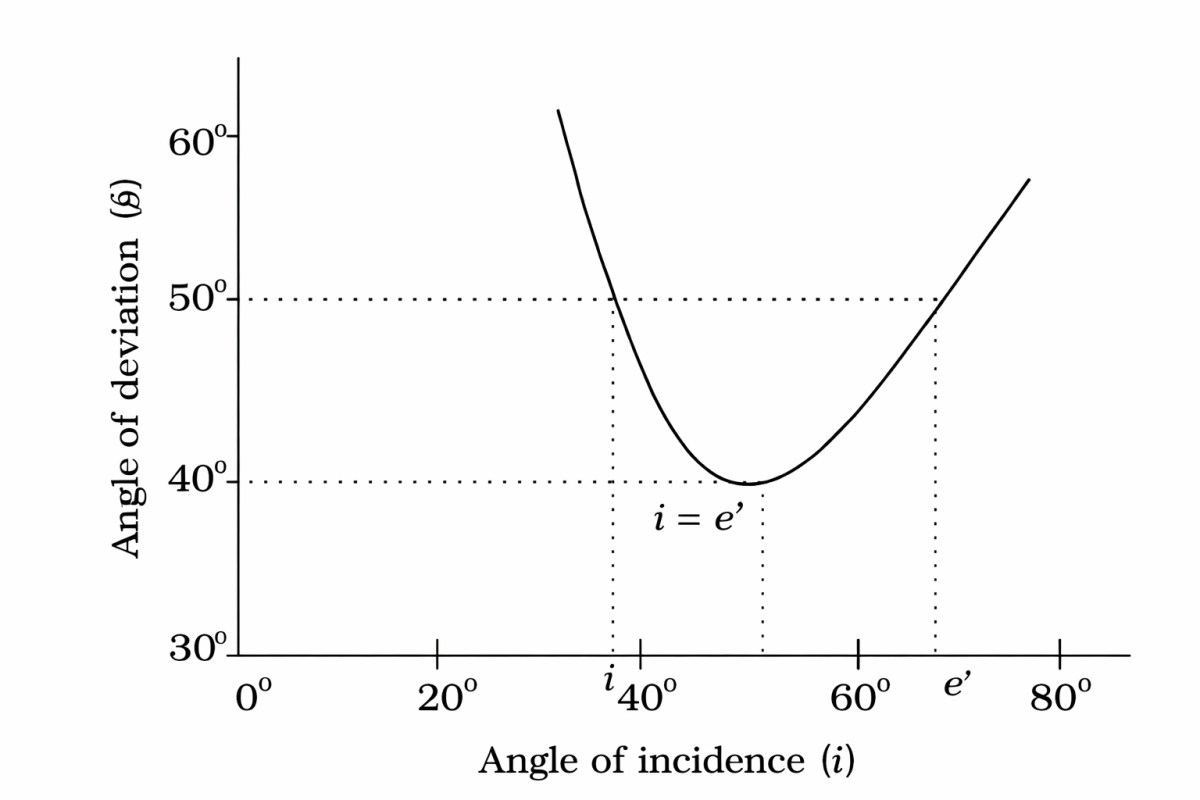 is minimum when
  → then
  .
.From
:  →
→ 
From
 :
: 
Snell’s law at first surface:


5. Optical Instruments
Human eyes have limited resolution and magnification. Optical instruments like microscopes and telescopes overcome these limits by using combinations of lenses (or mirrors) to produce highly magnified or resolved images of tiny or distant objects. Understanding their working principle is key to applications from biology to astronomy.

A. Simple Microscope (Magnifying Glass)
- Image at Near Point (D = 25 cm):

- Image at Infinity:


B. Compound Microscope
Consists of Objective (short  ) and Eyepiece (longer
  ). Tube length
  (standard).
near focus of eyepiece.Magnification
 (since
  , and
, and  )
)
Magnification


C. Astronomical Telescope (Refracting)

Objective: large , Eyepiece: small . Used for distant objects ().
 .
.Objective forms image
in focal plane. Angle subtended by image at eye (via eyepiece) =  .
.Magnifying power


From eyepiece (used as magnifier):

So:


Tube Length (Normal Adjustment):

6. Reflecting Telescope (Cassegrain)
Refracting telescopes (using lenses) suffer from chromatic and spherical aberrations, especially at large sizes. Reflecting telescopes replace the objective lens with a curved mirror, eliminating color fringing and allowing for massive apertures. The Cassegrain design folds the light path using a secondary mirror, creating a compact yet powerful instrument — the backbone of modern astronomy (e.g., Hubble Space Telescope).

The refracting telescope suffers from chromatic aberration (colors focus at different points) and spherical aberration. To overcome this, Reflecting Telescopes use mirrors instead of lenses for the objective.
Primary Mirror: A large concave parabolic mirror. Parabolic shape removes spherical aberration.
Secondary Mirror: A small convex mirror placed before the focus of the primary mirror.
Eyepiece: Light reflects off the secondary mirror and passes through a hole in the primary to the eyepiece.

- No Chromatic Aberration: Mirrors reflect all wavelengths equally; lenses disperse light.
- No Spherical Aberration: Parabolic mirrors focus all rays to a single point.
- Large Aperture: Mirrors are lighter and can be supported from the back, allowing for huge diameters (high resolving power). Lenses are heavy and can only be supported at the rim.
- Cost: Large mirrors are cheaper to manufacture than large defect-free lenses.
Master Ray Optics with our curated problem set: Important Questions & Numericals →