
Thermal Properties of Matter
NCERT Chapter 10 • Heat, Expansion, Calorimetry & Heat Transfer
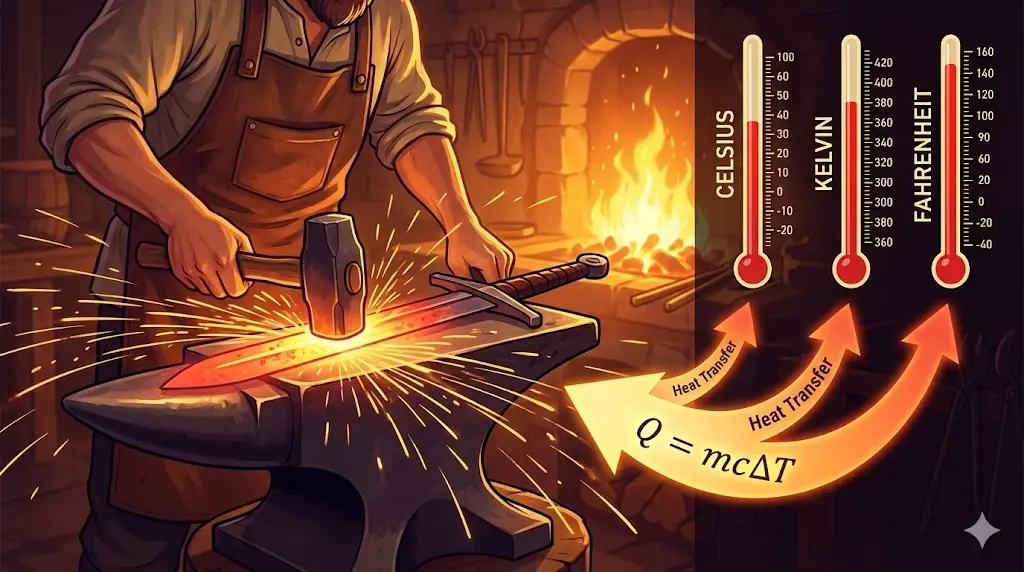
1. Temperature and Scales
Temperature is a relative measure of hotness or coldness. Heat is the form of energy transferred between two systems (or a system and its surroundings) by virtue of temperature difference.
1.1 Temperature Scales
| Scale | Freezing Point | Boiling Point | Conversion |
|---|---|---|---|
Celsius ( C) C) | 0 | 100 | – |
| Fahrenheit (F) | 32 | 212 |  |
| Kelvin (K) | 273.15 | 373.15 |  |
1.2 Ideal Gas Equation
Combining Boyle’s Law ( at constant
  ) and Charles’ Law (
 at constant
  ), we get:

where  = number of moles,
  J/mol·K (universal gas constant).
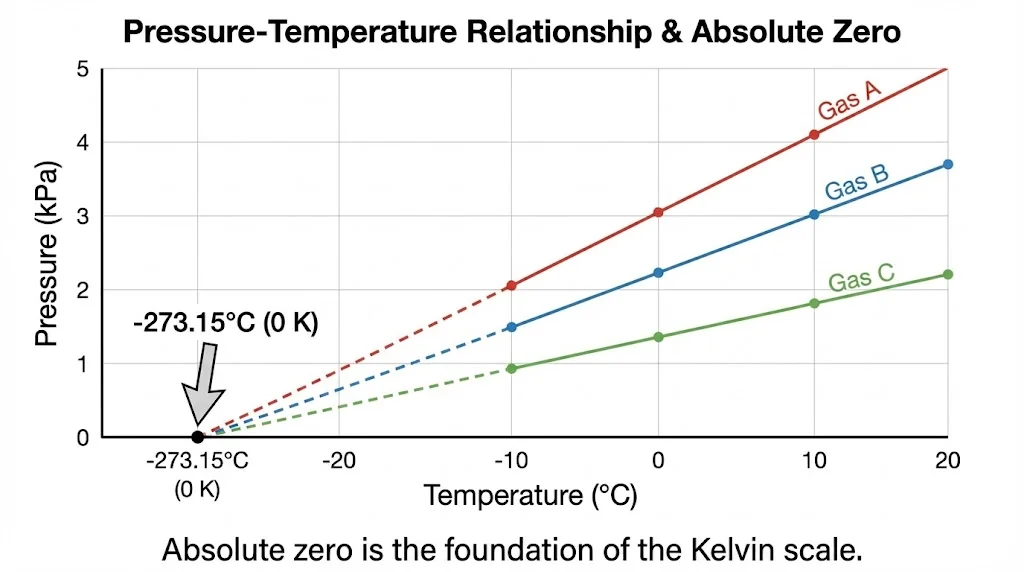
1.3 Absolute Zero
Experiments with low-density gases show that at constant volume,  . Extrapolating to
  gives
gives  C, defined as absolute zero (0 K).
1.4 Triple Point of Water
The triple point is the unique temperature and pressure where water coexists as solid, liquid, and vapor in equilibrium:
- Temperature = 273.16 K (0.01°C)
- Pressure = 6.11 × 10⁻³ Pa
This is used to define the Kelvin scale because it’s a reproducible fixed point.
2. Thermal Expansion
Most substances expand on heating and contract on cooling.
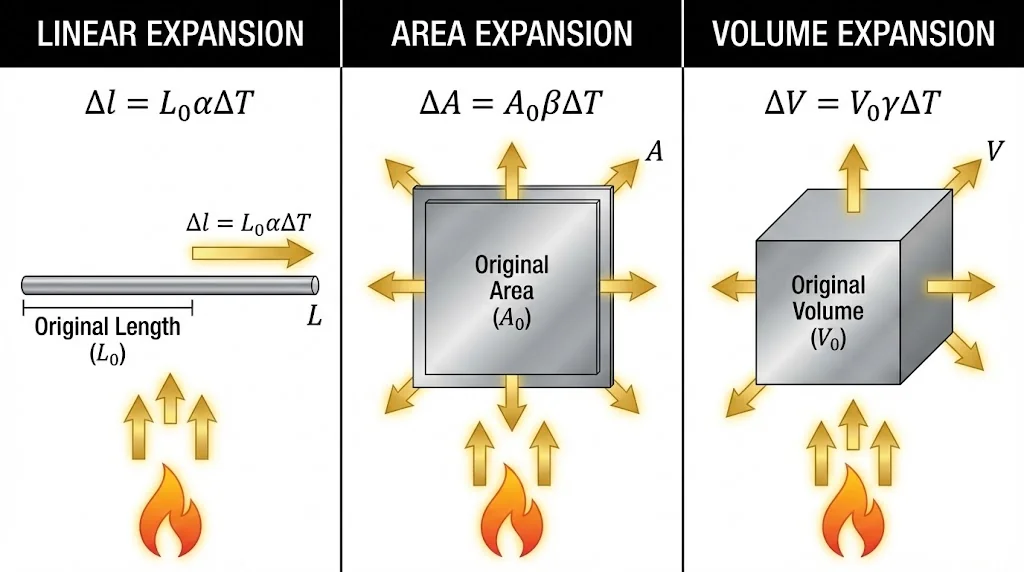
 ).
).2.1 Types of Expansion
- Linear Expansion (
 ): (1D: Length)
 - Area Expansion (): (2D: Area)
- Volume Expansion (): (3D: Volume)
 ):
):  (1D: Length)
 ):
):  (2D: Area)
 ):
):  (3D: Volume)
Relation:  . For solids,
  .
.
2.2 Thermal Stress
When a rod is rigidly fixed and heated, it cannot expand. This induces compressive stress:

where  = Young’s modulus.
Water contracts on heating from 0C to 4C. Its density is maximum at 4C. This property allows aquatic life to survive in frozen lakes.
C. The length of a steel rod measured by this tape is found to be 63.0 cm on a hot day when the temperature is 45.0 C. What is the actual length of the steel rod on that day? ( )
)Show Answer
The tape expands on the hot day, so its markings are farther apart. It measures less than the actual length. C.
C.Expansion factor =
 .
.True Length = Measured Length
 Expansion factor
 cm.
cm.
3. Calorimetry
Calorimetry implies measurement of heat. Principle: Heat Lost = Heat Gained.
3.1 Specific Heat Capacity ( or )
 or
or  )
)The amount of heat required to raise the temperature of unit mass of a substance by 1C.

For water,  J kg
J kg K (very high). This makes water an excellent coolant.
3.2 Change of State & Latent Heat ()
 )
)During a phase change (Melting/Boiling), temperature remains constant. Heat supplied is used to break bonds.

- Latent Heat of Fusion (): Solid Liquid. (Ice: J/kg)
- Latent Heat of Vaporisation (): Liquid Gas. (Water: J/kg)
 ): Solid
  Liquid. (Ice:
  J/kg)
J/kg) ): Liquid
  J/kg)
J/kg)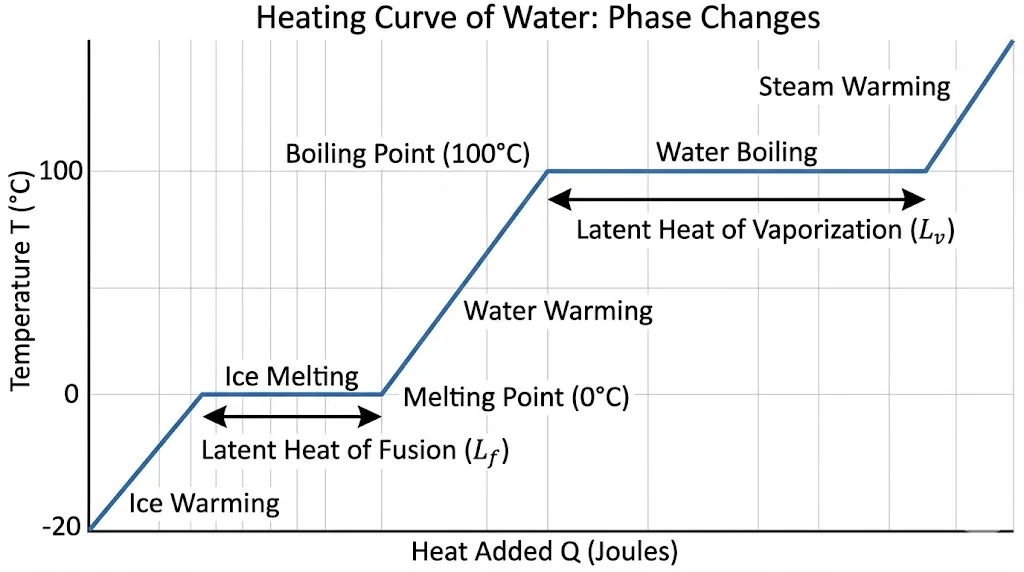
3.3 Molar Specific Heat for Gases
For gases, heat capacity depends on process:
- : At constant volume (no work done).
- : At constant pressure (work done in expansion).
 : At constant volume (no work done).
 : At constant pressure (work done in expansion).
Always  because extra heat is needed for work. For monatomic gases,
  .
.
3.4 Regelation
When pressure is applied to ice, its melting point lowers. A weighted wire can pass through an ice block because ice melts under the wire and refreezes above it. This is called regelation.
C to steam at 100 C.(
 J/kg)
J/kg)Show Answer
1. Ice (-12 to 0): J.
J.2. Melt Ice (0 to 0):
 J.
J.3. Water (0 to 100):
 J.
J.4. Boil Water (100 to 100):
 J.
J.Total
 J.
J.
4. Heat Transfer
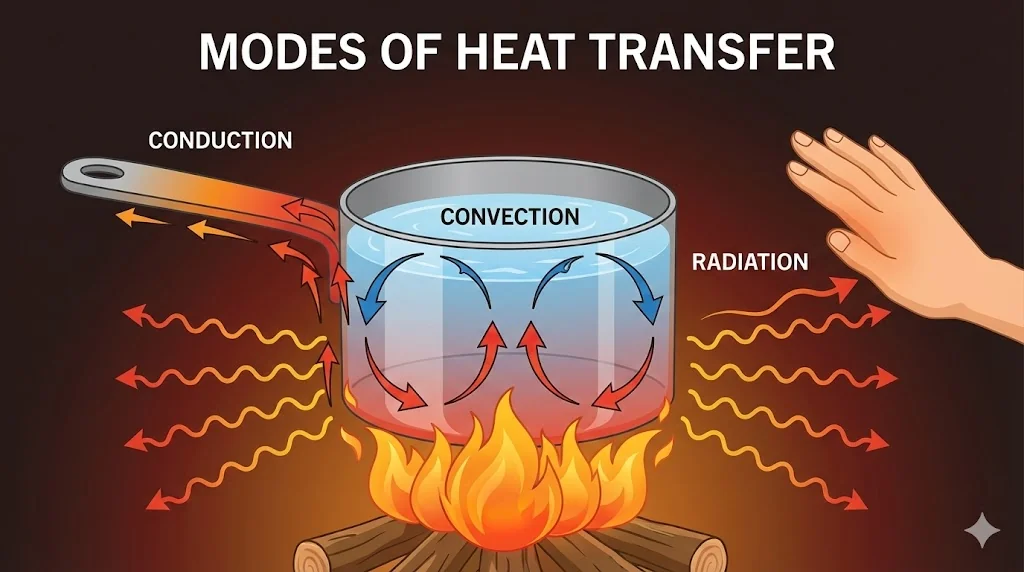
Heat flows from high temperature to low temperature via three modes:
4.1 Conduction
Heat transfer by molecular collision without bulk motion of matter (mostly solids). Rate of heat flow ( ):
):

Where  is Thermal Conductivity.
  .
.
4.2 Thermal Conductivity Table
| Material | K (W/m·K) |
|---|---|
| Silver | 406 |
| Copper | 385 |
| Water | 0.8 |
| Air | 0.024 |
4.3 Series Combination of Rods
For two rods in series (same heat current ):

4.4 Convection
Heat transfer by actual motion of fluid particles (liquids & gases). Examples: Sea breeze, trade winds.
4.5 Radiation
Heat transfer via electromagnetic waves (infrared). Needs no medium. Example: Sunlight.
4.6 Dewar Flask (Thermos)
A thermos minimizes heat transfer by:
- Conduction: Vacuum between double walls.
- Convection: No air in vacuum.
- Radiation: Silvered walls reflect heat.
5. Newton’s Law of Cooling
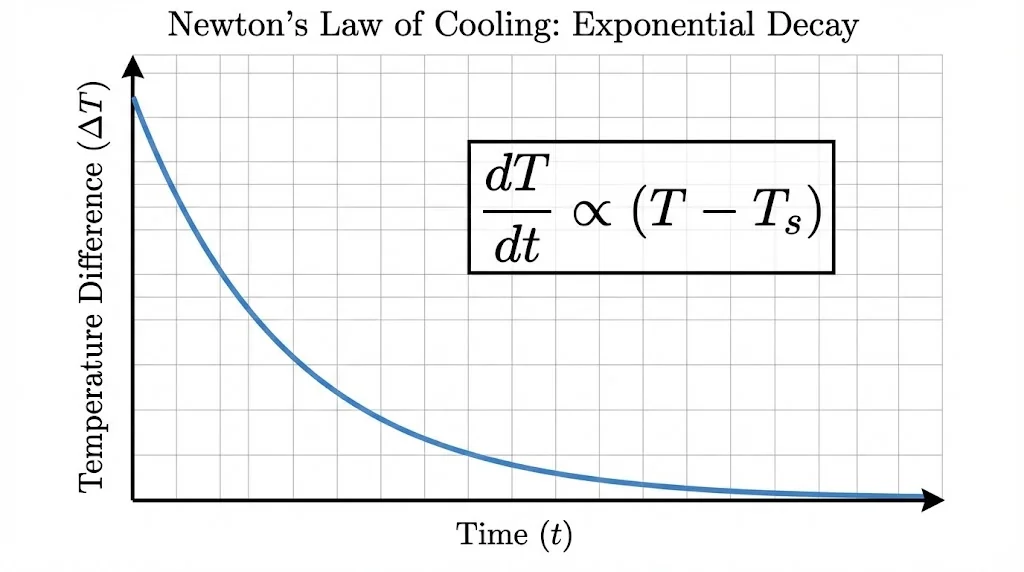
The rate of loss of heat ( ) of a body is directly proportional to the temperature difference between the body and its surroundings (
 ), provided
  is small.


 C to 50C in 5 minutes. Calculate the time it takes to cool from 60C to 30C. Temperature of surroundings is 20C.
Show Answer
Using Avg Rate form:
Case 1:
 .
.Case 2:
 .
. minutes.
6. Blackbody Radiation Laws
Stefan-Boltzmann Law
Energy radiated per second per unit area by a blackbody is proportional to the fourth power of its absolute temperature.

 (Stefan’s Constant).
6.1 Emissivity
A perfect blackbody has emissivity  . Real bodies have
  . The net power radiated is:

Wien’s Displacement Law
The wavelength ( ) corresponding to maximum emission intensity is inversely proportional to absolute temperature.

This explains why hotter stars appear blue (lower  ) and cooler stars appear red (higher ).
 /K,
/K,  Pa) is prevented from expanding. Find thermal stress if temperature rises by 20°C.
Show Answer
Thermal Stress = Pa.
Pa.