
Wave Optics
NCERT Chapter 10 • Huygens’ Principle, Interference & Diffraction
1. Huygens’ Principle
Christiaan Huygens proposed the wave theory of light. To understand this, we define a Wavefront: the locus of all particles vibrating in the same phase.

1. Each point on a wavefront acts as a source of new disturbance, called secondary wavelets.
2. These wavelets spread out in all directions with the speed of light.
3. The new wavefront is the forward envelope (tangent) to these secondary wavelets at any instant.

Consider a plane wavefront
 incident on a reflecting surface
  at angle
  .
.Let
 be the speed of light. Time taken for wavelet from
  to reach
  is
is  .
.So,
 .
.
In the same time
, the wavelet from point  travels distance
  after reflection.
Draw a tangent from
to the sphere of radius  centered at . This tangent
  is the reflected wavefront.
In
 and
and  :
: (by construction)
 is common
So,
 (RHS congruence).
Therefore,
 .
.The angle of incidence equals the angle of reflection.
Wavefronts through Optical Elements
Using Huygens’ principle, we can understand how wavefronts transform when passing through prisms, lenses, and mirrors:
- Thin Prism: Lower part of wavefront (travelling through more glass) slows down more, causing the wavefront to tilt.
- Convex Lens: Central part of wavefront (through thickest glass) is delayed the most, forming a converging spherical wavefront that meets at focus
 .
. - Concave Mirror: Reflects plane wavefront into a converging spherical wavefront focused at .
 .
.
In a convex lens, though the central ray travels a shorter geometric path, it spends more time in glass (slower speed). The optical path length (and thus time) is equal for all rays from object to image — this is Fermat’s principle.
2. Derivation: Snell’s Law using Wave Theory

Consider a plane wavefront
incident on a surface  separating medium 1 (speed
  ) and medium 2 (speed
  ).
).Let
be the angle of incidence and  be the angle of refraction.
Let
be the time taken for the wavelet from to reach .
Distance
 .
.In the same time
, the wavelet from travels distance  into the second medium.
In
:  .
.In
:  .
.
 .
.By definition, refractive index
 .
.Thus:
 (Snell’s Law).
3. Interference and Young’s Double Slit Experiment
Interference is the redistribution of light energy due to the superposition of waves from two coherent sources (sources with constant phase difference).
Coherent vs Incoherent Sources
For sustained interference fringes, the light sources must be coherent:
- Coherent Sources: Have a constant phase difference and same frequency (e.g., light from Young’s two slits, derived from a single source).
- Incoherent Sources: Phase difference changes randomly with time (e.g., two independent sodium lamps). They produce uniform illumination (no fringes).
 and phase difference
  :
:

Resultant:


Intensity:
 →
→ 
where
 is intensity due to a single source.
–
 :
:  →
→  (Bright Fringe)
–
 :
:  →
→  (Dark Fringe)
As Feynman noted: “There is no physical difference between interference and diffraction. It’s just a question of usage.”
– Interference: Superposition from a few distinct sources (e.g., YDSE).
– Diffraction: Superposition from many coherent sources across a single aperture.

 )
5 Marks
)
5 Marks
Let
 and
and  be two slits separated by
  . Screen distance is
  .
.Point
 is at distance
  from center
  .
.Path difference
 .
.From geometry, for
 :
:  .
.
Path difference must be integral multiple of
 .
.

 (where
  ).
).
Path difference must be odd integral multiple of
 .
.
 .
):
.
):Separation between two consecutive bright (or dark) fringes.
 .
. .
.
4. Diffraction (Single Slit)
Diffraction is the bending of light around corners of an obstacle. Unlike interference (which uses two sources), diffraction occurs due to wavelets from different parts of the same wavefront.
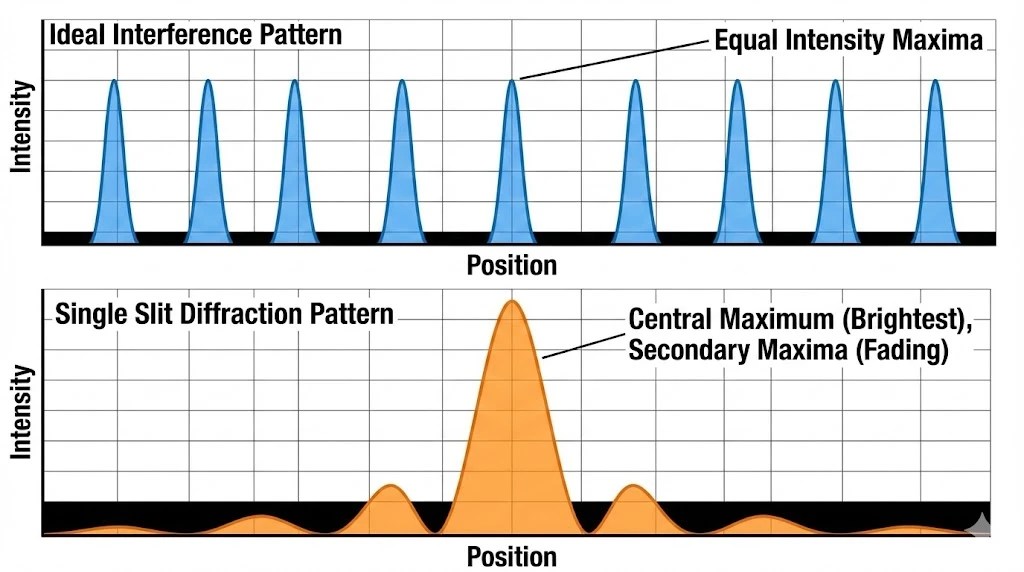

(Here
is slit width,  is diffraction angle).
Slit width =
. Divide the slit into two equal halves (width  ).
).Consider waves from the top of the first half and the top of the second half.
If the path difference between these two waves is
, they interfere destructively.Generalizing: For every point in the first half, there’s a corresponding point in the second half with path difference
.
Path difference =
 .
.For destructive interference:
 →
→  (first minima).
For complete cancellation, divide slit into
 equal parts.
Path difference between successive parts =
.→
 → (
→ ( )
)
In interference and diffraction, light energy is redistributed — it decreases in dark regions and increases in bright regions. Total energy remains constant, consistent with the law of conservation of energy.
The central maximum extends from the first minimum on one side to the first minimum on the other ( ).
).
Angular width:  .
.
Linear width:  .
.
5. Polarization
Polarization restricts the vibration of light vectors to a single plane. This proves the transverse nature of light.

A. Malus’s Law
 Where is the intensity of polarized light incident on the analyzer.
B. Brewster’s Law
At a specific angle of incidence ( ), the reflected light is completely polarized.
 (Reflected and refracted rays are perpendicular).
Test your concepts on YDSE and Diffraction: Important Numericals for Wave Optics →