
Waves
NCERT Chapter 14 • Wave Motion, Superposition, Beats, Standing Waves & Doppler Effect
1. Introduction & Wave Motion
A wave is a disturbance that propagates in space, transporting energy and momentum from one point to another without the transport of matter. In mechanical waves (like sound or water waves), this requires a material medium.
2. Transverse & Longitudinal Waves
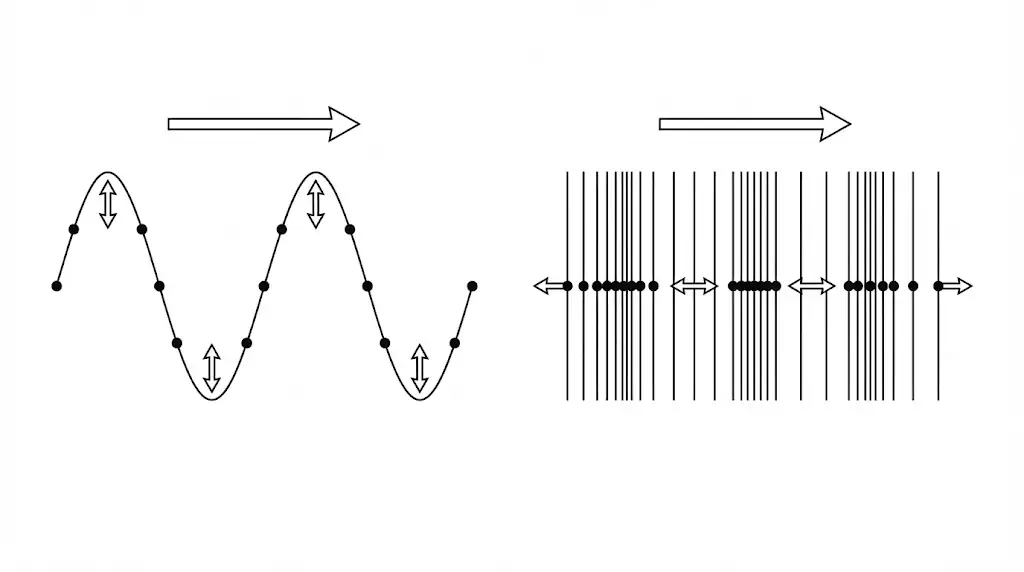
- Transverse Waves: Particles vibrate perpendicular to the direction of wave propagation. Example: Light, waves on a string. Form Crests and Troughs.
- Longitudinal Waves: Particles vibrate parallel to the direction of wave propagation. Example: Sound waves in air. Form Compressions and Rarefactions.
3. Progressive Wave Equation
A harmonic traveling wave moving in the positive x-direction is described by:
- A: Amplitude
- k: Angular Wave Number (k = 2π/λ)
- ω: Angular Frequency (ω = 2πν)
- λ: Wavelength, ν: Frequency, T: Period
- v: Wave Speed (v = ω/k = λν)
4. Speed of Traveling Waves
4.1 Speed on a Stretched String
where T is Tension and μ is mass per unit length (linear mass density).
4.2 Speed of Sound in Fluids (Newton-Laplace Formula)
where P is pressure, ρ is density, and γ is the adiabatic index (Cp/Cv). Newton originally assumed the process was isothermal (v=√(P/ρ)), which gave a wrong value. Laplace corrected it to adiabatic.
4.3 Speed of Sound in Solids
For longitudinal waves in a solid rod, the speed is given by:
where Y is Young’s modulus of the material and ρ is its density.
Show Answer
v = √(1.4 × 1.01 × 10⁵ / 1.29) = √(1.414 × 10⁵ / 1.29) ≈ √109612 ≈ 331 m/s.5. Principle of Superposition
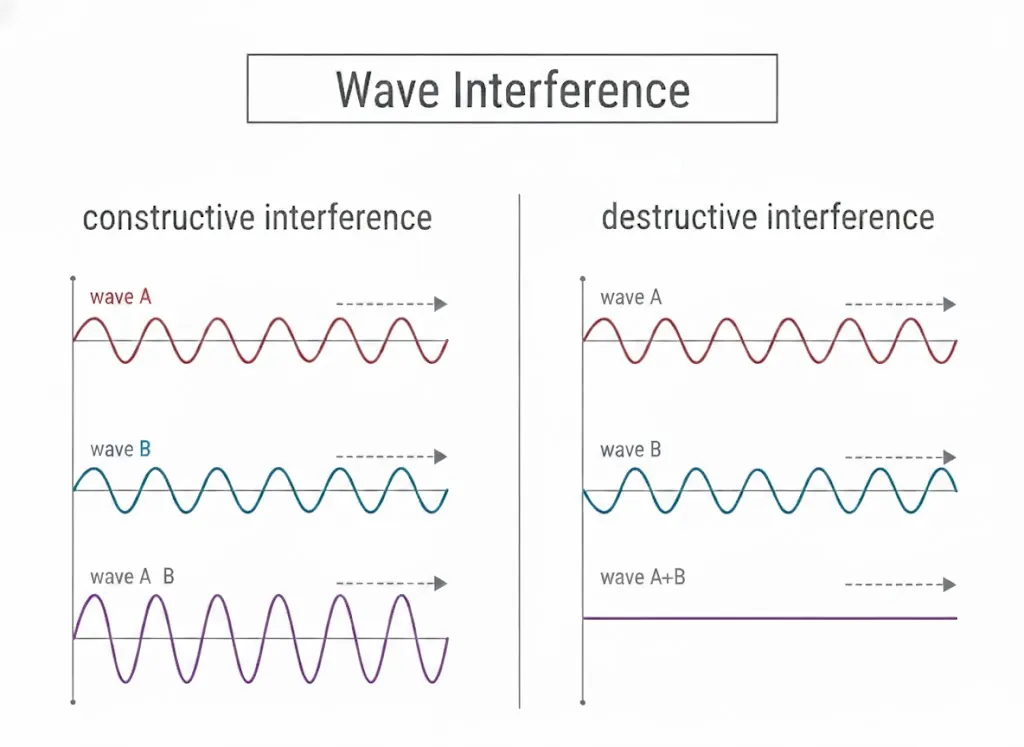
When two waves meet, the net displacement is the algebraic sum of individual displacements.
6. Reflection of Waves
- Rigid Boundary: Wave reflects with a phase change of π (180°). Crest becomes Trough.
- Open Boundary: Wave reflects with no phase change. Crest returns as Crest.
7. Standing Waves & Normal Modes
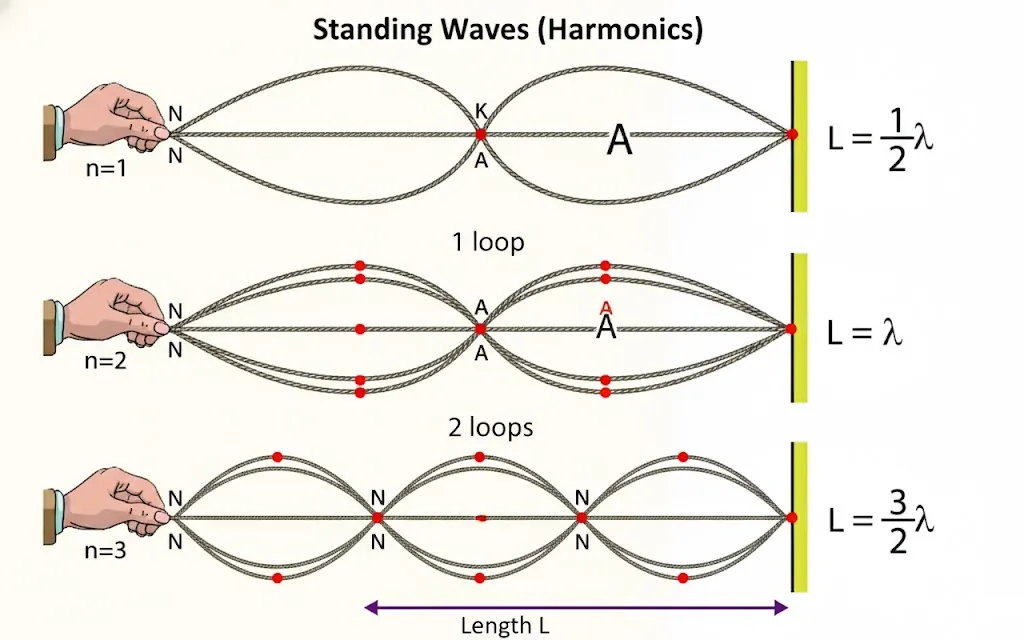
Formed by the superposition of two identical waves traveling in opposite directions.
- Nodes: Points of zero amplitude (sin kx = 0).
- Antinodes: Points of maximum amplitude (sin kx = ±1).
Frequencies for Stretched String (Fixed Ends)
All harmonics (odd and even) are present.
Organ Pipes
- Open Pipe: Open at both ends. νn = nv/(2L). All harmonics present.
- Closed Pipe: Closed at one end. νn = (2n-1)v/(4L). Only odd harmonics present (1, 3, 5…).
Show Answer
L = 0.3 m. Open pipe fundamental: ν₁ = v/(2L).ν₁ = 340 / (2 × 0.3) = 340 / 0.6 ≈ 566.7 Hz.
8. Beats
The periodic variation in intensity of sound when two waves of slightly different frequencies (ν₁, ν₂) superimpose.
Used in tuning musical instruments.
Show Answer
Possible frequencies for B: 324 ± 6 ⇒ 330 Hz or 318 Hz.Tightening B increases tension ⇒ increases νB.
If νB = 330 and increases, beat freq (330+δ – 324) increases (>6). Incorrect.
If νB = 318 and increases, beat freq (324 – (318+δ)) decreases (<6). Correct.
So, original frequency of B was 318 Hz.
9. Doppler Effect
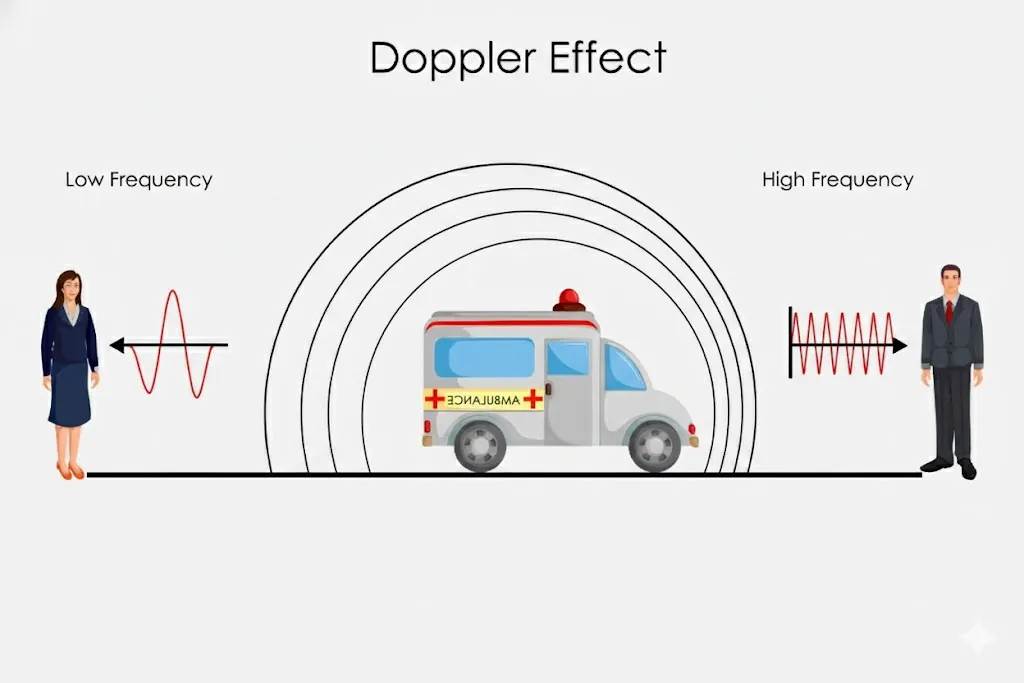
The apparent change in frequency of sound due to the relative motion between the source and the observer.
- v: Speed of sound
- vo: Speed of observer (Top sign + if moving towards source)
- vs: Speed of source (Top sign – if moving towards observer)
• Source moving towards stationary observer: ν’ = ν [v / (v – vs)]
• Observer moving towards stationary source: ν’ = ν [(v + vo) / v]
Show Answer
Observer stationary (vo = 0). Source approaching (vs = 40). Use ‘-‘ in denominator.ν’ = 500 [340 / (340 – 40)] = 500 [340 / 300]
ν’ = 500 × 1.133 ≈ 566.7 Hz.