
Gravitation
NCERT Chapter 7 • Universal Law, Variation of ‘g’, Escape Speed & Satellites
1. Kepler’s Laws of Planetary Motion
Before Newton, Johannes Kepler derived three empirical laws governing the motion of planets around the Sun.
- 1. Law of Orbits: All planets move in elliptical orbits with the Sun situated at one of the foci of the ellipse.
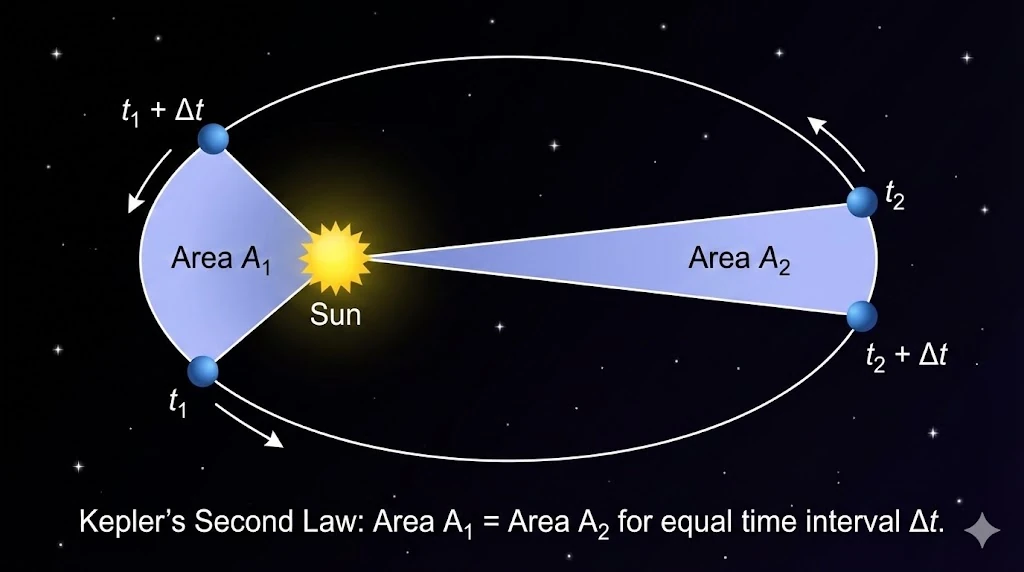
- 2. Law of Areas: The line that joins any planet to the Sun sweeps equal areas in equal intervals of time. (This is a consequence of conservation of angular momentum).
- 3. Law of Periods: The square of the time period of revolution is proportional to the cube of the semi-major axis of the orbit (
 ).
).
 ).
).
 ).
).1.1 Derivation of Kepler’s Second Law
For a planet under the Sun’s gravitational force (a central force), the torque about the Sun is zero:

Thus, angular momentum  is conserved.
The area swept out in time  is
is  .
.
So,

Hence, equal areas are swept in equal times.
1.2 Application of Kepler’s Second Law
From conservation of angular momentum ( ):
):
At perihelion (closest): 
Thus,  . Since
  ,
,  (Speed is fastest when closest to Sun).
2. Universal Law of Gravitation
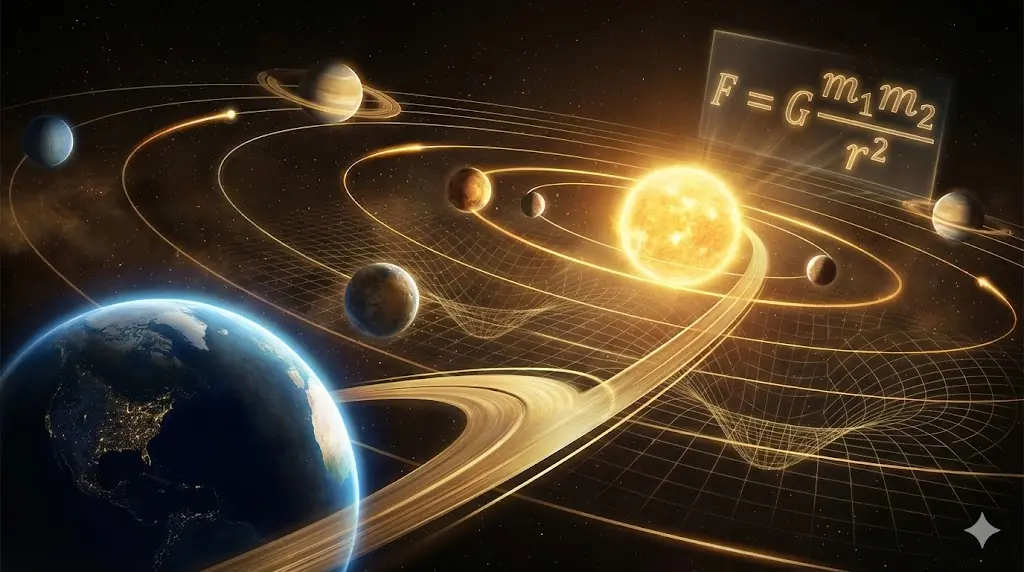
Newton stated that every particle in the universe attracts every other particle with a force directly proportional to the product of their masses and inversely proportional to the square of the distance between them.


Where  is the Universal Gravitational Constant.
2.1 Cavendish’s Experiment
In 1798, Henry Cavendish first measured the gravitational constant  using a torsion balance.
A light rod with two small lead spheres (mass  ) is suspended by a thin wire. Two large lead spheres (mass
  ) are brought close to the small ones. The gravitational attraction causes a torque, twisting the wire by an angle
  . At equilibrium:

This experiment is famously called “weighing the Earth”.
The gravitational force inside a hollow spherical shell of uniform density is zero. Outside the shell, it acts as if all mass is concentrated at the center.
3. Acceleration due to Gravity ()
The acceleration experienced by a body due to Earth’s gravitational pull is denoted by  . On the surface of Earth (mass , radius
  ):
):

3.1 Variation of
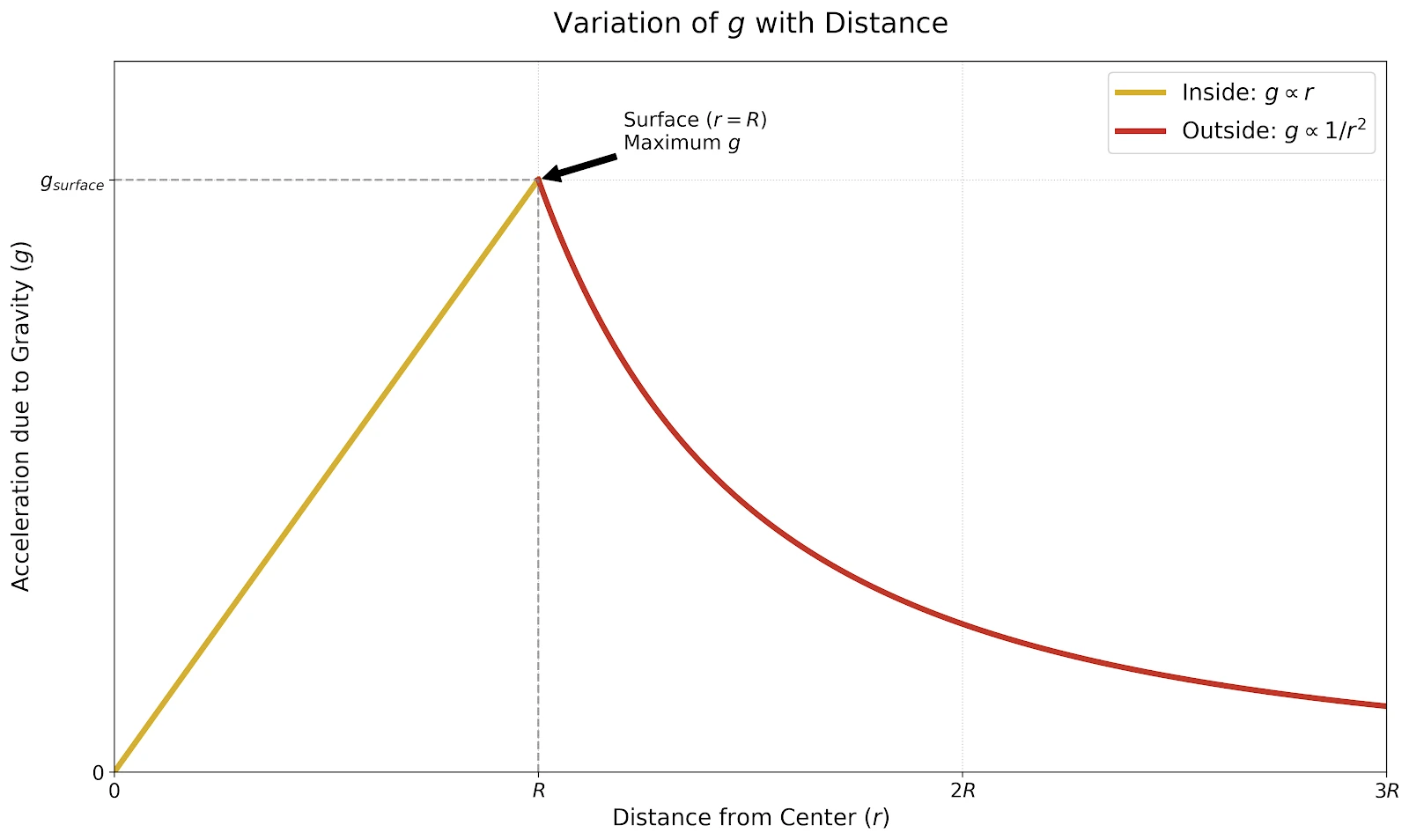
1. With Altitude ( ):
):

Approx (for
 ):
): 
2. With Depth ( ):
):

At the center of the Earth ( ),
),  .
.
3.2 Weighing the Earth
Method 1 (Using ): 
Method 2 (Using Moon’s orbit): From  ,
,  .
.
Both methods give  kg.
kg.
become half its value on the surface?Show Answer


 .
.
 km)
km)Show Answer
Using depth formula:
Change

 decrease
 .
.
4. Gravitational Potential Energy ()
 )
)The energy associated with the position of a particle in a gravitational field. The potential energy at infinity is taken as zero.

The negative sign indicates that the force is attractive and work must be done to move the mass to infinity.
4.1 Potential Energy near Earth’s Surface
For small heights (), the general formula simplifies to the familiar  .
.


For
,  , so:
, so: .
.
4.2 Gravitational Field Intensity
The gravitational field intensity ( ) at a point is the force experienced per unit test mass placed there.

It is related to gravitational potential by  .
.
5. Escape Speed
The minimum speed required to project a body from the surface of Earth so that it escapes Earth’s gravitational field forever.
 )
3 Marks
)
3 Marks
Total Energy at Surface (
 ) = Total Energy at Infinity (
 ).
).At infinity, Potential Energy = 0, Kinetic Energy
 (min 0).
So,
 .
.
 .
.

![\[v_e = \sqrt{\dfrac{2GM}{R}} = \sqrt{2gR}\]](https://i0.wp.com/physicsqanda.com/wp-content/ql-cache/quicklatex.com-8a46de2d1f69bd0ee03100d134901d24_l3.png?resize=176%2C43&ssl=1 "Rendered by QuickLaTeX.com")
For Earth,  km/s. It is independent of the mass of the projectile.
 ). What is its speed far away from Earth?
Show Answer
Initial energy:
Final energy (at ∞):

By conservation:
 km/s.
km/s.
6. Earth Satellites
Satellites revolve around Earth in circular orbits due to gravitational force acting as centripetal force.
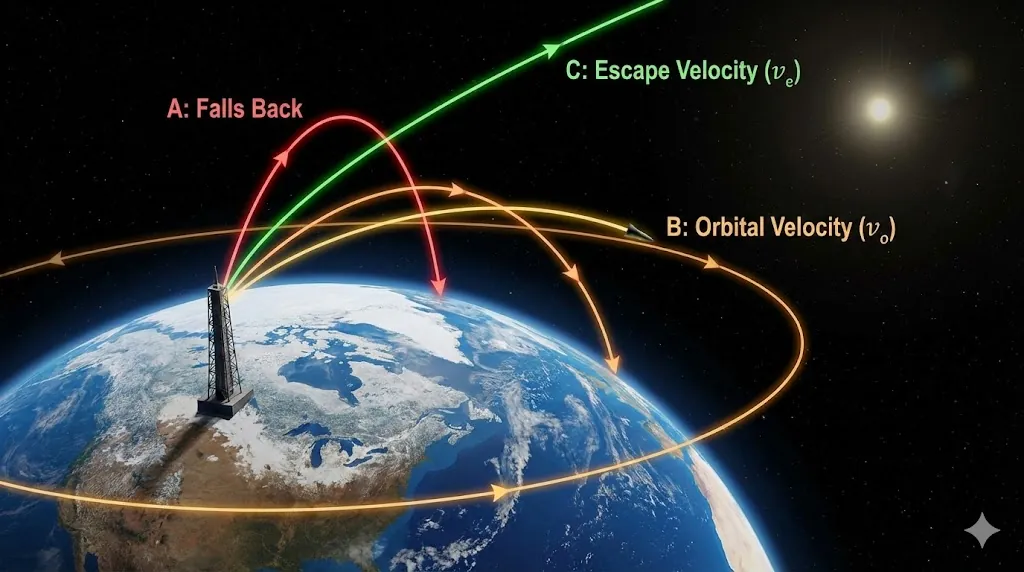
 km/s), an object can escape Earth’s gravity forever.
6.1 Orbital Speed ()
 )
)
For a satellite close to Earth surface ( ):
):  km/s.
km/s.
6.2 Time Period ()
 )
)
Squaring gives Kepler’s Third Law:  .
.
6.3 Energy of an Orbiting Satellite
| Energy Type | Formula | Sign |
|---|---|---|
Kinetic ( ) ) |  | Positive |
Potential ( ) ) |  | Negative |
Total ( ) ) |  | Negative (Bound) |
6.4 Binding Energy & Orbit Change
Binding Energy: Minimum energy to remove satellite to infinity ( ).
).
Orbit Change: Work done to shift from  to
to  :
:

 . How much energy is needed to move it to
  ?
?Show Answer


 J.
J.
An astronaut in a satellite feels weightless not because gravity is zero (it is quite strong there!), but because the satellite and the astronaut are both in a state of free fall towards Earth with the same acceleration ( ).
).