
Mechanical Properties of Fluids
NCERT Chapter 9 • Pressure, Bernoulli’s Principle, Viscosity & Surface Tension
1. Pressure and Pascal’s Law
Pressure ( ): The normal force acting per unit area. It is a scalar quantity.

Unit: Pascal (Pa) or N/m². 1 atm  Pa.
Pa.
1.1 Solids vs Fluids & Density
Solids resist shear stress and maintain shape. Fluids (liquids and gases) offer negligible resistance to shear stress and flow under its action.
- Liquids: Incompressible, fixed volume, free surface.
- Gases: Highly compressible, fill entire container.
Density: Mass per unit volume,  . SI unit: kg/m³.
Relative Density: Ratio of a substance’s density to that of water at 4°C (where  kg/m³). It is dimensionless.
1.2 Variation of Pressure with Depth
In a fluid at rest, pressure increases with depth due to the weight of the fluid column above.

Where  is atmospheric pressure,
  is density, and
  is depth.
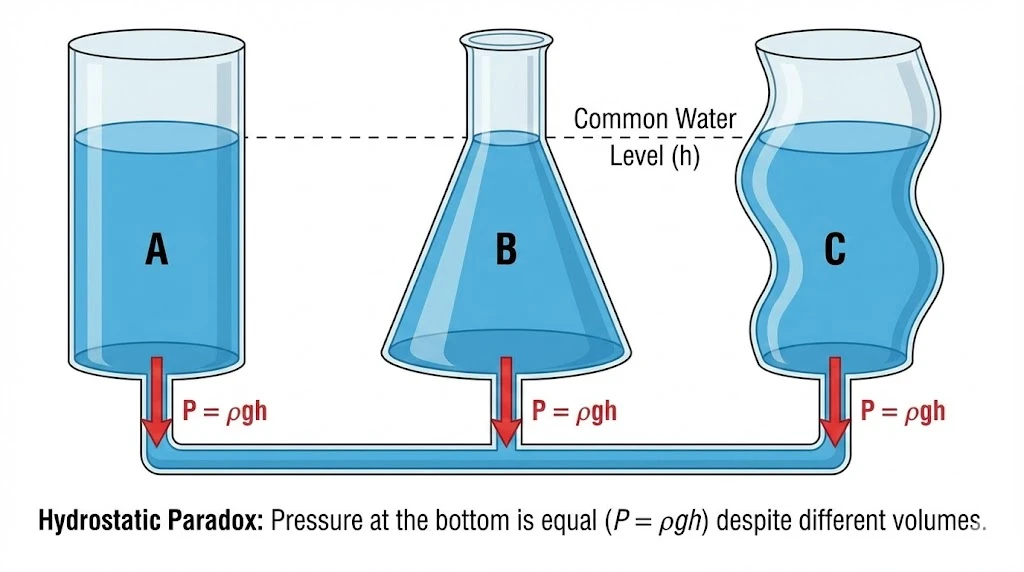
1.3 Hydrostatic Paradox
The pressure at a given depth in a fluid is independent of the shape or volume of the container. This is why water levels equalize in connected vessels of different shapes.
1.4 Atmospheric Pressure & Gauge Pressure
At sea level, atmospheric pressure is measured using a mercury barometer:  . With
  cm,
cm,  Pa.
Pa.
Gauge Pressure: Pressure relative to atmosphere:  .
.
1.5 Pascal’s Law
Pressure applied to an enclosed fluid is transmitted undiminished to every portion of the fluid and the walls of the containing vessel.
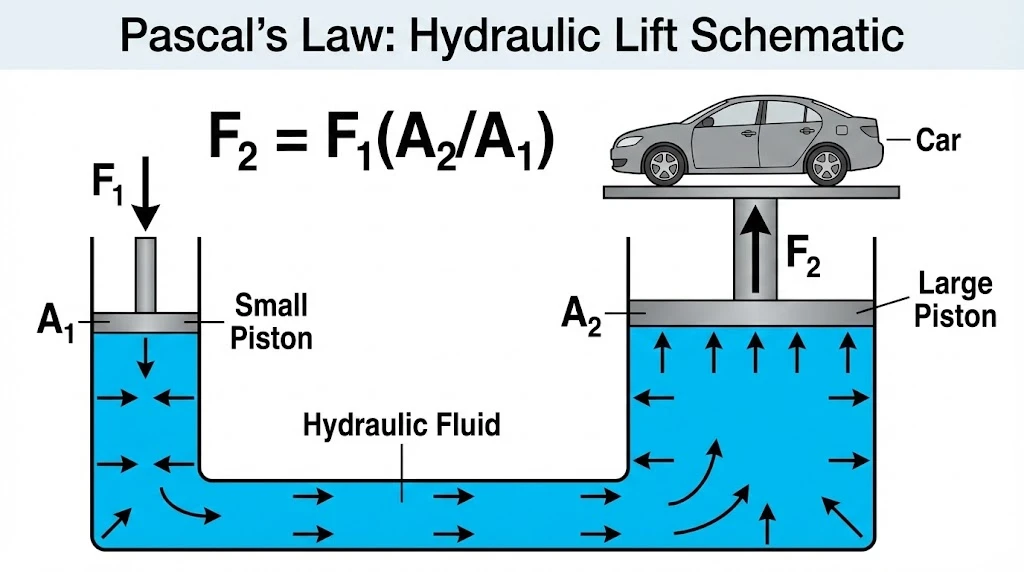
Since
 , we have
  .
.Therefore,
 . A large force
  is generated by a small force
  if
if  .
on a small piston of radius 5 cm. This pressure is transmitted to a second piston of radius 15 cm. If the mass of the car is 1350 kg, find . (
.
on a small piston of radius 5 cm. This pressure is transmitted to a second piston of radius 15 cm. If the mass of the car is 1350 kg, find . ( m/s²)
m/s²)Show Answer
Area ratio .
.Load force
 N.
N. N.
N.
2. Streamline Flow
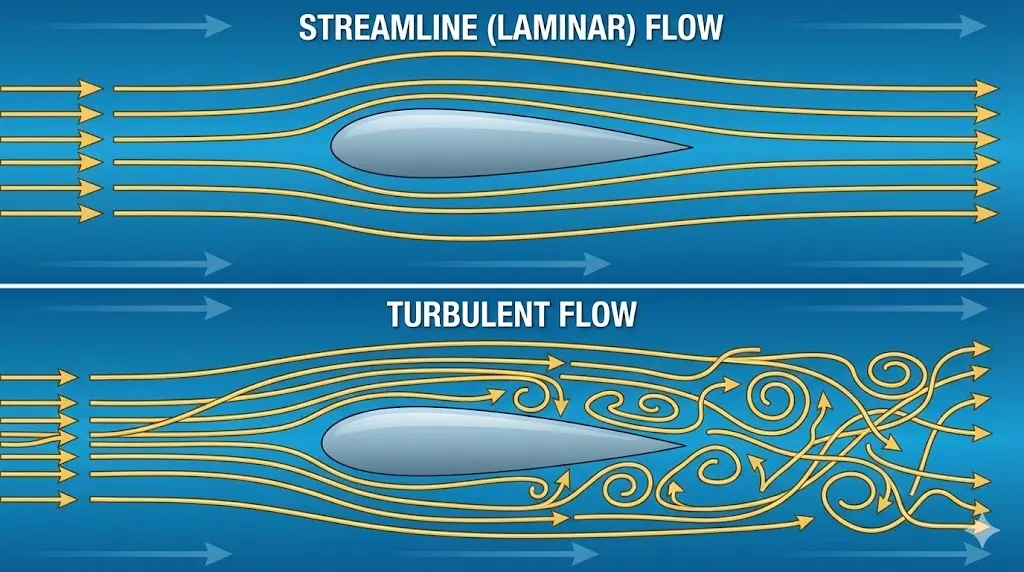
Streamline (Laminar) Flow: Flow in which every particle passing a point follows the same path as the preceding particles. It is steady and orderly.
Turbulent Flow: Irregular and chaotic flow occurring above a critical speed.
Equation of Continuity
For an incompressible fluid in streamline flow, the product of area and velocity is constant (Conservation of Mass).

This implies that velocity is higher where the tube is narrower ( ).
).
3. Bernoulli’s Principle
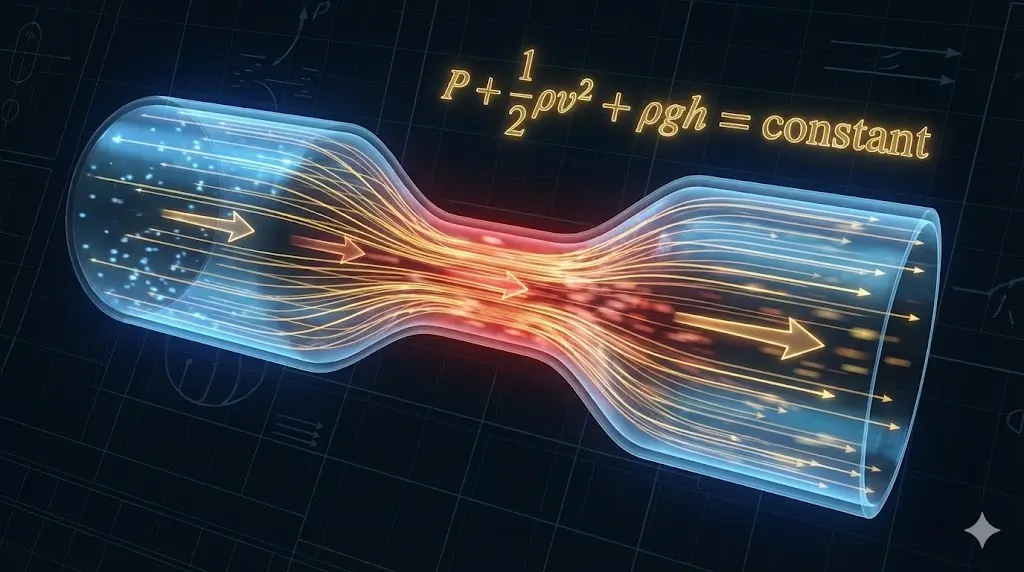
For streamline flow of an ideal fluid, the sum of pressure energy, kinetic energy, and potential energy per unit volume is constant.

Steady, incompressible, non-viscous flow.
Key Insight:
Where speed is high, pressure is low (and vice-versa). This explains dynamic lift in airplanes.
Applications
- Venturi Meter: Measures flow speed.
- Torricelli’s Law: Speed of efflux from a tank hole (
 ).
). - Dynamic Lift: Curved wings (aerofoils) create pressure difference.
 ).
).Show Answer
1. Continuity: m/s.
m/s.2. Bernoulli (Horizontal
 ):
):  .
. .
. Pa.
Pa.
4. Viscosity
Viscosity is the internal friction between fluid layers. It opposes relative motion.

Where  is the Coefficient of Viscosity. Unit: Poiseuille (Pl) or Pa-s.
Stokes’ Law
The viscous drag force on a sphere of radius  moving with velocity
  is:
is:

Terminal Velocity ()
The constant maximum speed attained by a falling body when Viscous Force + Buoyancy = Weight.

 kg/m³,
  kg/m³,
  Pa·s, find
  .
.Show Answer

 m/s.
m/s.
5. Surface Tension
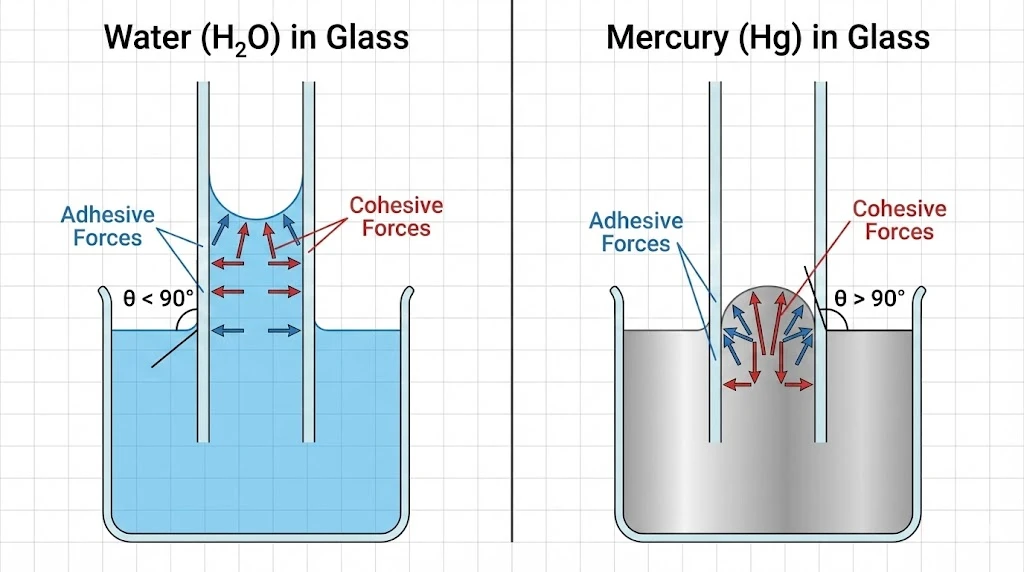
The property of a liquid surface to behave like a stretched elastic membrane. It arises due to cohesive forces.

5.1 Angle of Contact ()
 )
)- Acute angle (): Liquid wets the solid (e.g., water on glass).
- Obtuse angle (): Liquid does not wet the solid (e.g., mercury on glass).
 ): Liquid wets the solid (e.g., water on glass).
 ): Liquid does not wet the solid (e.g., mercury on glass).
5.2 Excess Pressure
Due to surface tension, pressure inside a curved surface is higher than outside.
- Liquid Drop:
- Soap Bubble: (Two surfaces)

 (Two surfaces)
5.3 Capillarity
The rise or fall of liquid in a narrow tube.

 kg/m³,
  m/s²,
m/s²,  )
)Show Answer

 N/m.
N/m.