
Mechanical Properties of Solids
NCERT Chapter 8 • Stress, Strain, Hooke’s Law & Elastic Moduli

1. Elasticity and Plasticity
Elasticity is the property of a body to regain its original size and shape when deforming forces are removed. Example: Steel, Rubber.
Plasticity is the inability of a body to regain its original shape, resulting in permanent deformation. Example: Putty, Mud.
2. Stress and Strain
When a body is deformed, internal restoring forces develop.
2.1 Stress ( )
)
 )
)The restoring force per unit area. Unit:  or Pascal (Pa).

2.2 Strain ()
 )
)The fractional change in dimension. It is dimensionless.

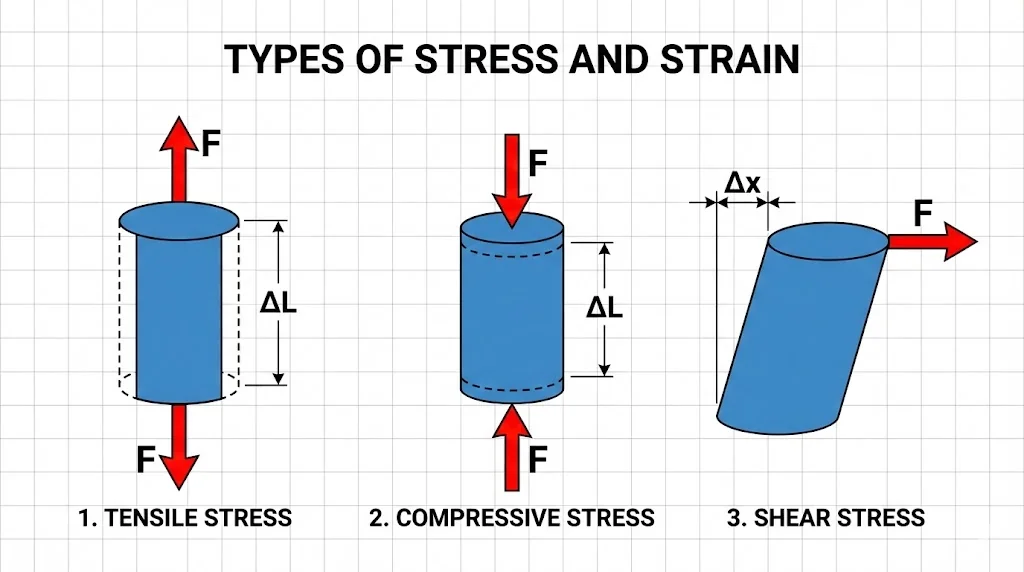
Types of Stress & Strain
| Type | Deformation | Formulae |
|---|---|---|
| Longitudinal | Change in Length | Tensile (stretch) or Compressive (squeeze) |
| Shearing (Tangential) | Change in Shape |  , ,  |
| Hydraulic (Volume) | Change in Volume |  (Pressure), (Pressure),  |
3. Hooke’s Law
For small deformations, stress is directly proportional to strain.

The constant of proportionality  is the Modulus of Elasticity.
4. Stress-Strain Curve
The behavior of a wire under increasing load is described by the stress-strain curve.
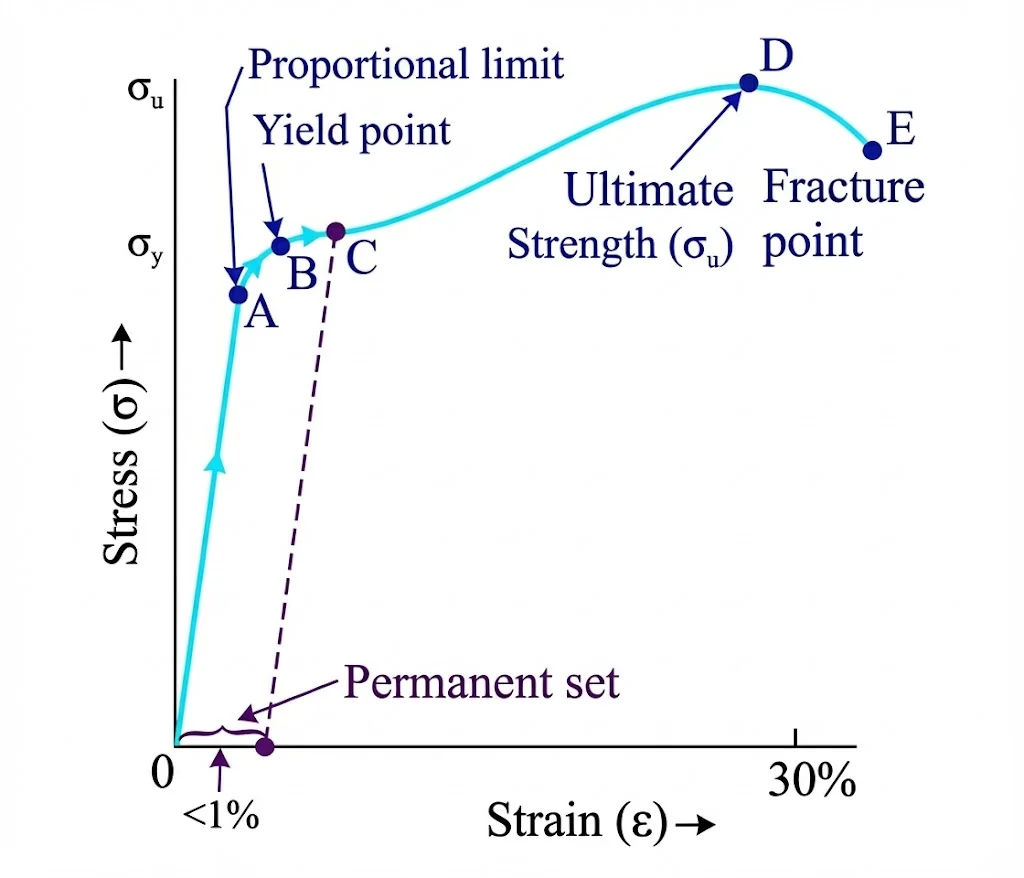
- Proportional Limit (A): Hooke’s law is valid. Linear region.
- Elastic Limit / Yield Point (B): Max stress for elastic behavior. Beyond B, deformation is permanent.
- Plastic Region (B to D): Small stress change causes large strain. Material flows.
- Fracture Point (E): The wire breaks.
Ductile materials (like copper) have a large plastic region. Brittle materials (like glass) break soon after the elastic limit.
Substances like rubber, elastin in arteries, and synthetic polymers can be stretched to several times their original length and still return to their original shape. They do not obey Hooke’s law over most of their range and have no well-defined plastic region.
5. Elastic Moduli
5.1 Young’s Modulus ()
 )
)Ratio of Longitudinal Stress to Longitudinal Strain. Measure of stiffness.

In everyday language, we say rubber is “more elastic” because it stretches more. But in physics, elasticity means resistance to deformation. Steel has a much higher Young’s modulus than rubber, so Steel is more elastic than Rubber in the scientific sense.
 is stretched by a load of 5 kg. Calculate change in length. (
 Pa,
Pa,  m/s²)
m/s²)Show Answer
 N.
N.
 m = 0.05 mm.
5.2 Shear Modulus ( or )
 or
or  )
)Ratio of Shearing Stress to Shearing Strain.

Generally,  .
.
5.3 Bulk Modulus ()
 )
)Ratio of Hydraulic Stress to Volume Strain.

Compressibility (): The reciprocal of Bulk Modulus ( ).
).
Solids are least compressible ( Pa), liquids more (
 Pa), and gases most compressible (
 Pa for air). Gases are about a million times more compressible than solids!
 kg/m³ and
  Pa. (1 atm
  Pa)
Pa)Show Answer
 Pa.
Pa.Volume Strain
 .
.Density

 kg/m³.
6. Elastic Potential Energy
Work done in stretching a wire is stored as elastic potential energy.
Average force during stretching from 0 to
 is
is  .
.Work
 .
.


 )
)Energy per unit volume

 .
.
7. Poisson’s Ratio ()
When a wire is stretched, it becomes longer but thinner. The ratio of lateral strain to longitudinal strain is Poisson’s Ratio.

Theoretical limits:  to
to  . For most solids:
  to
to  .
.
Show Answer
Longitudinal strain .
.Lateral strain
 .
.Volume

 .
.% Change =
 .
.
8. Applications of Elastic Behaviour
The elastic properties of materials are crucial in engineering design:
8.1 Design of Cranes and Ropes
A crane lifting 10 tonnes must use a steel rope thick enough so that stress does not exceed the yield strength ( Pa for mild steel). The required cross-sectional area is:

For safety, a factor of 10 is often used, leading to thicker ropes made of braided wires for flexibility.
8.2 I-Shaped Beams
In bridges and buildings, beams are designed with an I-shaped cross-section. This provides large depth  (which reduces bending
  ) while minimizing material and weight.

8.3 Maximum Height of Mountains
The maximum height of a mountain (~10 km) is limited by the elastic strength of rocks. At the base, the shear stress due to the weight of the mountain is  . When this exceeds the critical shear stress of rock (
 Pa), the rock flows. Solving
  gives
gives  km.
km.