
Work, Energy and Power
NCERT Chapter 5 • Work-Energy Theorem, Potential Energy & Collisions

1. Work and Scalar Product
In physics, Work is said to be done only when a force produces a displacement in the direction of the force. We use the Scalar (Dot) Product to define it.
1.1 Scalar Product

 : Work is Positive.
- : Work is Zero (e.g., Centripetal force).
- : Work is Negative (e.g., Friction).
 : Work is Positive.
 : Work is Zero (e.g., Centripetal force).
 : Work is Negative (e.g., Friction).
1.2 Work Done by a Force
Constant Force:  .
.
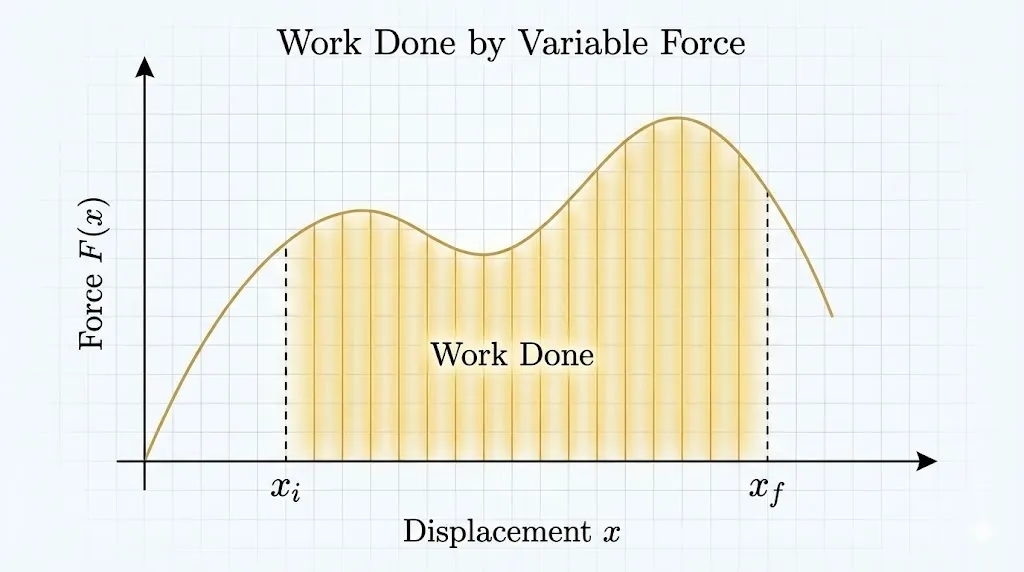
Variable Force: If force changes with position, we integrate over the limits:

 N acts on a body, displacing it from origin to point
  . Find Work done.
Show Answer
Displacement m.
m. J.
J.
2. Kinetic Energy & Work-Energy Theorem
Kinetic Energy ( ) is the energy possessed by a body by virtue of its motion.
  .
.
The Work-Energy Theorem
The work done by the net force on a particle equals the change in its kinetic energy.

Rate of change of K is
 .
.
Since
 , we get
  .
.
 . Integrating from
  to
to  :
: .
.
 .
.
Show Answer
 kg,
kg,  m/s.
m/s.
 J.
J.
3. Potential Energy
Potential Energy ( ) is the stored energy by virtue of position or configuration. It is defined only for Conservative Forces (like Gravity, Spring Force).


The value of potential energy depends on the choice of reference point (where  ). However, the change in potential energy (
 ) is independent of this choice and physically meaningful.
Why friction has no potential energy: The work done by kinetic friction depends on the total path length, not just start and end points. Such forces are called non-conservative.
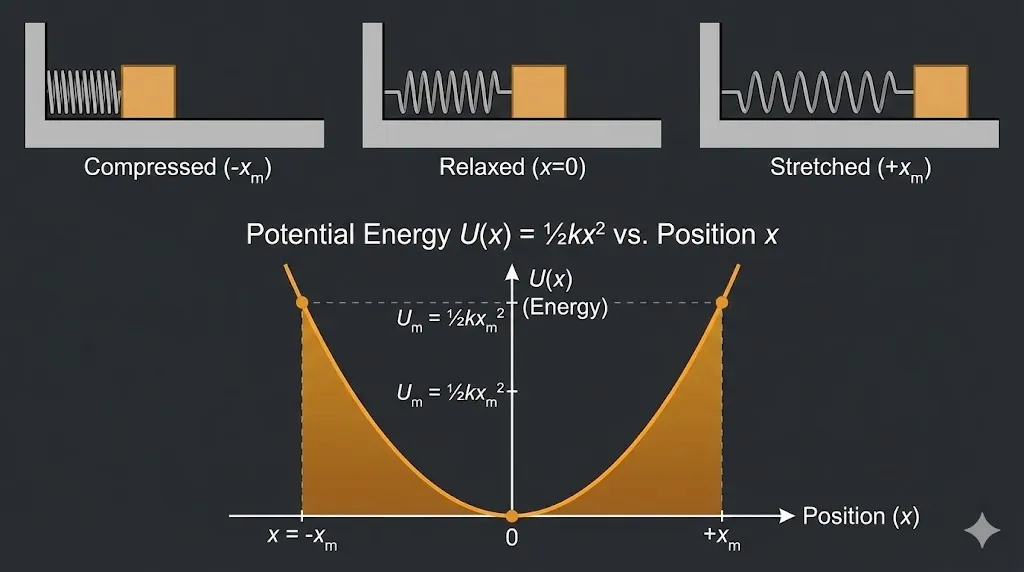
Potential Energy of a Spring
For a spring obeying Hooke’s Law ( ), the work done against the restoring force is stored as Elastic Potential Energy.
Elastic Potential Energy ( )
)
To stretch a spring by
 , external force
  .
. .
.
Total work to stretch from
 to
to  :
:![W = \int_{0}^{x} kx \, dx = k \left[ \dfrac{x^2}{2} \right]_0^x](https://i0.wp.com/physicsqanda.com/wp-content/ql-cache/quicklatex.com-cafd27087a17ca303caea8efd31b94c5_l3.png?resize=193%2C46&ssl=1 "Rendered by QuickLaTeX.com") .
.
 .
.
4. Conservation of Mechanical Energy
If only conservative forces act on a system, the Total Mechanical Energy ( ) remains constant.


Motion in a Vertical Circle
For objects like pendulums or roller coasters in vertical loops, mechanical energy conservation applies.
- Minimum Speed at Top: (to just complete loop).
- Minimum Speed at Bottom: .
 (to just complete loop).
 .
. . Find velocity at height
  using conservation of energy.
Show Answer
At top: . Total
  .
.At height
:  .
.
 .
.
When Non-Conservative Forces Act
If non-conservative forces (like friction, air resistance) do work, mechanical energy is not conserved. The generalized work-energy principle states:

where  is the work done by non-conservative forces. This work usually appears as heat or sound.
 m/s²)
m/s²)Show Answer
(a) J.
J.(b)
 J.
J.By work-energy theorem:

 J.
J.
5. Power & Efficiency
Power is the rate of doing work. It is a scalar quantity.


Unit: Watt (W). 1 Horsepower (hp) = 746 W.
Energy consumption is measured in kilowatt-hours (kWh).
 .
.
Efficiency ( ) of a device:
  .
.
 m/s²)
m/s²)Show Answer
Force required N.
N.Power
 W = 10 kW.
6. Collisions
A collision is an isolated event where strong forces act for a short time. Momentum is conserved in ALL collisions.
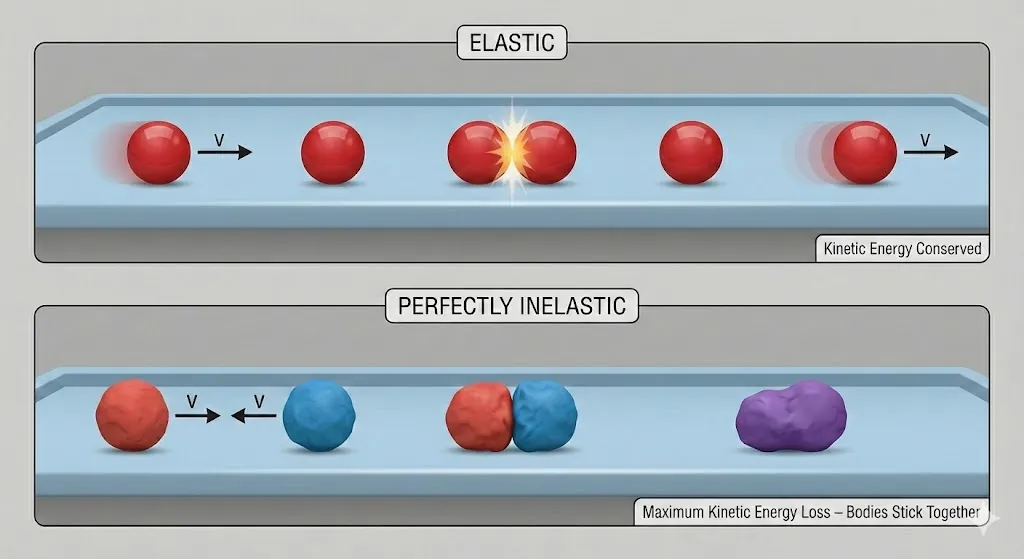
Types of Collisions
| Type | Momentum | Kinetic Energy |
|---|---|---|
| Elastic | Conserved | Conserved |
| Inelastic | Conserved | Not Conserved (Loss) |
| Perfectly Inelastic | Conserved | Max Loss (Bodies stick) |
Coefficient of Restitution ()
The elasticity of a collision is quantified by the coefficient of restitution ( ):
):

- Elastic:
- Inelastic:
- Perfectly Inelastic: (bodies stick together)


 (bodies stick together).
Show Answer
Using ,
, .
.
Elastic Collision in 1D
If two bodies of masses  moving with
  collide elastically:

Note on 2D Collisions: In two-dimensional collisions, momentum conservation gives two equations (x and y components). A third equation (e.g., from elasticity or measured angle) is needed to solve for the unknowns.
Show Answer
1. Momentum: .
.2. Elasticity:
 .
.Substitute (2) in (1):
 m/s.
m/s. m/s (Rebounds).
Show Answer
Momentum Conservation: .
.
 m/s.
m/s.
