

 by
by Ray Optics: Question Bank
Practice Set: Reflection, Refraction, Lenses & Instruments.
Part 1: Multiple Choice Questions (1 Mark)
1. An object is placed at a distance of 40 cm from a concave mirror of focal length 15 cm. If the object is displaced through a distance of 20 cm towards the mirror, the displacement of the image is:
(a) 30 cm towards the mirror
(b) 36 cm away from the mirror
(c) 30 cm away from the mirror
(d) 36 cm towards the mirror
Case 1:
 cm.
cm.Case 2:
 cm.
cm.Displacement
 cm. Since
  increased from 24 to 60, it moved away.
2. Which of the following is NOT a consequence of Total Internal Reflection?
(a) Glittering of a diamond
(b) Mirage on a hot day
(c) Blue colour of the sky
(d) Working of optical fibers
The blue colour of the sky is due to Scattering of light, not TIR.
3. A convex lens is dipped in a liquid whose refractive index is equal to the refractive index of the lens. Then its focal length will:
(a) Become zero
(b) Become infinite
(c) Remain unchanged
(d) Become small but non-zero
From Lens Maker’s Formula, if
 , then
  . Thus,
  . It behaves like a plane glass plate.
4. In a compound microscope, the intermediate image formed by the objective lens is:
(a) Virtual, erect, and magnified
(b) Real, erect, and magnified
(c) Real, inverted, and magnified
(d) Virtual, inverted, and diminished
The objective forms a real, inverted, and magnified image of the object, which acts as the object for the eyepiece.
5. For a prism of angle  , the angle of deviation
  is minimum when the angle of incidence
  and angle of emergence
  are related as:
(a) 
(b) 
(c) 
(d) 
Minimum deviation occurs when the ray passes symmetrically through the prism, i.e.,
.
6. An air bubble in a glass slab ( ) appears to be at a depth of 6 cm when viewed from one side and at 4 cm when viewed from the other side. The thickness of the glass slab is:
(a) 10 cm
(b) 6.67 cm
(c) 15 cm
(d) 20 cm
Real Depth
 Apparent Depth.
 Total thickness
 cm.
cm.
7. The magnifying power of a telescope in normal adjustment is given by:
(a) 
(b) 
(c) 
(d) 
For normal adjustment (image at infinity),
 .
.
8. Two thin lenses of power +6D and -2D are in contact. The focal length of the combination is:
(a) 25 cm
(b) 50 cm
(c) -25 cm
(d) -50 cm
 D.
D. cm.
cm.
9. The critical angle for diamond is approximately:
(a) 
(b) 
(c) 
(d) 
Diamond has a high refractive index (
 ), resulting in a small critical angle.
10. Which color of light is deviated the most when passing through a prism?
(a) Red
(b) Yellow
(c) Violet
(d) Green
Refractive index is maximum for violet light (shortest wavelength), so deviation
 is maximum.
Part 2: Assertion-Reason Questions
(B) Both A & R are true, R does NOT explain A.
(C) A is true, R is false.
(D) A is false, R is true.
1. Assertion (A): A convex mirror always produces a virtual image independent of the location of the object.
Reason (R): The focal length of a convex mirror is positive.
A and R are true. Convex mirrors diverge rays, forming virtual images.
 is positive. However, the sign of alone isn’t the complete physical explanation for the virtual nature.
2. Assertion (A): An air bubble in water behaves like a diverging lens.
Reason (R): The refractive index of air is less than that of water.
Correct. Since the surrounding medium (water) is denser than the lens material (air), the nature of the lens is reversed (Convex shape becomes Diverging).
3. Assertion (A): Optical fibers can transmit light signals even if the fiber is bent.
Reason (R): Light undergoes repeated total internal reflections along the length of the fiber.
Correct. As long as the angle of incidence exceeds the critical angle, light stays confined in the core.
4. Assertion (A): The objective of a telescope has a large aperture.
Reason (R): Large aperture increases the magnifying power of the telescope.
Assertion is True. Reason is False. Large aperture increases light gathering power and resolution, not magnification (
 ).
).
5. Assertion (A): A diamond sparkles brightly.
Reason (R): The critical angle for diamond is very small ( ).
).
Correct. Small critical angle allows light to easily undergo Total Internal Reflection multiple times before exiting.
6. Assertion (A): Reflecting telescopes are preferred over refracting telescopes.
Reason (R): Mirrors suffer from chromatic aberration.
Assertion is True. Reason is False. Mirrors do not suffer from chromatic aberration, which is their main advantage.
7. Assertion (A): When a lens is immersed in water, its power decreases.
Reason (R): The focal length of the lens increases in water.
Correct. Since
 , an increase in focal length leads to a decrease in power. The relative refractive index
  is smaller than
  .
.
8. Assertion (A): A thin prism does not deviate light much.
Reason (R): For a thin prism, deviation .
Correct. Since
is small, the deviation is also small.
9. Assertion (A): In a compound microscope, the objective lens has a small focal length.
Reason (R): This is required to achieve high magnification.
Correct. Magnification
 . To maximize
  ,
,  must be small.
10. Assertion (A): The power of a combination of lenses in contact is the algebraic sum of individual powers.
Reason (R): 
Correct. This is the standard formula for thin lenses in contact.
Part 3: Important Derivations & Theory
1. Derive the Lens Maker’s Formula for a double convex lens.

 ):
): … (i)
… (i)Step 2: Refraction at second surface (
 ). The image from the first surface acts as a virtual object:
 … (ii)
Step 3: Adding (i) and (ii):

Divide by
 :
: 
Since
 , we get:
2. Draw the ray diagram of a compound microscope and write the formula for its magnification when the image is formed at infinity.

Magnification (
 ): Product of objective magnification (
 ) and eyepiece magnification (
 ).
).For image at infinity:
 .
.
3. Explain Total Internal Reflection (TIR) with a diagram. What is the relation between critical angle and refractive index?
 is greater than the critical angle (
 ), the ray reflects back into the denser medium.
Relation:
 (where
  ).
).
4. Derive the relation  for a triangular prism and deduce the formula for the refractive index of the prism material in terms of the angle of minimum deviation.

Part A: Deviation Formula
In the quadrilateral  ,
,  .
.
In  ,
,  .
.
Comparing the two, we get:  .
.
The total deviation is the sum of deviations at two faces:  .
.
 .
.
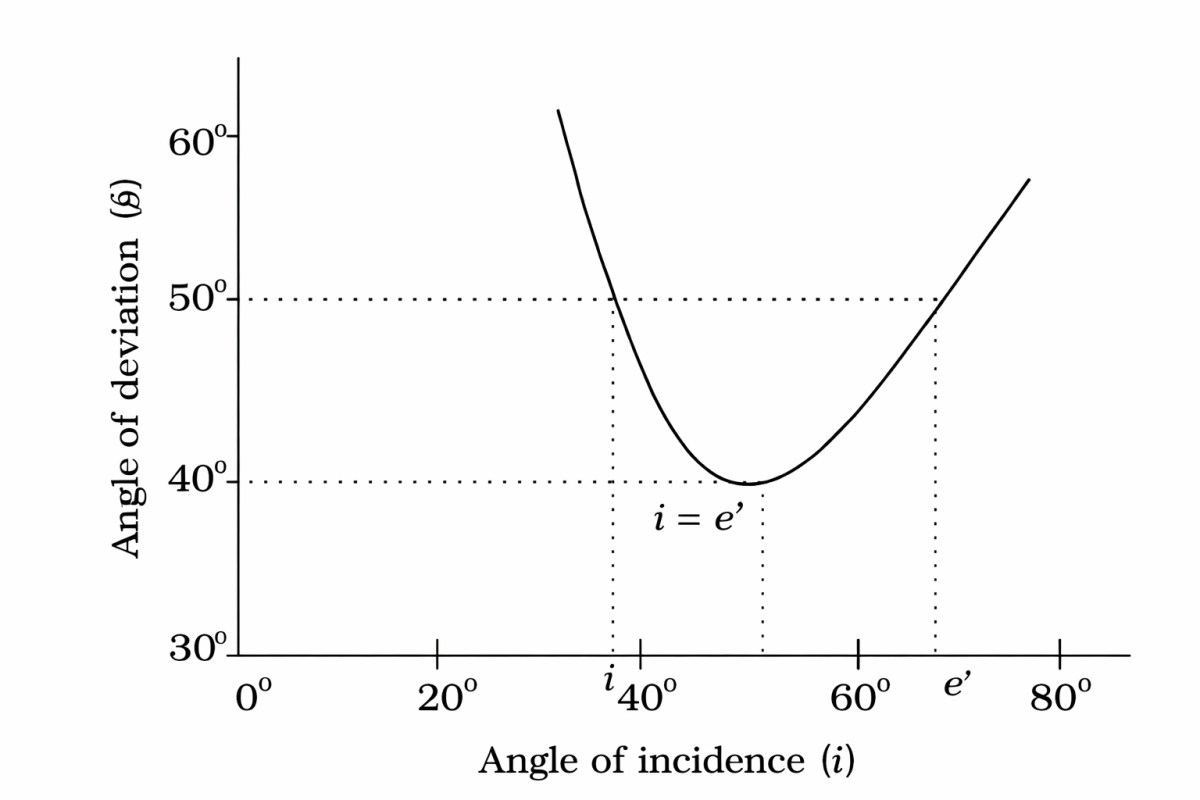
Part B: Refractive Index
At minimum deviation ( ), the ray passes symmetrically: and
  .
.
From  .
.
From  .
.
Using Snell’s Law ( ):
):
![\[n = \frac{\sin\left(\frac{A + \delta_m}{2}\right)}{\sin\left(\frac{A}{2}\right)}\]](https://i0.wp.com/physicsqanda.com/wp-content/ql-cache/quicklatex.com-12f5ca92c9fd37b705e1973659e6705d_l3.png?resize=120%2C51&ssl=1 "Rendered by QuickLaTeX.com")
Part 4: Numericals
1. Double-convex lenses are to be manufactured from a glass of refractive index 1.55, with both faces of the same radius of curvature. What is the radius of curvature required if the focal length is to be 20 cm?

For double convex:
 .
.

 cm.
cm.
2. A small telescope has an objective lens of focal length 144 cm and an eyepiece of focal length 6.0 cm. What is the magnifying power and the separation between the objective and the eyepiece?
 .
.Separation (Tube Length)
 .
.
3. A prism is made of glass of unknown refractive index. A parallel beam of light is incident on a face of the prism. The angle of minimum deviation is measured to be  . The refracting angle of the prism is
  . Calculate the refractive index. (Given
  )
)


 .
.
4. A ray of light passes through an equilateral glass prism such that the angle of incidence is equal to the angle of emergence, and each of these angles is equal to  of the angle of the prism. Calculate the (a) angle of deviation and (b) refractive index of the prism.
 .
.Condition:
 .
.(a) Angle of Deviation (
):Since
, the prism is in minimum deviation.Formula:

 .
.(b) Refractive Index (
 ):
):

 (or
(or  ).
).
5. A thin prism of angle  gives a deviation of
  . What is the refractive index of the material of the prism?
), deviation is given by:


 .
.
Part 5: Case Study
Case Study 1: Telescopes
Telescopes are used to observe distant objects clearly. There are two main types: refracting (using lenses) and reflecting (using mirrors). The largest telescopes in the world are reflecting telescopes, as mirrors are easier to support and do not suffer from chromatic aberration.

- Identify the primary mirror used in the Cassegrain telescope shown above (Concave/Convex).
- Why are reflecting telescopes preferred over refracting telescopes for astronomical purposes?
- If the focal length of the objective mirror is 200 cm and the eyepiece is 5 cm, what is the magnification?
2. They do not suffer from chromatic aberration, and large mirrors are lighter and easier to support than large lenses.
3.
 .
.
Case Study 2: Optical Fibers
Optical fibers are the backbone of modern communication, capable of transmitting audio and video signals over long distances with minimal loss. They operate on the principle of Total Internal Reflection (TIR). Structurally, a fiber consists of a central core made of high-quality glass or quartz (refractive index ) surrounded by a thinner layer called cladding (refractive index  ), and a protective outer coating.

- What is the necessary condition regarding refractive indices for an optical fiber to work?
- Why is a coating (cladding) necessary? Why not just use the bare core?
- If the refractive index of the core is 1.50 and the cladding is 1.45, calculate the critical angle for the core-cladding interface. (Given
 )
) - Name one medical application of optical fibers.
 )
)- The refractive index of the core () must be greater than the refractive index of the cladding () so that light travels from a denser to a rarer medium, enabling TIR.
- The cladding prevents light from leaking out into the surroundings and protects the core surface from scratches or contamination, which would otherwise cause light loss.
- Calculation:
Using the formula:
. - Endoscopy: Optical fibers (light pipes) are used to visualize internal organs like the stomach and intestines.
 :
:
 .
.


