
Electricity
NCERT Chapter 11 • Current, Resistance, and Power

Electricity is a controllable and convenient form of energy. In this chapter, we explore how current flows, what controls it (resistance), and how we use it for heating and lighting.
1. Electric Current and Circuit
Electric Current is expressed by the amount of charge flowing through a particular area in unit time. It is the rate of flow of electric charges.
- Conventionally, the direction of electric current is opposite to the flow of electrons.
- SI Unit: Ampere (A). One ampere is the flow of one coulomb of charge per second (
 ).
).
 ).
). ![\[I = \dfrac{Q}{t}\]](https://i0.wp.com/physicsqanda.com/wp-content/ql-cache/quicklatex.com-1a3d96cec359d7b5fb7d3f81d7d430f1_l3.png?resize=50%2C37&ssl=1 "Rendered by QuickLaTeX.com")
Where  is current,
  is net charge, and
  is time.
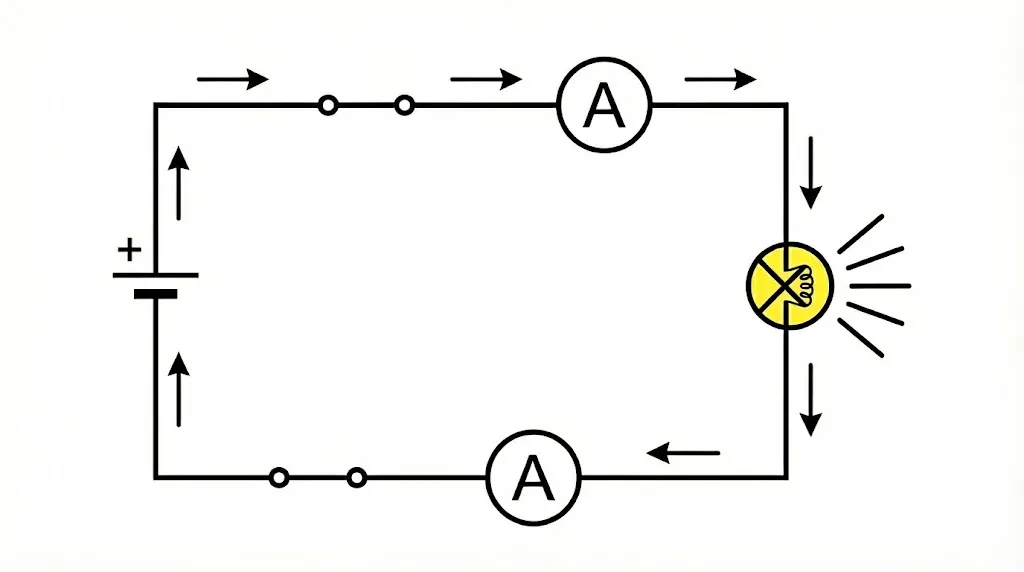
Solution:
Given:
 .
.From
 :
: .
.
 .
.Total charge
 .
.For
 ,
,  electrons (approx
  ).
).
2. Electric Potential and Potential Difference
Electrons move only if there is a difference of electric pressure, called Potential Difference. This is often produced by a battery.
Electric potential difference ( ) between two points is the work done (
 ) to move a unit charge () from one point to the other.
![\[V = \dfrac{W}{Q}\]](https://i0.wp.com/physicsqanda.com/wp-content/ql-cache/quicklatex.com-dc245f4d7b43aad23483bb80cba8e0bf_l3.png?resize=60%2C41&ssl=1 "Rendered by QuickLaTeX.com")
SI Unit: Volt (V).  .
.
Solution:
 .
.
 .
.For each coulomb (
 ), Energy =
  .
.
3. Ohm’s Law
Ohm’s Law states that the potential difference () across the ends of a given metallic wire is directly proportional to the current flowing through it (), provided the temperature remains the same.
Here,  is the Resistance, a property of the conductor to resist the flow of charges. Its SI unit is Ohm (
 ).
).
4. Factors on which Resistance Depends
The resistance of a conductor depends on:
- Length (): Directly proportional ().
- Area of Cross-section (): Inversely proportional ().
- Nature of Material: Represented by Resistivity ().
 ).
). ![\[R = \rho \dfrac{l}{A}\]](https://i0.wp.com/physicsqanda.com/wp-content/ql-cache/quicklatex.com-ed04a3654cb66298706ac8f0c70b58d6_l3.png?resize=62%2C36&ssl=1 "Rendered by QuickLaTeX.com")
 (rho) is the Electrical Resistivity. Metals have very low resistivity (
 ), while insulators have high resistivity.
 and area
  has a resistance of
  . What would be the resistance of another wire of the same material having length
  and area
  ?
?Solution:
 .
. .
. .
.
 ). A thicker wire has less resistance.
 . If becomes
  and is constant, the current will also become half.
(2) Alloys do not oxidise (burn) readily at high temperatures.
 ) is a better conductor than Mercury (
 ).
).(b) Silver is the best conductor (lowest resistivity =
 ).
).
5. Resistance of a System of Resistors
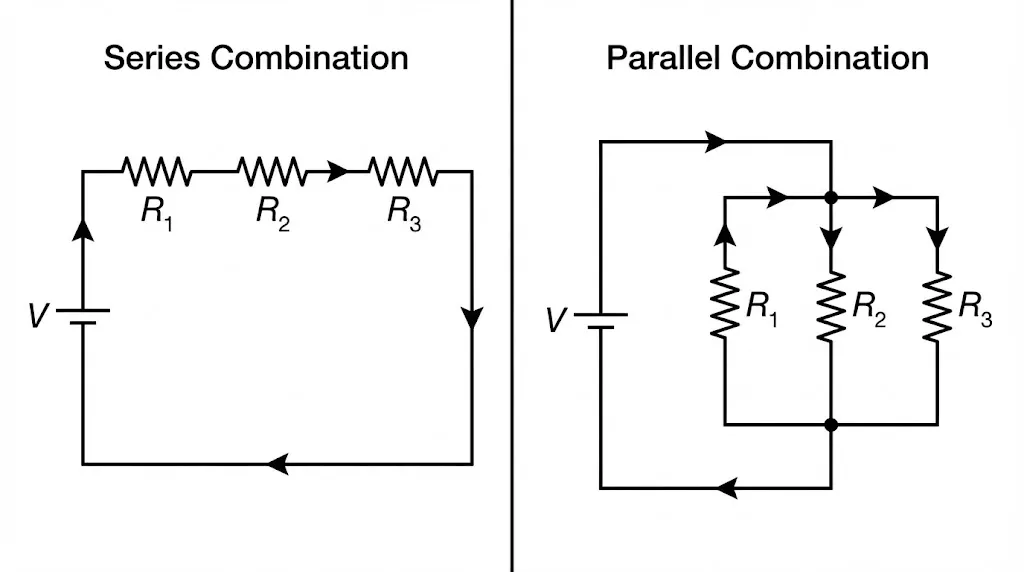
A. Resistors in Series
Joined end to end. The current is the same in every part of the circuit.
![\[R_s = R_1 + R_2 + R_3\]](https://i0.wp.com/physicsqanda.com/wp-content/ql-cache/quicklatex.com-4ccffc7a00d5290bc6ac5e8f71461023_l3.png?resize=150%2C14&ssl=1 "Rendered by QuickLaTeX.com")
The total potential difference is the sum of potential differences across individual resistors ( ).
).
resistor, an 8 resistor, and a 12 resistor, and a plug key, all connected in series. resistor. What would be the readings? .
.Total Voltage
 .
.Current (Ammeter Reading)
 .
.Voltage across 12
(Voltmeter Reading)  .
.
B. Resistors in Parallel
Connected between the same two points. The potential difference is the same across each resistor.
![\[\dfrac{1}{R_p} = \dfrac{1}{R_1} + \dfrac{1}{R_2} + \dfrac{1}{R_3}\]](https://i0.wp.com/physicsqanda.com/wp-content/ql-cache/quicklatex.com-10029ec6affbb1a69d79d174fd14e1a8_l3.png?resize=164%2C42&ssl=1 "Rendered by QuickLaTeX.com")
The total current is the sum of currents through individual branches ( ).
).
and  , (b) 1 ,
  , and .
(a) Slightly less than 1
.(b) Slightly less than 1
.
, a toaster of 50 , and a water filter of 500 are connected in parallel to a 220 V source. What is the resistance of an electric iron connected to the same source that takes as much current as all three appliances, and what is the current? .
. .
.Current
 .
.
(2) If one device fails, others continue to work (unlike series where the circuit breaks).
(3) Different devices can draw different currents according to their resistance.
, 3 , and 6 be connected to give a total resistance of (a) 4 , (b) 1 ?: Connect 3 and 6 in parallel (gives 2 ), then connect that in series with 2 . ( ).
).(b) 1
: Connect all three in parallel. ( ).
, 8 , 12 , 24 ?
).
, 8 , 12 , 24 ? .
.(b) Lowest (Parallel):
 . So
. So  .
.
6. Heating Effect of Electric Current
If an electric circuit is purely resistive, the source energy is dissipated entirely as heat. This is the heating effect of current.
Joule’s Law of Heating:
![\[H = I^2 R t\]](https://i0.wp.com/physicsqanda.com/wp-content/ql-cache/quicklatex.com-701828c1c181eb6d877f88b8c2d56e5c_l3.png?resize=77%2C17&ssl=1 "Rendered by QuickLaTeX.com")
Heat ( ) is directly proportional to square of current (), resistance (), and time ().
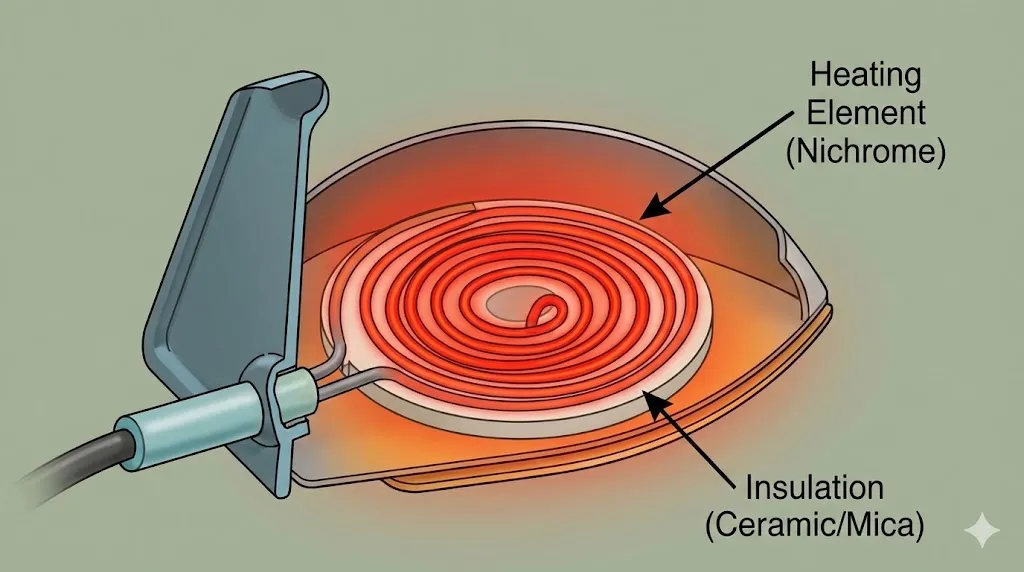
 ) and glows. The cord is made of copper (low resistance), so negligible heat is produced.
 .
. .
takes a current of 5 A. Calculate the heat developed in 30 s.
.
takes a current of 5 A. Calculate the heat developed in 30 s. .
.
7. Electric Power
The rate at which electric energy is dissipated or consumed. The SI unit is Watt (W).
![\[P = VI = I^2R = \dfrac{V^2}{R}\]](https://i0.wp.com/physicsqanda.com/wp-content/ql-cache/quicklatex.com-b7d594f901c02410ae5346b5a2011eed_l3.png?resize=162%2C39&ssl=1 "Rendered by QuickLaTeX.com")
Commercial Unit: Kilowatt-hour (kWh).  .
.
 .
.Energy
 .
.
8. Chapter Exercises
Practice these NCERT exercise questions to master the chapter:
(a) 1/25 (b) 1/5 (c) 5 (d) 25
Each part has resistance
 . Connected in parallel,
  . So
. So  , thus
  .
.
(a)
 (b)
(b)  (c)
(c)  (d)
(d)  .
.
(a) 100 W (b) 75 W (c) 50 W (d) 25 W
 .
.New Power
 .
.
(a) 1:2 (b) 2:1 (c) 1:4 (d) 4:1
Series resistance
 . Parallel resistance
  .
.Heat
 (for same V). Ratio
  .
.
 m. What will be the length of this wire to make its resistance 10 ? How much does the resistance change if the diameter is doubled?
 .
.Length
 .
.If diameter is doubled, Area becomes 4 times. Resistance becomes 1/4th.
resistors (in parallel) are required to carry 5 A on a 220 V line? .
.For
 resistors in parallel:
  .
. .
.
 .
.Total Max Current = 5 A.
Number of bulbs
 .
.
(a) Why is tungsten used for filaments?
(b) Why are alloys used for heating devices?
(c) Why is series arrangement not used for domestic circuits?
(d) How does resistance vary with area?
(e) Why are copper and aluminium used for transmission?
(b) Higher resistivity and high melting point.
(c) Voltage divides, total resistance increases, and if one appliance fails, all stop.
(d) Resistance is inversely proportional to area.
(e) Low resistivity (good conductors).