
« Back to AP Physics Guide / Unit 1: Kinematics
AP Physics 1: 1D Motion & The “Big 4” Equations
1. The 5 Variables of Motion

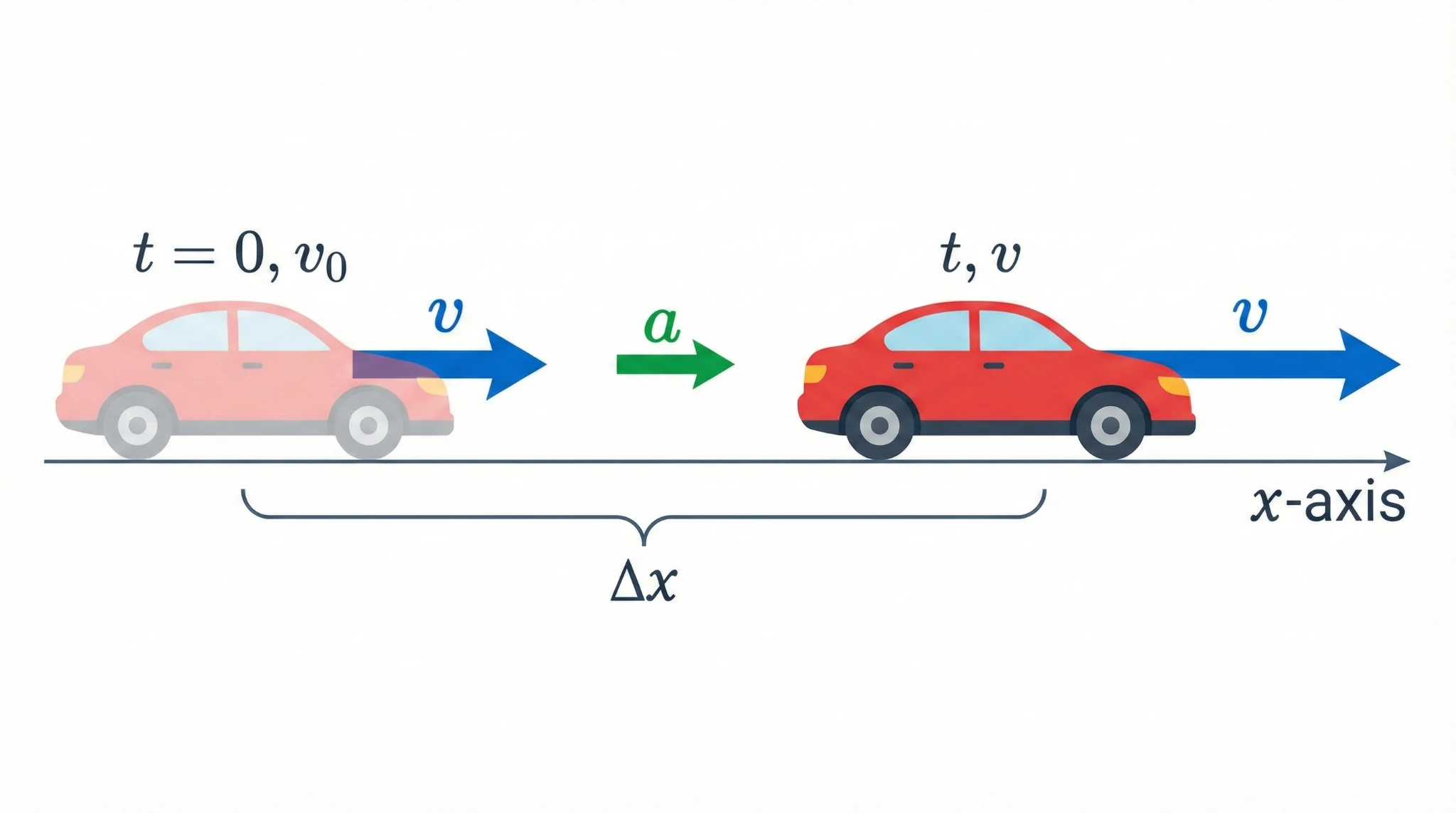
Every kinematics problem involves exactly 5 variables. Your first step is always to list them:
 : Displacement (m)
- : Time interval (s)
- : Initial Velocity (m/s)
- : Final Velocity (m/s)
- : Acceleration (m/s²)
 : Initial Velocity (m/s)
2. The “Big 4” Equations
These are provided on your AP Formula Sheet. The secret to speed is knowing which variable is missing.
| Equation | Missing Variable? | Best Use Case |
|---|---|---|
 |
Displacement ( ) ) |
Finding velocity or time. |
 |
Final Velocity ( ) ) |
Dropping objects or finding distance. |
 |
Time ( ) ) |
Stopping distance problems. |
 |
Acceleration ( ) ) |
Average velocity problems. |
3. Vertical Motion (Free Fall)

 ). Right: Throwing a ball up. Notice that acceleration (
 ) is always pointing down, even when the ball goes up!
When an object is in the air (thrown up or dropped), only gravity acts on it.
Dropping an Object
- (or on MCQ)
- Displacement is negative.
 (or
(or  on MCQ)
 is negative.
Throwing Upward
- Velocity at peak =
- Acceleration is always , even at the top!
- Time up = Time down (if landing on same level).

 , even at the top!
4. AP-Style Practice Question
Question: A car traveling at  applies the brakes and stops over a distance of
  . What was the car’s acceleration?
▶ Click to see Solution
Step 1: List Variables
 ,
,  (stopped),
  ,
, 
Time () is missing!
Step 2: Choose Equation
Use the “Time Independent” equation:
Step 3: Solve


5. Level Up: Harder Practice Problems
Question 2 (Free Fall): A student throws a ball straight up into the air with an initial speed of  . How long does it take for the ball to reach its maximum height? (Assume
  )
)
▶ Click for Solution
Key Concept: At the maximum height, the velocity is zero ().
Variables:  , ,
, ,  (gravity points down!),
Equation:
Solve:


Question 3 (Symbolic Derivation): A sprinter starts from rest and accelerates at a constant rate for a time . Derive an expression for the final velocity  in terms of the distance traveled
  and the acceleration .
▶ Click for Solution
Step 1: Identify Knowns
Initial velocity . Acceleration = . Distance  .
.
Note: We need to eliminate time () because it is not in the requested answer!
Step 2: Choose Equation
Use the time-independent equation:
Step 3: Solve

