
« Back to AP Physics Guide / Unit 1: Kinematics
AP Physics 1: Motion Graphs Master Guide
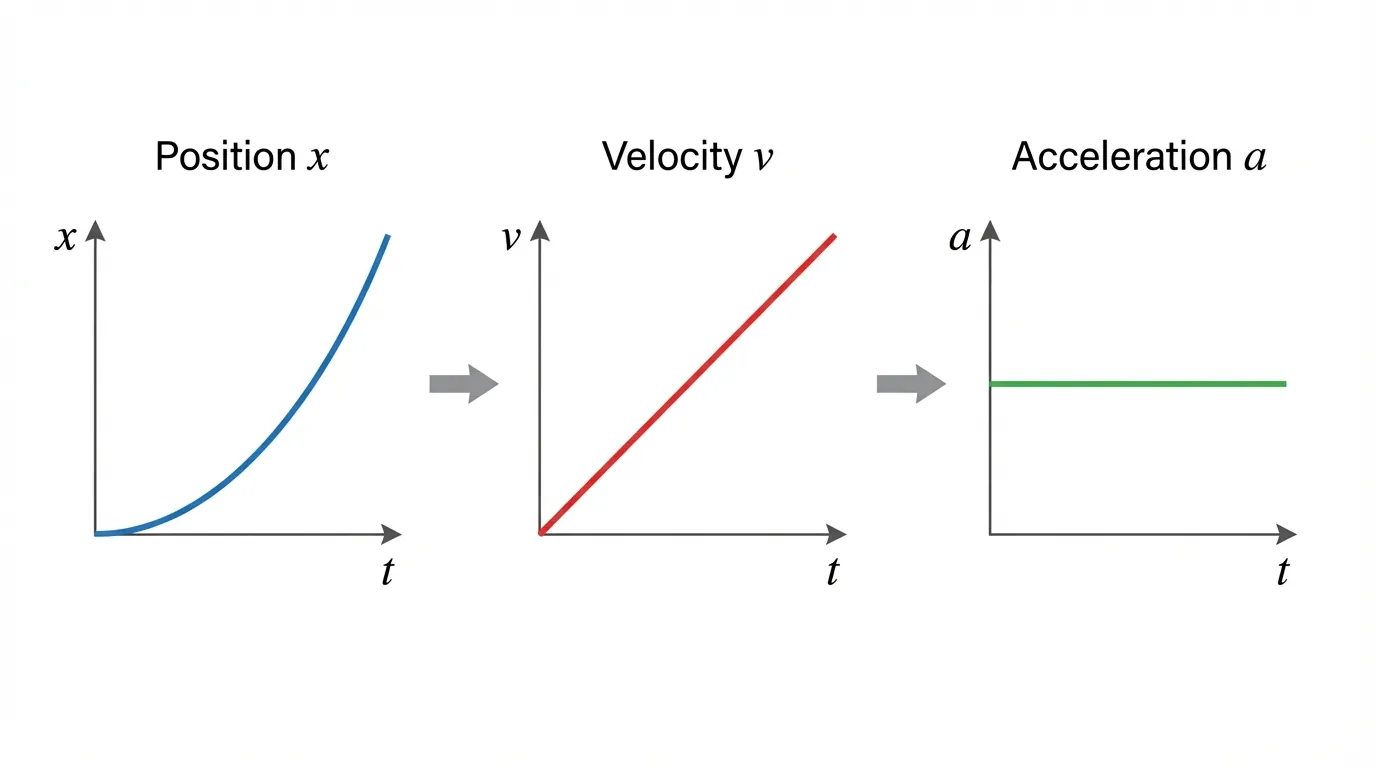
1. Position vs. Time Graphs ( vs. )
vs. )
 vs.
vs.  )
)This graph tells you where an object is located.

| Slope = Velocity | If slope is steep, it’s fast. If horizontal, it’s stopped. |
| Shape = Acceleration |
|
 )
) ): Positive Acceleration
2. Velocity vs. Time Graphs ( vs. )
This is the most important graph on the AP Exam because it links everything together.

 graph, the slope tells you acceleration, and the shaded area tells you how far it moved (displacement).
Slope = Acceleration
Steep slope = High acceleration.
Horizontal line = Constant velocity ( ).
).
Area = Displacement
The “Area Under the Curve” (between the line and the x-axis) tells you how far it moved ( ).
).
The “Crossing the Axis” Rule: Whenever the graph crosses the horizontal axis (goes from + to – or vice versa), the object has changed direction.
3. Acceleration vs. Time Graphs ( vs. )
 vs.
vs. In AP Physics 1, this graph is almost always a series of flat horizontal lines (because we deal with constant acceleration).
- Read the Value: Tells you the acceleration at that moment.
- Area Under Curve: Tells you the Change in Velocity ().
 ).
).4. AP-Style Concept Checks
Test your ability to read graphs without using a calculator. These are typical multiple-choice style concepts.
Question 1 (Velocity Graph): An object moves along the x-axis. Its velocity vs. time graph is a straight diagonal line starting at  and ending at
  . Describe the motion.
▶ Click to see Answer
Answer: The object slows down while moving left, stops momentarily, and then speeds up moving right.
Reasoning:
- Start: Negative velocity means moving left.
- Middle: The line crosses the axis at . This means it stops.
- End: Positive velocity means moving right.
- Slope: The constant positive slope means constant positive acceleration the whole time.
 . This means it stops.
Question 2 (Position Graph): Two cars, A and B, are moving along a straight road. On a Position vs. Time graph, Car A’s line is steep and negative. Car B’s line is shallow and positive. Which car is moving faster?
▶ Click to see Answer
Answer: Car A is faster.
Reasoning: Speed is determined by the magnitude (steepness) of the slope, not the direction. Car A has a steeper slope, so it covers more meters per second, even though it is moving in the negative direction.
Question 3 (The “Frown” Rule): An object’s Position vs. Time graph is shaped like an upside-down parabola (a frown  ). The object is moving in the positive direction. Is the object speeding up or slowing down?
▶ Click to see Answer
Answer: Slowing down.
Reasoning:
- Velocity: The slope is positive (moving positive direction).
- Acceleration: The shape is a “frown” (concave down), which means acceleration is negative.
- Conclusion: When velocity (+) and acceleration (-) have opposite signs, the object slows down.
Explore More Unit 1: Kinematics
-
📏
Master the Basics:
1D Motion & The “Big 4” Equations » - 🚀
Ready to move on?
Start Unit 2: Dynamics (Forces) »