3D scientific visualization showing electric potential surfaces around a charge and a parallel plate capacitor glowing with stored energy.

10 Solved Numericals on Electrostatic Potential and Capacitance

Spread the love

10 Solved Numericals on Electrostatic Potential and Capacitance | Physics Q&A

10 Solved Numericals on Electrostatic Potential and Capacitance

NCERT Chapter 2 • Practice Problems with Step-by-Step Solutions

NCERT 2025–26 Exam Practice • 8-10 Marks JEE Main • Important

1. Potential Due to Point Charge

Problem: Calculate the electrostatic potential at a point 9 cm away from a point charge of 4 × 10⁻⁷ C. How much work is done in bringing a charge of 2 × 10⁻⁹ C from infinity to this point? Does the work depend on the path taken?

Solution 2 Marks
Given:
q = 4 \times 10^{-7}\, \text{C},\; r = 9\, \text{cm} = 0.09\, \text{m},\; q_0 = 2 \times 10^{-9}\, \text{C}
\frac{1}{4\pi\epsilon_0} = 9 \times 10^9\, \text{Nm}^2\text{C}^{-2}
Step 1: Calculate potential
V = \frac{1}{4\pi\epsilon_0} \frac{q}{r} = 9 \times 10^9 \times \frac{4 \times 10^{-7}}{0.09} = 4 \times 10^4\, \text{V}
Step 2: Calculate work done
Work done in bringing charge q_0 from infinity:
W = q_0 V = (2 \times 10^{-9}) \times (4 \times 10^4) = 8 \times 10^{-5}\, \text{J}
Path independence:
No, the work done is path independent because electrostatic force is conservative. Work depends only on initial and final positions.
\boxed{V = 4 \times 10^4\,\text{V}, \quad W = 8 \times 10^{-5}\,\text{J}}

2. Zero Potential Point Between Charges

Problem: Two charges 5 × 10⁻⁸ C and -3 × 10⁻⁸ C are located 16 cm apart. At what point(s) on the line joining the two charges is the electric potential zero? Take potential at infinity to be zero.
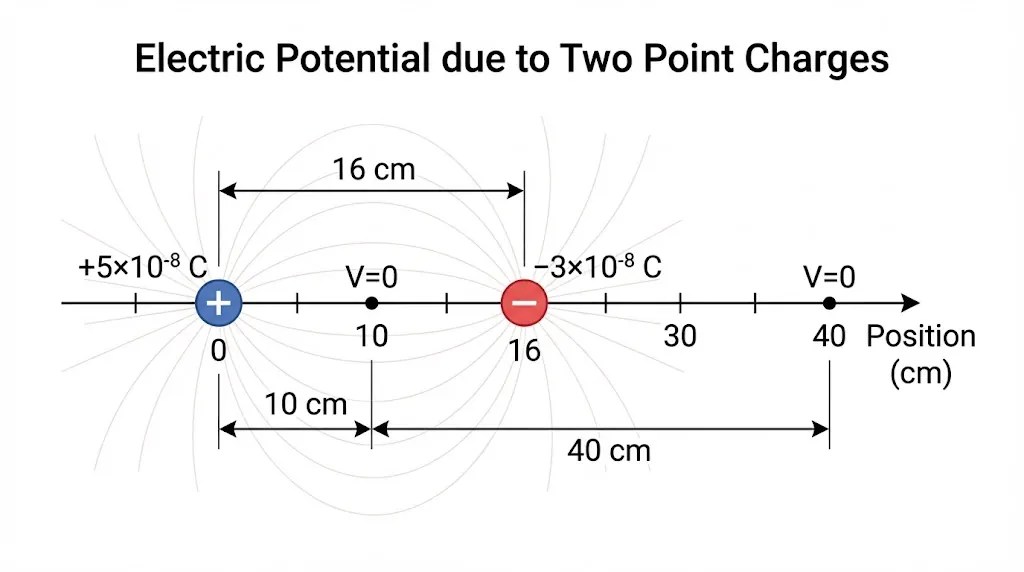
Two charges with zero potential points marked on the line joining them
Points where electric potential becomes zero between two opposite charges
Solution 3 Marks
Given:
q_1 = +5 \times 10^{-8}\, \text{C},\; q_2 = -3 \times 10^{-8}\, \text{C},\; d = 16\, \text{cm} = 0.16\, \text{m}
Case 1: Point between charges (at distance x from q₁)
V = \frac{1}{4\pi\epsilon_0} \left( \frac{q_1}{x} + \frac{q_2}{d-x} \right) = 0
\frac{5 \times 10^{-8}}{x} = \frac{3 \times 10^{-8}}{0.16 - x}
5(0.16 - x) = 3x \Rightarrow 0.8 = 8x \Rightarrow x = 0.1\, \text{m} = 10\, \text{cm}
Case 2: Point on extension beyond q₂ (at distance x from q₁)
V = \frac{1}{4\pi\epsilon_0} \left( \frac{q_1}{x} + \frac{q_2}{x-d} \right) = 0
\frac{5}{x} = \frac{3}{x-0.16} \Rightarrow 5x - 0.8 = 3x \Rightarrow 2x = 0.8 \Rightarrow x = 0.4\, \text{m} = 40\, \text{cm}
\boxed{\text{At 10 cm from } q_1 \text{ (between charges) and 40 cm from } q_1 \text{ (beyond } q_2)}

3. Dipole Potential on Axial Line

Problem: An electric dipole with charges ±5 nC separated by 2 mm is placed in vacuum. Calculate the electric potential at a point 15 cm from the dipole center (a) on the axial line, and (b) on the equatorial line.

Solution 2 Marks
Given:
q = 5 \times 10^{-9}\, \text{C},\; 2a = 2 \times 10^{-3}\, \text{m} \Rightarrow a = 10^{-3}\, \text{m}
r = 0.15\, \text{m},\; \frac{1}{4\pi\epsilon_0} = 9 \times 10^9
Step 1: Dipole moment
p = q \times 2a = 5 \times 10^{-9} \times 2 \times 10^{-3} = 10^{-11}\, \text{C·m}
Part (a): Axial line potential
V_{\text{axial}} = \frac{1}{4\pi\epsilon_0} \frac{p}{r^2} = 9 \times 10^9 \times \frac{10^{-11}}{(0.15)^2} = 9 \times 10^9 \times \frac{10^{-11}}{0.0225} = 4\, \text{V}
Part (b): Equatorial line potential
For any point on equatorial line of a dipole: V_{\text{eq}} = 0
(Because distances to +q and -q are equal, potentials cancel)
\boxed{\text{(a) } 4\,\text{V} \quad \text{(b) } 0\,\text{V}}

4. Work Done Moving Charge in Field

Problem: A uniform electric field of magnitude 3 × 10³ N/C makes an angle of 60° with the normal to a square surface of side 10 cm. (a) Calculate the electric flux through the surface. (b) How much work is done in moving a charge of 5 μC between two points 8 cm apart along a direction making 30° with the field?

Solution 3 Marks
Given:
E = 3 \times 10^3\, \text{N/C},\; a = 0.1\, \text{m},\; \theta = 60^\circ,\; q = 5 \times 10^{-6}\, \text{C},\; d = 0.08\, \text{m},\; \phi = 30^\circ
Part (a): Electric flux
Area: A = a^2 = 0.01\, \text{m}^2
\phi_E = EA \cos\theta = (3 \times 10^3) \times 0.01 \times \cos 60^\circ = 30 \times 0.5 = 15\, \text{N·m}^2\text{/C}
Part (b): Work done
Potential difference: \Delta V = -E d \cos\phi = -(3 \times 10^3) \times 0.08 \times \cos 30^\circ = -240 \times \frac{\sqrt{3}}{2} = -207.8\, \text{V}
Work done: W = q \Delta V = (5 \times 10^{-6}) \times (-207.8) = -1.039 \times 10^{-3}\, \text{J}
Negative sign indicates work is done by the field (not external agent).
\boxed{\text{(a) } 15\,\text{N·m}^2\text{/C} \quad \text{(b) } -1.04 \times 10^{-3}\,\text{J}}

5. Potential Energy of Three-Charge System

Problem: Three charges +2 μC, -3 μC, and +4 μC are placed at the vertices of an equilateral triangle of side 10 cm. Calculate the total electrostatic potential energy of the system.

Solution 3 Marks
Given:
q_1 = +2 \times 10^{-6}\, \text{C},\; q_2 = -3 \times 10^{-6}\, \text{C},\; q_3 = +4 \times 10^{-6}\, \text{C}
r_{12} = r_{23} = r_{31} = 0.1\, \text{m}
Formula for 3-charge system:
U = \frac{1}{4\pi\epsilon_0} \left( \frac{q_1 q_2}{r_{12}} + \frac{q_2 q_3}{r_{23}} + \frac{q_3 q_1}{r_{31}} \right)
Substitute values:
U = 9 \times 10^9 \left[ \frac{(2 \times 10^{-6})(-3 \times 10^{-6})}{0.1} + \frac{(-3 \times 10^{-6})(4 \times 10^{-6})}{0.1} + \frac{(4 \times 10^{-6})(2 \times 10^{-6})}{0.1} \right]
U = 9 \times 10^9 \times 10^{-5} \left[ -6 - 12 + 8 \right] = 9 \times 10^4 \times (-10) = -0.9\, \text{J}
\boxed{-0.9\,\text{J}}

6. Parallel Plate Capacitor Calculation

Problem: A parallel plate capacitor has plates of area 6 × 10⁻³ m² each separated by 3 mm in air. Calculate (a) its capacitance, and (b) the charge on each plate when connected to a 100 V battery.

Solution 2 Marks
Given:
A = 6 \times 10^{-3}\, \text{m}^2,\; d = 3\, \text{mm} = 3 \times 10^{-3}\, \text{m},\; V = 100\, \text{V}
\epsilon_0 = 8.854 \times 10^{-12}\, \text{C}^2\text{N}^{-1}\text{m}^{-2}
Part (a): Capacitance
C = \frac{\epsilon_0 A}{d} = \frac{(8.854 \times 10^{-12}) \times (6 \times 10^{-3})}{3 \times 10^{-3}} = 17.71 \times 10^{-12}\, \text{F} = 17.71\, \text{pF}
Part (b): Charge on plates
Q = CV = (17.71 \times 10^{-12}) \times 100 = 1.771 \times 10^{-9}\, \text{C} = 1.771\, \text{nC}
\boxed{\text{(a) } 17.71\,\text{pF} \quad \text{(b) } 1.771\,\text{nC}}

7. Capacitors in Series Combination

Problem: Three capacitors of capacitances 2 pF, 3 pF and 4 pF are connected in series. (a) What is the total capacitance of the combination? (b) What is the potential difference across each capacitor if the combination is connected to a 120 V supply?

Three capacitors connected in series with voltage supply
Capacitors connected in series share the same charge but different voltages
Solution 3 Marks
Given:
C_1 = 2\, \text{pF},\; C_2 = 3\, \text{pF},\; C_3 = 4\, \text{pF},\; V = 120\, \text{V}
Part (a): Equivalent capacitance
\frac{1}{C_{\text{eq}}} = \frac{1}{C_1} + \frac{1}{C_2} + \frac{1}{C_3} = \frac{1}{2} + \frac{1}{3} + \frac{1}{4} = \frac{6+4+3}{12} = \frac{13}{12}
C_{\text{eq}} = \frac{12}{13} = 0.923\, \text{pF}
Part (b): Potential differences
Charge on each capacitor (same in series):
Q = C_{\text{eq}} V = 0.923 \times 120 = 110.76\, \text{pC}
V_1 = \frac{Q}{C_1} = \frac{110.76}{2} = 55.38\, \text{V}
V_2 = \frac{Q}{C_2} = \frac{110.76}{3} = 36.92\, \text{V}
V_3 = \frac{Q}{C_3} = \frac{110.76}{4} = 27.69\, \text{V}
(Check: 55.38 + 36.92 + 27.69 ≈ 120 V)
\boxed{\text{(a) } 0.923\,\text{pF} \quad \text{(b) } V_1 = 55.38\,\text{V},\; V_2 = 36.92\,\text{V},\; V_3 = 27.69\,\text{V}}

8. Capacitors in Parallel Combination

Problem: Three capacitors each of capacitance 9 pF are connected in parallel. (a) What is the total capacitance of the combination? (b) Determine the charge on each capacitor if the combination is connected to a 120 V supply.

Solution 2 Marks
Given:
C_1 = C_2 = C_3 = 9\, \text{pF},\; V = 120\, \text{V}
Part (a): Equivalent capacitance
For parallel combination:
C_{\text{eq}} = C_1 + C_2 + C_3 = 9 + 9 + 9 = 27\, \text{pF}
Part (b): Charge on each capacitor
In parallel, voltage across each capacitor is same (120 V):
Q_1 = C_1 V = 9 \times 120 = 1080\, \text{pC} = 1.08\, \text{nC}
Q_2 = C_2 V = 9 \times 120 = 1080\, \text{pC} = 1.08\, \text{nC}
Q_3 = C_3 V = 9 \times 120 = 1080\, \text{pC} = 1.08\, \text{nC}
Total charge: Q_{\text{total}} = 3 \times 1080 = 3240\, \text{pC} = 3.24\, \text{nC}
\boxed{\text{(a) } 27\,\text{pF} \quad \text{(b) } 1.08\,\text{nC on each capacitor}}

9. Effect of Dielectric on Capacitance

Problem: A parallel plate capacitor with air between the plates has a capacitance of 8 pF. What will be the capacitance if (a) the distance between the plates is reduced by half, and (b) the space between them is filled with a substance of dielectric constant 6?

Solution 2 Marks
Given:
C_0 = 8\, \text{pF},\; K = 6
Part (a): Distance reduced by half
Since C \propto \frac{1}{d}, when d' = \frac{d}{2}:
C_1 = 2C_0 = 2 \times 8 = 16\, \text{pF}
Part (b): Dielectric inserted (with original separation)
With dielectric constant K:
C_2 = K C_0 = 6 \times 8 = 48\, \text{pF}
Combined effect (both changes together):
C_{\text{final}} = K \times 2C_0 = 6 \times 16 = 96\, \text{pF}
\boxed{\text{(a) } 16\,\text{pF} \quad \text{(b) } 48\,\text{pF} \quad \text{(combined) } 96\,\text{pF}}

10. Energy Stored in Capacitor

Problem: A 600 pF capacitor is charged by a 200 V supply. It is then disconnected from the supply and connected to another uncharged 600 pF capacitor. (a) How much electrostatic energy is stored initially? (b) How much electrostatic energy is lost in the process?

Solution 3 Marks
Given:
C_1 = C_2 = 600\, \text{pF} = 6 \times 10^{-10}\, \text{F},\; V_1 = 200\, \text{V},\; V_2 = 0\, \text{V}
Part (a): Initial energy
U_i = \frac{1}{2} C_1 V_1^2 = \frac{1}{2} \times (6 \times 10^{-10}) \times (200)^2 = 1.2 \times 10^{-5}\, \text{J}
Part (b): Final energy after connection
Charge conservation: Q = C_1 V_1 = (6 \times 10^{-10}) \times 200 = 1.2 \times 10^{-7}\, \text{C}
Equivalent capacitance (parallel): C_{\text{eq}} = C_1 + C_2 = 1200\, \text{pF}
Common potential: V_f = \frac{Q}{C_{\text{eq}}} = \frac{1.2 \times 10^{-7}}{12 \times 10^{-10}} = 100\, \text{V}
Final energy: U_f = \frac{1}{2} C_{\text{eq}} V_f^2 = \frac{1}{2} \times (12 \times 10^{-10}) \times (100)^2 = 6 \times 10^{-6}\, \text{J}
Energy lost:
\Delta U = U_i - U_f = 1.2 \times 10^{-5} - 6 \times 10^{-6} = 6 \times 10^{-6}\, \text{J}
This energy is dissipated as heat and electromagnetic radiation during charge redistribution.
\boxed{\text{(a) } 1.2 \times 10^{-5}\,\text{J} \quad \text{(b) } 6 \times 10^{-6}\,\text{J}}
Exam Tip: For numerical problems on Electrostatic Potential and Capacitance:

• Always convert units to SI before calculations (cm → m, μC → C, pF → F)
• For potential: scalar quantity – algebraic sum (watch signs of charges)
• For potential energy of system: use U = \frac{1}{4\pi\epsilon_0} \sum \frac{q_i q_j}{r_{ij}} for all unique pairs
• In series capacitors: same charge, voltage divides
• In parallel capacitors: same voltage, charge divides
• When dielectric is inserted with battery connected: V constant, Q changes
• When dielectric is inserted after disconnecting battery: Q constant, V changes

Leave a Reply

Your email address will not be published. Required fields are marked *