
Current Electricity (Basics)
NCERT Chapter 3 (Part 1) • Ohm’s Law, Drift Velocity & Power
1. Electric Current
Charges in motion constitute an electric current. In a conductor, if a net charge  flows across a cross-section in time
  , the average current is defined as
  .
.

2. Ohm’s Law
For a conductor, the potential difference  across its ends is directly proportional to the current
  flowing through it, provided physical conditions (like temperature) remain constant.

The constant  is the Resistance. It depends on the dimensions of the conductor:
- Proportional to length
 .
. - Inversely proportional to area .
 .
. .
.Thus,  , where
  is Resistivity.
3. Drift of Electrons & Resistivity
In a metal, electrons move randomly with high thermal speeds. The average velocity is zero. When an electric field  is applied, electrons experience a force
  and accelerate, acquiring a small net velocity opposite to the field called Drift Velocity (
 ).
).

Force on electron
 . Acceleration
  .
.
Electrons collide with ions. Let
 be the average time between successive collisions (relaxation time). The average velocity gained is:
 .
.
Volume of conductor =
 . Total charge
  .
.Current
 .
.
Current density
 . Thus,
  .
Comparing with Ohm’s Law (
.
Comparing with Ohm’s Law ( ), we get conductivity:
 .
.
4. Temperature Dependence
Resistivity  . It depends on temperature:
- Metals: decreases as temperature rises (more collisions). So, increases.
- Semiconductors: increases significantly with temperature. So, decreases.
 increases significantly with temperature. So,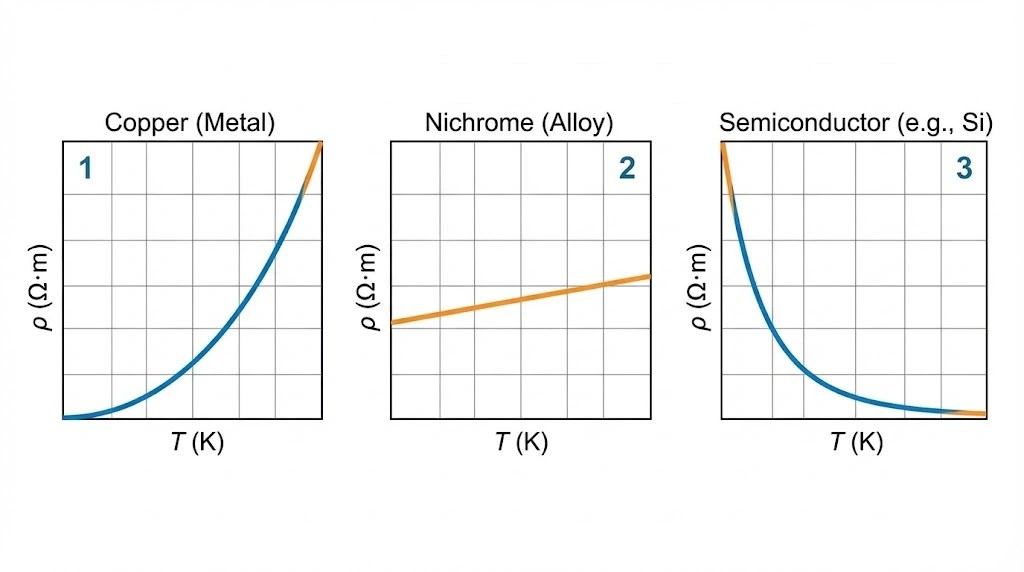
For metals over a limited range:
![\rho_T = \rho_0 [1 + \alpha(T - T_0)]](https://i0.wp.com/physicsqanda.com/wp-content/ql-cache/quicklatex.com-9e98d3ba8a1477aa3337a5e91649e37b_l3.png?resize=177%2C19&ssl=1 "Rendered by QuickLaTeX.com") .
.
5. Electrical Energy & Power
The energy dissipated as heat in a conductor is the work done to move charges against resistance.
