
Motion in a Straight Line
NCERT Chapter 2 • Velocity, Acceleration & Kinematic Equations

1. Path Length and Displacement
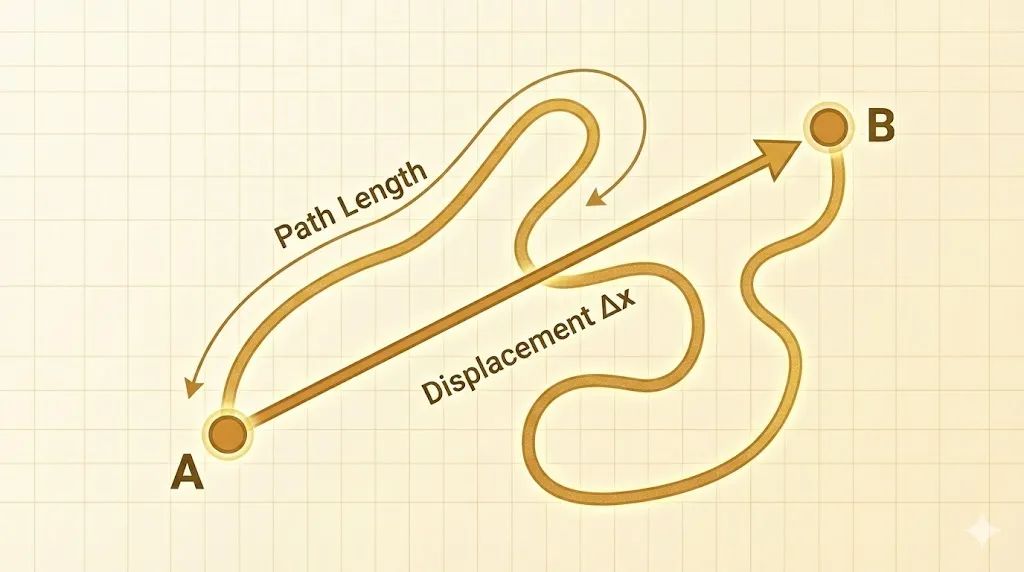
Motion is the change in position of an object with time. To describe this, we use a reference point (origin).
- Path Length (Distance): The total length of the actual path traversed by the object. It is a scalar quantity (always positive).
- Displacement (
 ): The shortest distance between the initial and final positions. It is a vector quantity (can be positive, negative, or zero).
![\[\Delta x = x_2 - x_1\]](https://i0.wp.com/physicsqanda.com/wp-content/ql-cache/quicklatex.com-bad76e270ee3e4345283cf0c07c061f6_l3.png?resize=104%2C15&ssl=1 "Rendered by QuickLaTeX.com")
 is final position and
  is initial position.
 from point A to B. Find distance and displacement.
Show Answer
Distance = Circumference/2 = .
.Displacement = Diameter =
 .
.
Show Answer
No. Displacement is the shortest path. It can be equal to path length (straight line motion without turning back) or less than it, but never greater.2. Average Velocity and Speed
Average Velocity ()
 )
)Defined as the change in position or displacement divided by the time interval.
![\[\bar{v} = \dfrac{\Delta x}{\Delta t} = \dfrac{x_2 - x_1}{t_2 - t_1}\]](https://i0.wp.com/physicsqanda.com/wp-content/ql-cache/quicklatex.com-b06911464a605e2cb488cfcbdb6d244c_l3.png?resize=145%2C40&ssl=1 "Rendered by QuickLaTeX.com")
Average Speed
Defined as the total path length travelled divided by the total time interval.

 ):
): The velocity at a specific instant of time. It is defined as the limit of average velocity as the time interval  approaches zero.

Show Answer
Average Velocity: 0 (Since displacement is zero).Average Speed: Harmonic Mean =
 km/h.
km/h.
3. Acceleration
Acceleration is the rate of change of velocity with time.
![\[a = \dfrac{dv}{dt} = \dfrac{d^2x}{dt^2}\]](https://i0.wp.com/physicsqanda.com/wp-content/ql-cache/quicklatex.com-ed0ceef5b7753d951d29273918bebce5_l3.png?resize=109%2C39&ssl=1 "Rendered by QuickLaTeX.com")
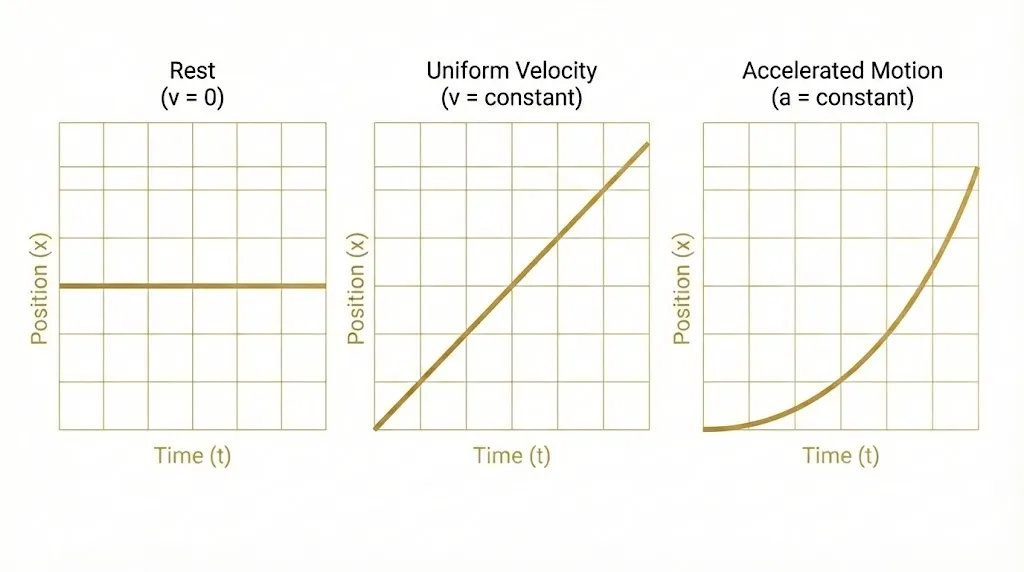
* Positive Acceleration: Velocity increases in positive direction.
* Negative Acceleration (Retardation): Velocity decreases (if moving positively).
 , find the time when acceleration is zero.
Show Answer
Velocity .
.Acceleration
 .
.Set
 s.
s.
4. Kinematic Equations (Uniform Acceleration)
For objects moving with constant acceleration ( ), we use three key equations. While these can be derived graphically, the calculus method is essential for competitive exams.
Check out our detailed guide on how easy is to derive the 5 equations of motion


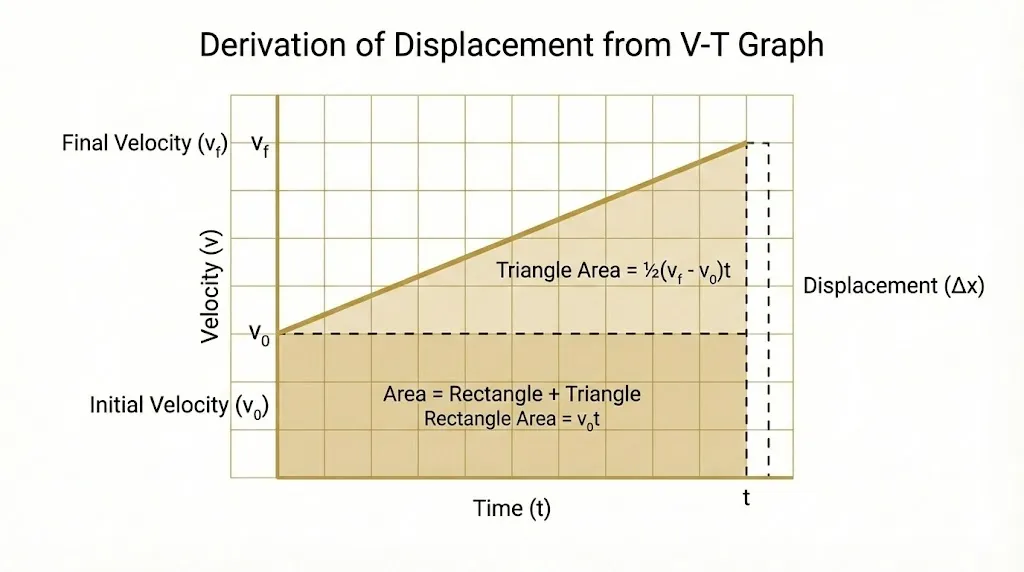
 .
.Velocity-Time Relation ( )
)
![\[a = \dfrac{dv}{dt} \Rightarrow dv = a dt\]](https://i0.wp.com/physicsqanda.com/wp-content/ql-cache/quicklatex.com-4da71978621720a12392a03af5137e18_l3.png?resize=149%2C36&ssl=1 "Rendered by QuickLaTeX.com")
Integrate both sides with limits (
 to ) and (
 to
to  ):
): ![\[\int_{v_0}^{v} dv = \int_{0}^{t} a dt\]](https://i0.wp.com/physicsqanda.com/wp-content/ql-cache/quicklatex.com-4b9b2b75dbdcaa6ee514ece694e89d62_l3.png?resize=121%2C46&ssl=1 "Rendered by QuickLaTeX.com")
Since
is constant, take it out of integral: ![\[[v]_{v_0}^{v} = a [t]_{0}^{t}\]](https://i0.wp.com/physicsqanda.com/wp-content/ql-cache/quicklatex.com-d1b3f07317116a351ba4357b7dc2f4dc_l3.png?resize=87%2C23&ssl=1 "Rendered by QuickLaTeX.com")
![\[v - v_0 = a(t - 0)\]](https://i0.wp.com/physicsqanda.com/wp-content/ql-cache/quicklatex.com-e607d115c061ca142a991918b13894d0_l3.png?resize=131%2C19&ssl=1 "Rendered by QuickLaTeX.com")
![\[v = v_0 + at\]](https://i0.wp.com/physicsqanda.com/wp-content/ql-cache/quicklatex.com-745033e2f58541aacfe6adb7e713bd3b_l3.png?resize=85%2C14&ssl=1 "Rendered by QuickLaTeX.com")
Position-Time Relation ( )
)
![\[v = \dfrac{dx}{dt} \Rightarrow dx = v dt\]](https://i0.wp.com/physicsqanda.com/wp-content/ql-cache/quicklatex.com-9fdde738a55948ddc67bc54747a7521d_l3.png?resize=151%2C36&ssl=1 "Rendered by QuickLaTeX.com")
From the first equation,
. ![\[dx = (v_0 + at) dt\]](https://i0.wp.com/physicsqanda.com/wp-content/ql-cache/quicklatex.com-c2e011fcf16a457d253c1d3fb74e3e10_l3.png?resize=125%2C19&ssl=1 "Rendered by QuickLaTeX.com")
Integrate from initial position
 (usually 0) to final
  :
: ![\[\int_{0}^{x} dx = \int_{0}^{t} (v_0 + at) dt\]](https://i0.wp.com/physicsqanda.com/wp-content/ql-cache/quicklatex.com-2def20c0aea54dde348c49b934c6aaf2_l3.png?resize=178%2C44&ssl=1 "Rendered by QuickLaTeX.com")
![\[x = \int_{0}^{t} v_0 dt + \int_{0}^{t} at dt\]](https://i0.wp.com/physicsqanda.com/wp-content/ql-cache/quicklatex.com-fdb2077713293f1f57c768fbc36254a6_l3.png?resize=170%2C44&ssl=1 "Rendered by QuickLaTeX.com")
![\[x = v_0 [t]_{0}^{t} + a \left[\dfrac{t^2}{2}\right]_{0}^{t}\]](https://i0.wp.com/physicsqanda.com/wp-content/ql-cache/quicklatex.com-ae70842b7791c155e64b1543d23bac00_l3.png?resize=151%2C49&ssl=1 "Rendered by QuickLaTeX.com")
![\[x = v_0t + \dfrac{1}{2}at^2\]](https://i0.wp.com/physicsqanda.com/wp-content/ql-cache/quicklatex.com-0563418bc37f32bf6764a9ad013b2ad6_l3.png?resize=113%2C36&ssl=1 "Rendered by QuickLaTeX.com")
Velocity-Position Relation ( )
)
![\[a = \dfrac{dv}{dt} = \dfrac{dv}{dx} \cdot \dfrac{dx}{dt} = v \dfrac{dv}{dx}\]](https://i0.wp.com/physicsqanda.com/wp-content/ql-cache/quicklatex.com-d781d5b4d0229e320064e64efa8797b8_l3.png?resize=193%2C36&ssl=1 "Rendered by QuickLaTeX.com")
![\[a dx = v dv\]](https://i0.wp.com/physicsqanda.com/wp-content/ql-cache/quicklatex.com-a5825756ad8f117016967e6d28aff255_l3.png?resize=79%2C12&ssl=1 "Rendered by QuickLaTeX.com")
Integrate with position limits (
to ) and velocity limits ( to ): ![\[\int_{0}^{x} a dx = \int_{v_0}^{v} v dv\]](https://i0.wp.com/physicsqanda.com/wp-content/ql-cache/quicklatex.com-55c1f1134f3e9b0b299604ad279d28e7_l3.png?resize=137%2C43&ssl=1 "Rendered by QuickLaTeX.com")
![\[a [x]_{0}^{x} = \left[\dfrac{v^2}{2}\right]_{v_0}^{v}\]](https://i0.wp.com/physicsqanda.com/wp-content/ql-cache/quicklatex.com-1320eb3aaa2c22db4ef7cdefae353c7a_l3.png?resize=114%2C47&ssl=1 "Rendered by QuickLaTeX.com")
![\[ax = \dfrac{v^2}{2} - \dfrac{v_0^2}{2}\]](https://i0.wp.com/physicsqanda.com/wp-content/ql-cache/quicklatex.com-5adfa6c56659c434ea64cf61b4c72d8e_l3.png?resize=104%2C39&ssl=1 "Rendered by QuickLaTeX.com")
![\[2ax = v^2 - v_0^2\]](https://i0.wp.com/physicsqanda.com/wp-content/ql-cache/quicklatex.com-7189a70b8c3745ad32772f13a7b48684_l3.png?resize=107%2C21&ssl=1 "Rendered by QuickLaTeX.com")
![\[v^2 = v_0^2 + 2ax\]](https://i0.wp.com/physicsqanda.com/wp-content/ql-cache/quicklatex.com-0367816a07be4fcd665cc7e7470df476_l3.png?resize=107%2C21&ssl=1 "Rendered by QuickLaTeX.com")
 m/s²)
m/s²)Show Answer
Using :
:
 s.
s.
 stops after distance
  upon braking. If speed is doubled (
 ), what is the new stopping distance?
Show Answer
Using , with
  :
: .
.Stopping distance is proportional to
 .
.If
becomes , becomes  times.
New distance =
 .
.
5. Relative Velocity
The velocity of object A with respect to object B is given by:
![\[v_{AB} = v_A - v_B\]](https://i0.wp.com/physicsqanda.com/wp-content/ql-cache/quicklatex.com-4ad9ea9be8a68e258c7eac54751cec85_l3.png?resize=116%2C10&ssl=1 "Rendered by QuickLaTeX.com")
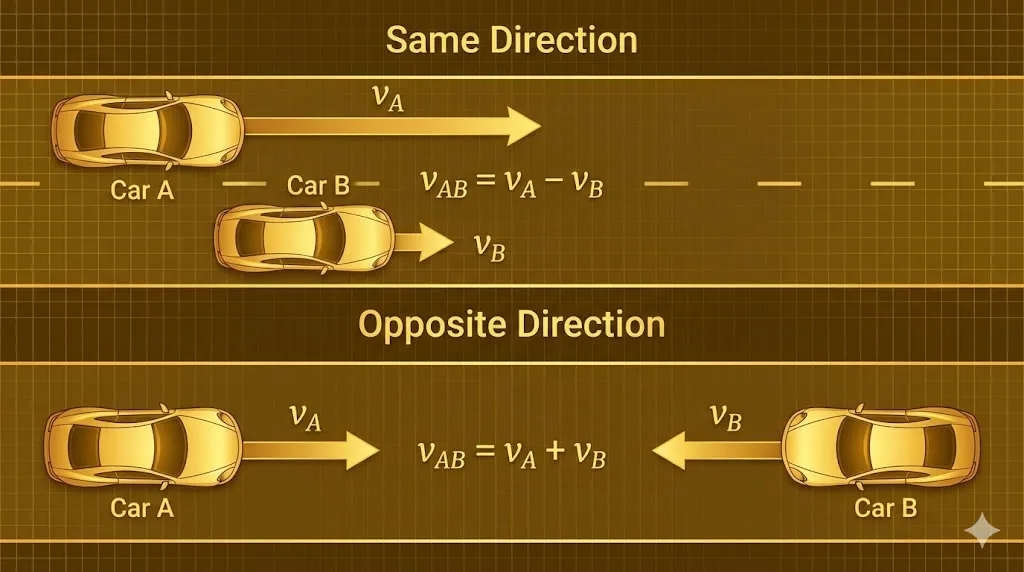
Show Answer
 km/h = 10 m/s.
 km/h = -15 m/s.
Relative Velocity
 m/s.
m/s.Total distance =
 m.
m.Time
 s.
s.
You can also solve this problem on relative velocity.