
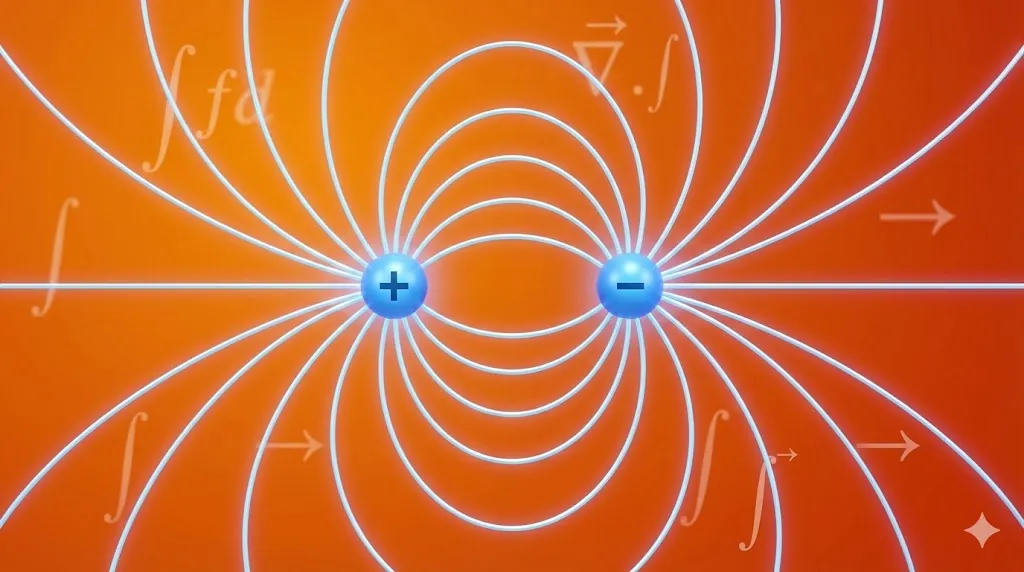
Electric Charges & Fields
NCERT Class 12 Physics • Chapter 1 • Full Notes & Derivations
NCERT 2025–26
Unit I (Electrostatics) • ~9 Marks
JEE Main • 1–2 Questions
| Topic | Question Type | Marks (Approx.) |
|---|---|---|
| Field Lines / Properties | MCQ / Assertion | 1 |
| Dipole Fields (Axial & Equatorial) | Short Answer / Derivation | 3 |
| Gauss Law + Applications | Long Answer (Derivations) | 5 |
1. Electric Charge & Coulomb’s Law
Electric charge is an intrinsic property of matter. Like charges repel, unlike charges attract. Benjamin Franklin introduced the convention of positive and negative charges.
Three Basic Properties of Charge
- Additivity: Total charge is the scalar sum
 .
. - Conservation: Charge is neither created nor destroyed in an isolated system, only transferred.
- Quantisation: , where is an integer and is elementary charge.
 .
. is an integer and
  is elementary charge.
Quantisation of Charge


Coulomb’s Law
The electrostatic force between two stationary point charges is along the line joining them, directly proportional to the product of charges and inversely proportional to the square of the separation.
Vector Form


Superposition Principle:
Net force on a charge due to multiple charges is the vector sum of individual forces:
.
 .
.
2. Electric Field & Field Lines
The electric field at a point is defined as the force experienced by a unit positive test charge placed at that point, with the source charges undisturbed.
Field of a Point Charge
Units: N/C or V/m

Properties of Electric Field Lines

- Start on positive charge and end on negative charge.
- Are continuous curves, with no breaks in charge-free region.
- Never intersect: otherwise, field would have two directions at one point.
- Do not form closed loops in electrostatics (field is conservative).
3. Electric Dipole Derivations
An electric dipole consists of charges  and
and  separated by distance
  . Its dipole moment is
  directed from negative to positive charge.
Derivation 1: Field on Axial Line
3 Marks

Step 1: Expression for Fields
Take point P at distance from the centre on axial line. Distances from charges are and .
 from the centre on axial line. Distances from charges are
  and
and  .
.
Step 2: Net Field
Both fields are along the same direction (from to ):
to ): 
Step 3: Simplify & Approximate
Simplifying and using , for :
 , for
, for  :
:
Derivation 2: Field on Equatorial Line
3 Marks

 .
.
Step 1: Equal Magnitudes
Distances from charges are equal. So .
 .
.
Step 2: Components
Vertical components cancel; horizontal components add opposite to dipole moment.
Step 3: Result for r ≫ a
After substitution and approximation:

Derivation 3: Torque on Dipole in Uniform Field
2 Marks

Concept
In uniform field, net force is zero but forces and form a couple.
 and
and  form a couple.
Torque Expression
Perpendicular distance between forces is .
 .
.
Vector Form

4. Continuous Charge Distribution
Charge Densities
- Linear Density (): Charge per unit length ().
- Surface Density (): Charge per unit area ().
- Volume Density (): Charge per unit volume ().
 ).
). ).
). ): Charge per unit volume (
 ).
).5. Electric Flux & Gauss’s Law
Electric Flux Through Surface
Unit: N·m²/C

Gauss’s Law:
The total electric flux through any closed surface is
where is the net charge enclosed by the surface.

 is the net charge enclosed by the surface.
6. Applications of Gauss’s Law
Application 1: Infinite Straight Wire (Linear Charge Density )
5 Marks
 )
5 Marks
)
5 Marks

Gaussian Surface
Choose a cylinder of radius and length coaxial with the wire. Enclosed charge: .
and length  coaxial with the wire. Enclosed charge:
  .
.
Flux Calculation
Flux through circular ends is zero (field is radial). Only curved area contributes: .
 contributes:
  .
.
Final Result
Apply Gauss’s law:


Application 2: Infinite Plane Sheet (Surface Density )
5 Marks
 )
5 Marks
)
5 Marks

Gaussian Surface
Take a thin pillbox of cross-sectional area cutting the sheet. Enclosed charge: .
 cutting the sheet. Enclosed charge:
  .
.
Flux Calculation
Field is perpendicular to sheet on both sides: total flux .
 .
.
Final Result
Using Gauss’s law:
(independent of distance ).

 (independent of distance ).
Application 3: Thin Spherical Shell (Total Charge )
5 Marks
 )
5 Marks
)
5 Marks

Case A: Outside the Shell ()
Gaussian sphere radius encloses charge .
From symmetry, is radial and constant over surface:
 )
Gaussian sphere radius encloses charge .
)
Gaussian sphere radius encloses charge . From symmetry,
 is radial and constant over surface:

Case B: Inside the Shell ()
Gaussian sphere encloses no charge: . Hence
everywhere inside the hollow shell.
 )
Gaussian sphere encloses no charge:
)
Gaussian sphere encloses no charge:  . Hence
 everywhere inside the hollow shell.