CBSE Physics

Electrostatic Potential & Capacitance

NCERT Chapter 2 Weightage: ~9 Marks JEE Main: ~2 Qs
Topic Question Type Marks
Derivation: Potential due to Point Charge Short Answer 2 Marks
Derivation: Potential due to Dipole Long Answer 5 Marks
Derivation: Parallel Plate Capacitor Short Answer 3 Marks
Derivation: Energy Stored Short Answer 2 Marks

1. Electric Potential

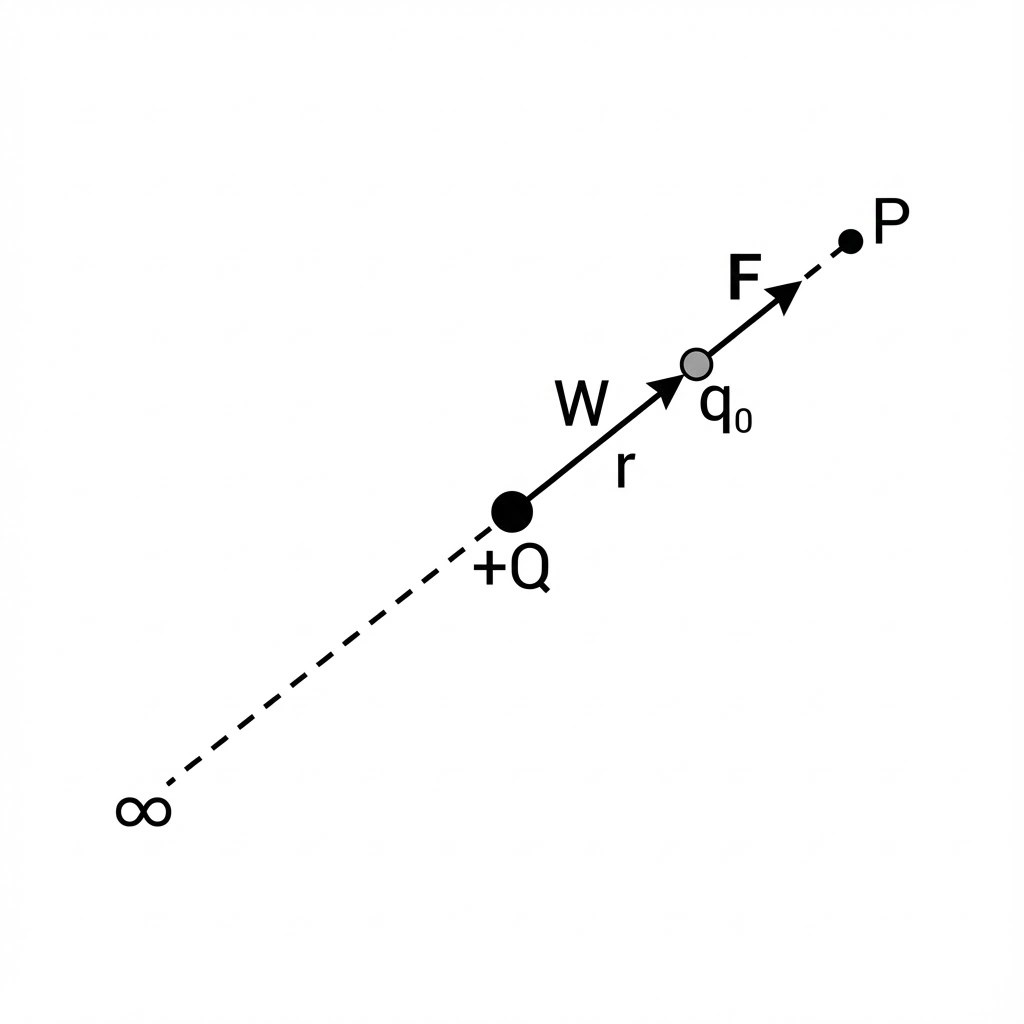
Electrostatic potential V at a point is defined as the work done by an external force in bringing a unit positive charge from infinity to that point (without acceleration).

Definition
V_P - V_R = \frac{W_{RP}}{q}
SI Unit: Volt (V) = Joule/Coulomb
Derivation 1: Potential due to a Point Charge 3 Marks
Diagram showing work done in bringing a unit positive test charge from infinity to point P against the repulsive force of charge Q.
Calculating work done to bring a unit positive charge from infinity to point P.
Step 1: Electrostatic Force Consider a source charge Q at origin. Force on unit positive test charge at distance r':
F = \frac{1}{4\pi\epsilon_0} \frac{Q \times 1}{(r')^2}
Step 2: Work Done Work done by external force against this repulsion to move by dr':
dW = -F dr' = -\frac{Q}{4\pi\epsilon_0 (r')^2} dr'
Step 3: Integration Total work done from \infty to r:
W = -\int_{\infty}^{r} \frac{Q}{4\pi\epsilon_0 (r')^2} dr' = -\frac{Q}{4\pi\epsilon_0} \left[ -\frac{1}{r'} \right]_{\infty}^{r}
Final Result W = \frac{Q}{4\pi\epsilon_0} \left( \frac{1}{r} - 0 \right)
V(r) = \frac{Q}{4\pi\epsilon_0 r}
⚠️
Relation between E and V: Electric field is the negative gradient of potential.
E = - \frac{dV}{dr} (Field flows from high to low potential).
Derivation 2: Potential due to an Electric Dipole 5 Marks
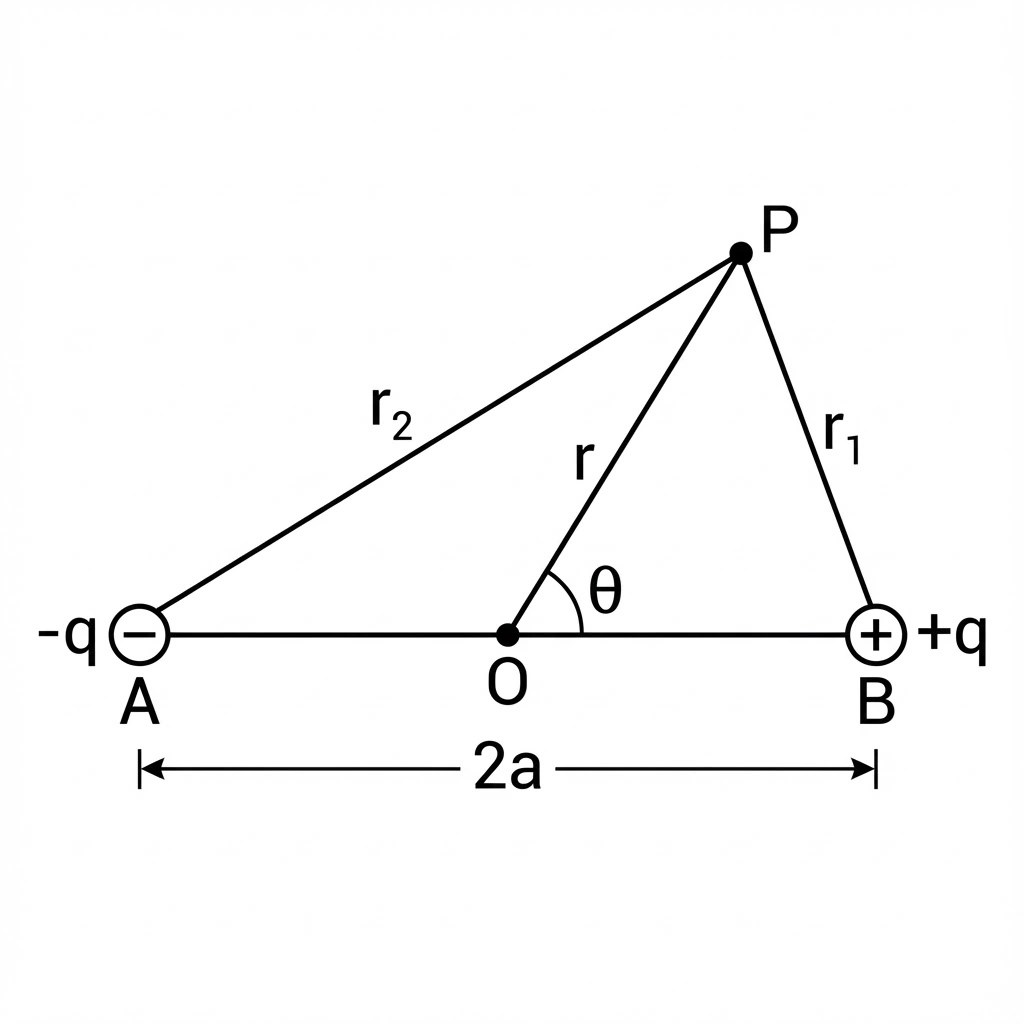
Geometry diagram for calculating potential at a point P due to a dipole, showing distances r1, r2 and angle theta.
Geometry involved in calculating potential at P due to charges +q and -q separated by 2a.
Step 1: Superposition Potential at P due to +q (at r_1) and -q (at r_2):
V = \frac{q}{4\pi\epsilon_0} \left( \frac{1}{r_1} - \frac{1}{r_2} \right)
Step 2: Geometry (Cosine Rule) For r \gg a:
r_1^2 \approx r^2 \left( 1 - \frac{2a \cos\theta}{r} \right) \implies \frac{1}{r_1} \approx \frac{1}{r} \left( 1 + \frac{a \cos\theta}{r} \right)
r_2^2 \approx r^2 \left( 1 + \frac{2a \cos\theta}{r} \right) \implies \frac{1}{r_2} \approx \frac{1}{r} \left( 1 - \frac{a \cos\theta}{r} \right)
Step 3: Substitution V = \frac{q}{4\pi\epsilon_0 r} \left[ \left( 1 + \frac{a \cos\theta}{r} \right) - \left( 1 - \frac{a \cos\theta}{r} \right) \right]
V = \frac{q}{4\pi\epsilon_0 r} \left( \frac{2a \cos\theta}{r} \right)
Final Result Using Dipole Moment p = 2qa:
V = \frac{p \cos\theta}{4\pi\epsilon_0 r^2}

2. Equipotential Surfaces

An equipotential surface is a surface with a constant value of potential at all points.
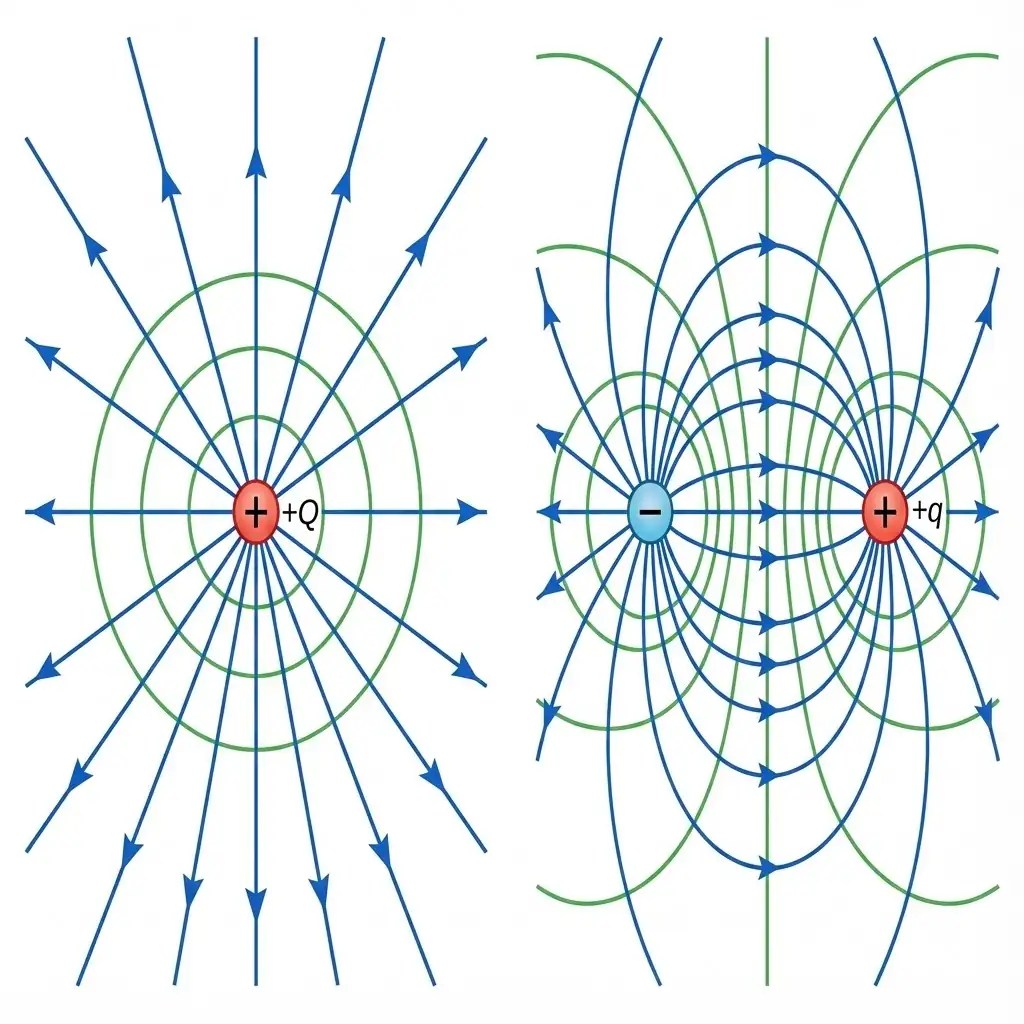
Equipotential surfaces for a single point charge (concentric spheres) and an electric dipole.
Equipotential surfaces are concentric spheres for a point charge, but distorted for a dipole.
Key Properties
  • Work Done: No work is done in moving a test charge over an equipotential surface.
  • Field Direction: Electric field is always normal to the equipotential surface at every point.
  • Pattern: For a point charge, they are concentric spheres.

3. Potential Energy

Electrostatic potential energy is the work done in assembling a system of charges by bringing them from infinity to their present locations.
Derivation 3: Potential Energy of a System of Charges 3 Marks
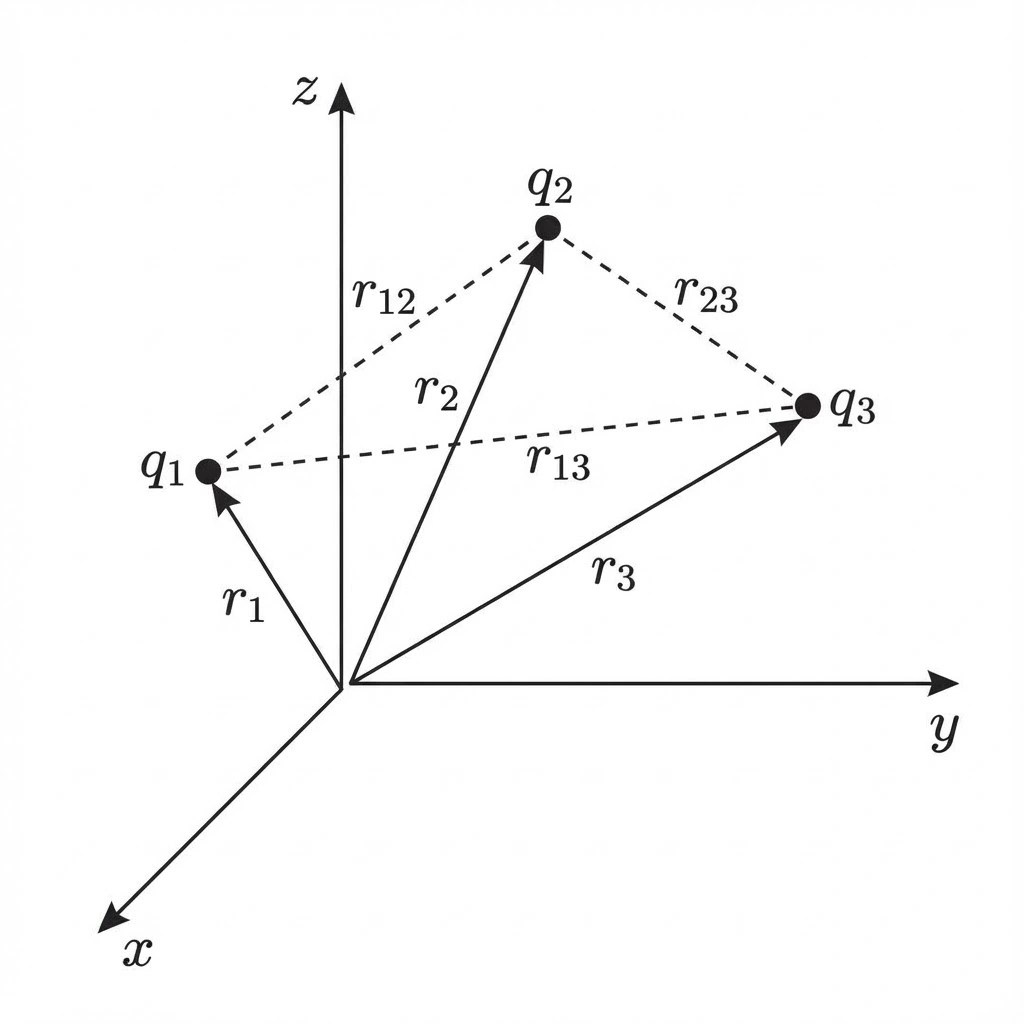
Three point charges in space to illustrate the potential energy of a system.
The potential energy of the system arises from the work done in assembling the charges.
Step 1: First Charge Bring q_1 from infinity to r_1. Work done W_1 = 0 (no external field).
Step 2: Second Charge Bring q_2 from infinity to r_2. Work is done against field of q_1.
W_2 = q_2 V_1(r_2) = \frac{1}{4\pi\epsilon_0} \frac{q_1 q_2}{r_{12}}
Step 3: Third Charge (Optional) Bring q_3 against fields of q_1 and q_2.
W_3 = \frac{1}{4\pi\epsilon_0} \left( \frac{q_1 q_3}{r_{13}} + \frac{q_2 q_3}{r_{23}} \right)
Final Result Total U = W_1 + W_2 + W_3:
U = \frac{1}{4\pi\epsilon_0} \sum \frac{q_i q_j}{r_{ij}}
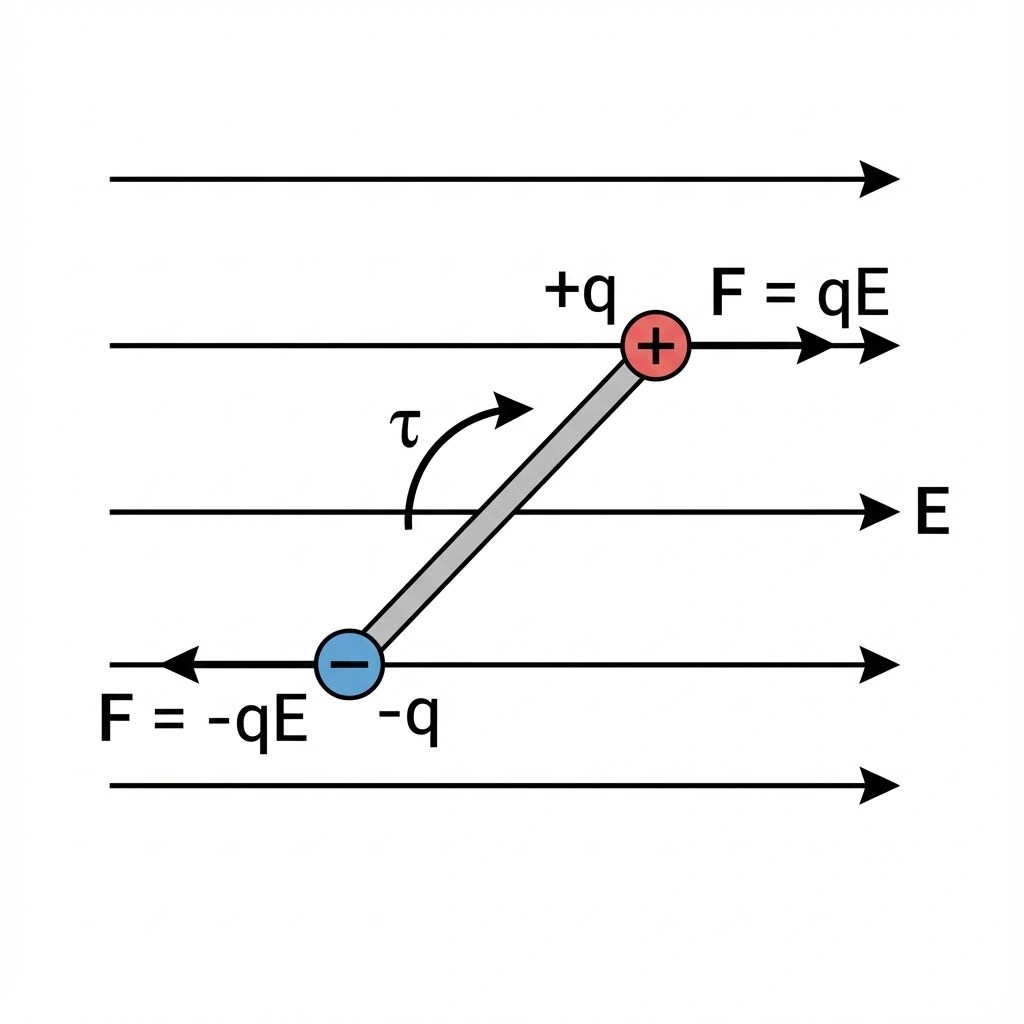
Derivation 4: PE of Dipole in External Field 3 Marks
Diagram of an electric dipole in a uniform electric field experiencing a torque.
An external field exerts a torque on the dipole, storing potential energy.
Step 1: Torque External field E exerts torque on dipole p:
\tau = pE \sin\theta
Step 2: Work Done Work done to rotate dipole from \theta_0 to \theta_1:
W = \int_{\theta_0}^{\theta_1} \tau d\theta = \int_{\theta_0}^{\theta_1} pE \sin\theta d\theta
W = pE [-\cos\theta]_{\theta_0}^{\theta_1} = pE(\cos\theta_0 - \cos\theta_1)
Final Result Setting reference \theta_0 = \pi/2 (where U=0):
U(\theta) = -pE \cos\theta = -\vec{p} \cdot \vec{E}

4. Electrostatics of Conductors

Important Results
  • Inside: Electrostatic field is zero everywhere inside the conductor.
  • Surface: Electric field is normal to the surface.
  • Potential: Constant throughout volume and surface.
  • Shielding: Electric field inside a cavity is zero.

5. Capacitance & Dielectrics

Capacitance is the ratio of charge to potential difference: C = Q/V.

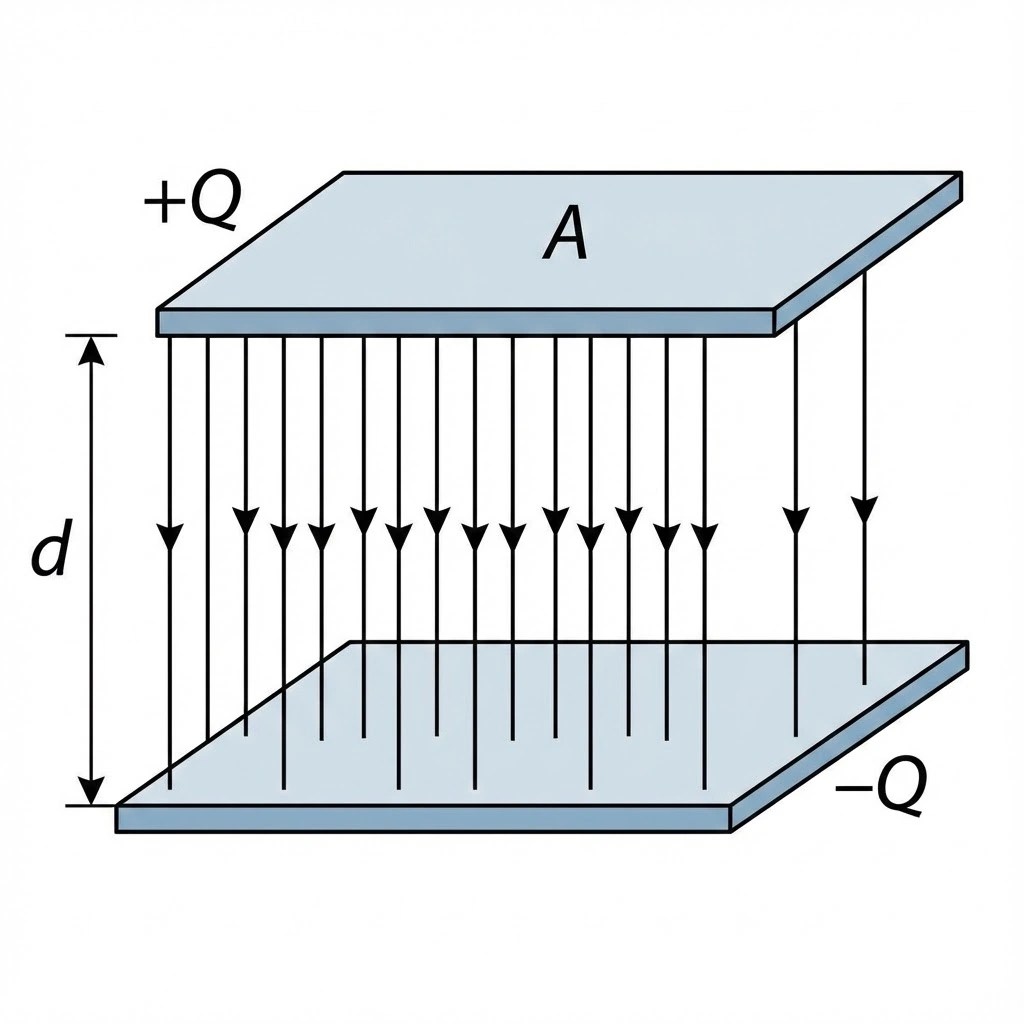
Derivation 5: Parallel Plate Capacitor 3 Marks
Cross-section of a parallel plate capacitor showing the uniform electric field between plates.
The electric field is uniform between the plates and zero outside.
Step 1: Electric Field Using Gauss’s Law, field between plates with charge density \sigma:
E = \frac{\sigma}{\epsilon_0} = \frac{Q}{A\epsilon_0}
Step 2: Potential Difference For uniform field E and separation d:
V = Ed = \left( \frac{Q}{A\epsilon_0} \right) d
Final Result Using C = Q/V:
C_0 = \frac{\epsilon_0 A}{d}
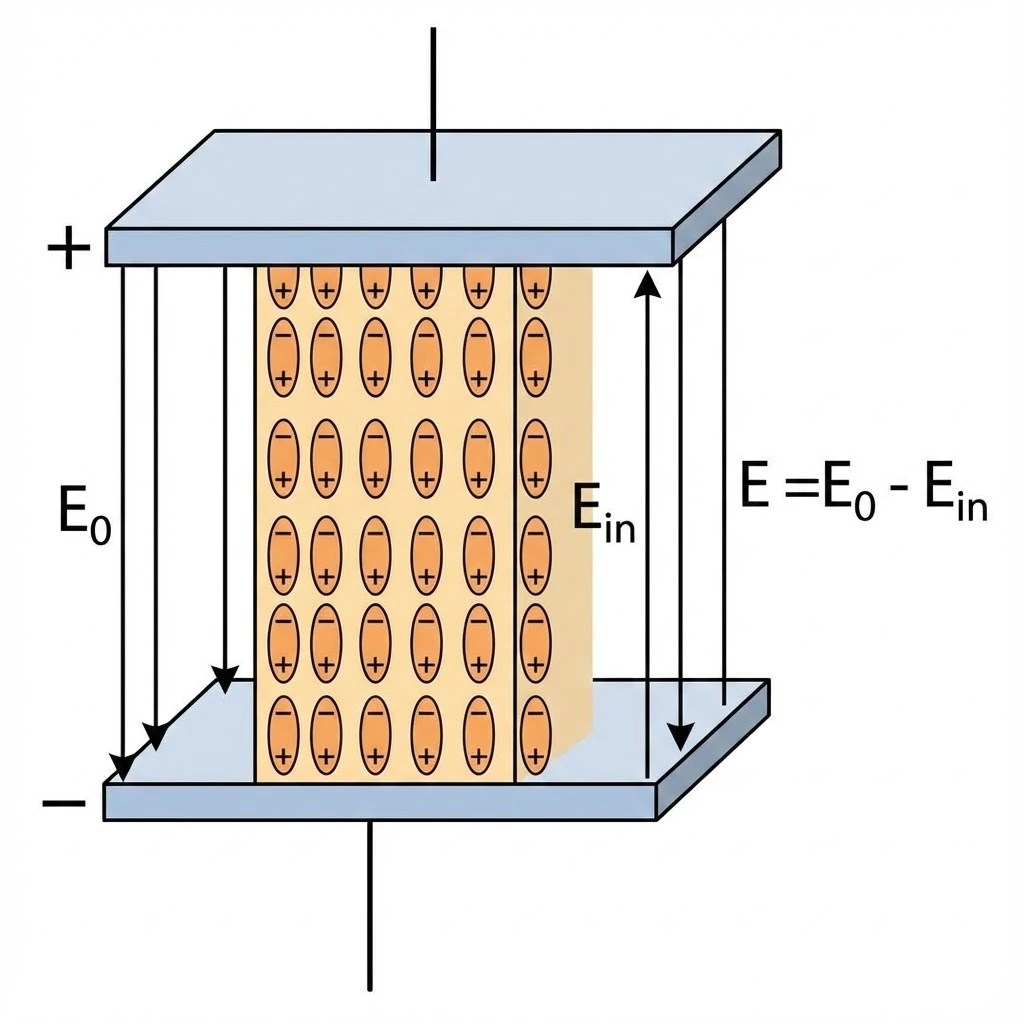
Derivation 6: Effect of Dielectric on Capacitance 3 Marks
Polarization of a dielectric material inside a capacitor reducing the net electric field.
The polarized dielectric produces an opposing field, reducing the net field and increasing capacitance.
Step 1: Polarization Dielectric polarized creates induced surface charge \sigma_p.
Net field E = \frac{\sigma - \sigma_p}{\epsilon_0} = \frac{\sigma}{K\epsilon_0} (since K = \frac{E_0}{E}).
Step 2: Potential V = Ed = \frac{\sigma d}{K\epsilon_0} = \frac{Qd}{AK\epsilon_0}
Final Result C = \frac{Q}{V} = \frac{K \epsilon_0 A}{d}
C = K C_0

6. Combinations of Capacitors

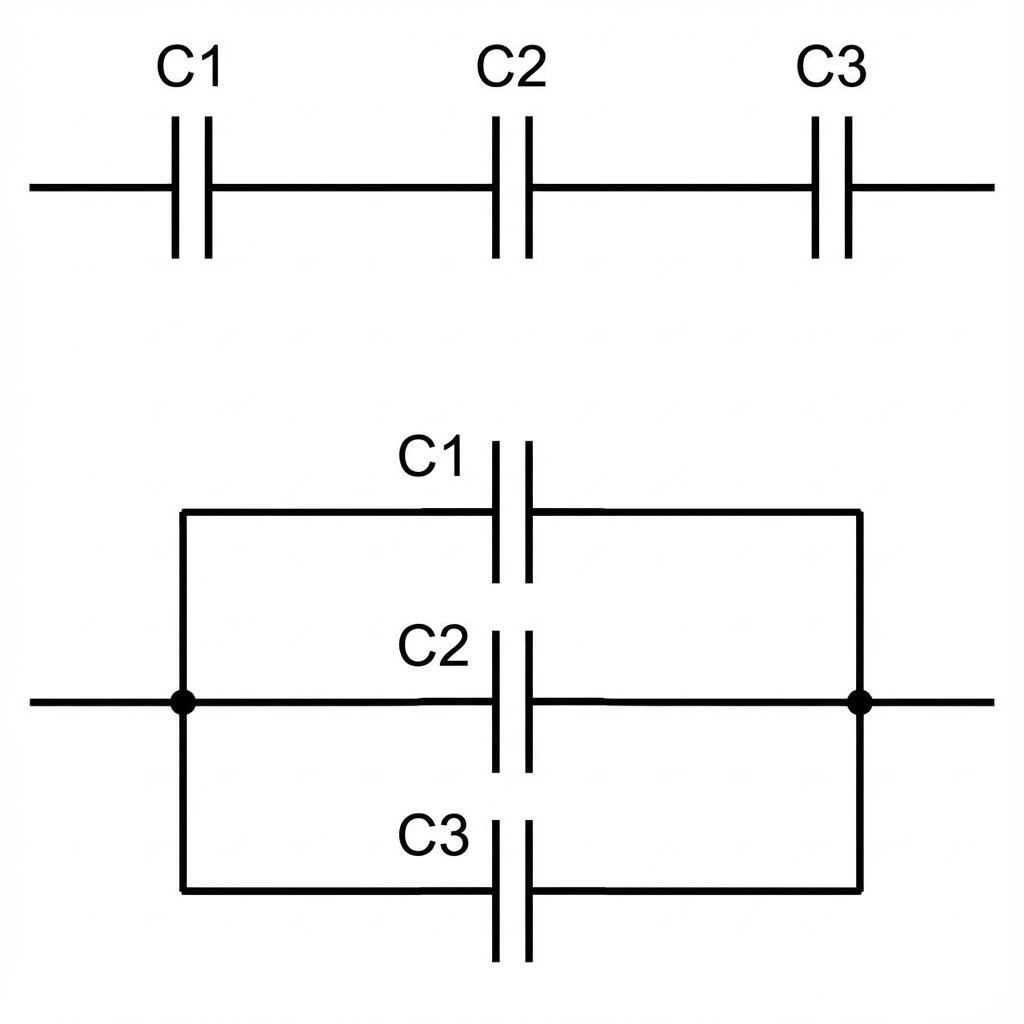
Circuit diagrams showing capacitors connected in series and in parallel.
Capacitors in series share charge; capacitors in parallel share potential.
Derivation 7: Capacitors in Series 2 Marks
Logic In series, Charge (Q) is same on all plates. Potential V divides.
V = V_1 + V_2
Substitution \frac{Q}{C_{eq}} = \frac{Q}{C_1} + \frac{Q}{C_2}
Result \frac{1}{C_{eq}} = \frac{1}{C_1} + \frac{1}{C_2}
Derivation 8: Capacitors in Parallel 2 Marks
Logic In parallel, Potential (V) is same. Charge Q adds up.
Q = Q_1 + Q_2
Substitution C_{eq}V = C_1V + C_2V
Result C_{eq} = C_1 + C_2

7. Energy Stored in Capacitor

Derivation 9: Energy Stored 3 Marks
Step 1: Work Done Work done to transfer infinitesimal charge dq' against potential V':
dW = V' dq' = \frac{q'}{C} dq'
Step 2: Integration Total work to charge from 0 to Q:
W = \int_{0}^{Q} \frac{q'}{C} dq' = \frac{1}{C} \left[ \frac{(q')^2}{2} \right]_0^Q
Final Result U = \frac{Q^2}{2C} = \frac{1}{2}CV^2
⚡
Energy Density: Energy per unit volume: u = \frac{1}{2} \epsilon_0 E^2
Practice Time!

Ready to test your knowledge? Try 10 solved numericals on Electrostatic Potential & Capacitance: Click here →


Also practice the Question Bank

CBSE Class XII Physics 2026–27 Syllabus Alignment

Chapter: Class XII: Electrostatic Potential and Capacitance.

Learning focus: Cover potential, potential difference, equipotential surfaces, potential energy, conductors, capacitors, combinations and stored energy. Check sign conventions and distinguish field from potential.

Use the official CBSE syllabus to verify the exact examinable subtopics, practical requirements and assessment details. Textbook coverage and older question banks may include material outside the current board specification; label such material as enrichment rather than required syllabus content.

Official CBSE Physics syllabus 2026–27 (PDF).