

AP Physics C: Circular Motion
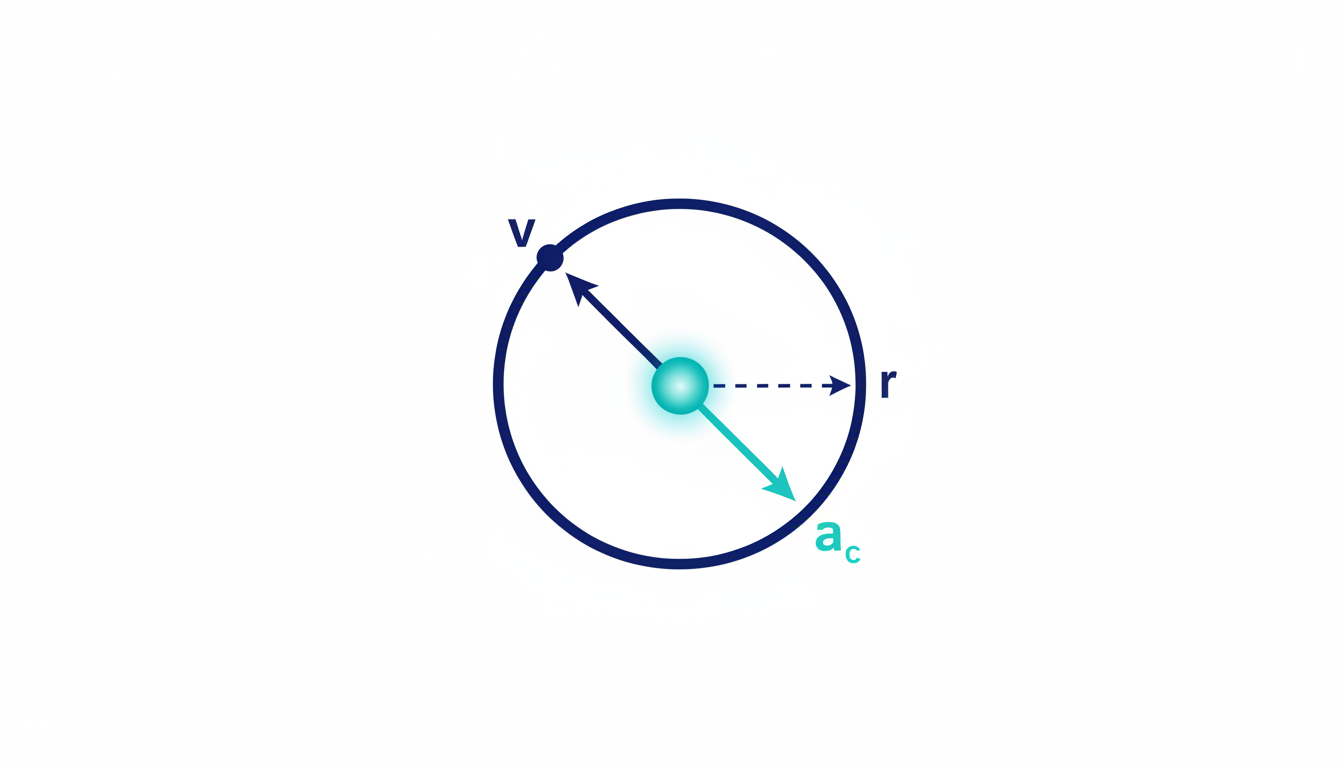
An object moving along a circular path has centripetal acceleration directed toward the center, even if its speed is constant. The acceleration exists because the direction of velocity changes continuously.
AP Exam Tip
Choose a sign convention and identify the physical source of each force before substituting values.
Quick Check: Test Your Intuition
A car moves around a circular track at constant speed. Which statement about its acceleration is correct?
- Its acceleration is zero because its speed is constant.
- Its acceleration points tangent to the track.
- Its acceleration points toward the center of the circle.
- Its acceleration points away from the center.
Check answer and explanation
Correct answer: C. Velocity changes direction continuously, so the car accelerates even when its speed is constant. The centripetal acceleration points toward the center and has magnitude ac = v²/r.
The corresponding net radial force is ΣFradial = mv²/r. “Centripetal force” is not a separate kind of force; it is the name for the net inward force supplied by tension, gravity, friction, normal force, or a combination.
1. Uniform circular motion
For constant speed v on a circle of radius r, the period is T = 2πr/v and angular speed is ω = 2π/T = v/r. The velocity is tangent to the circle; centripetal acceleration is perpendicular to velocity and points inward.
Worked example 1: Car on a flat curve
A 1000 kg car travels at 12 m/s around a flat curve of radius 30 m. Required inward net force is mv²/r = 1000(144)/30 = 4800 N. Static friction between tires and road supplies this force in the ideal model.
2. Vertical circular motion
In vertical circles, gravity’s radial component changes with position. At the bottom, for an object on a string, tension points inward and weight points outward relative to the center, so T − mg = mv²/r. At the top, both tension and weight may point toward the center, so T + mg = mv²/r.
Worked example 2: Bottom of a vertical circle
A 0.50 kg object moves at 4.0 m/s at the bottom of a circle of radius 0.80 m. T − mg = mv²/r, so T = mv²/r + mg = 0.50(16)/0.80 + 4.9 = 14.9 N.
3. Banked curves
On an ideal frictionless banked curve, the normal force has a vertical component balancing weight and a horizontal component supplying centripetal acceleration. With bank angle θ, tan θ = v²/(rg). This result assumes the design speed and no frictional contribution.
4. Circular motion and energy
The centripetal force is perpendicular to instantaneous velocity in uniform circular motion, so it does no work and does not change speed. It changes the direction of velocity. If a tangential force also acts, speed can change while the path curves.
Common mistakes
- Drawing “centripetal force” as an extra force in addition to real forces.
- Pointing acceleration tangent to the circle in uniform circular motion.
- Using v²/r without identifying the inward radial direction.
- Assuming tension is the same at the top and bottom of a vertical circle.
Practice questions
- A 2.0 kg object moves at 5.0 m/s in a circle of radius 10 m. Find centripetal acceleration and net radial force.
- At the top of a loop, which direction is centripetal acceleration?
- For a frictionless banked curve, what happens to the required bank angle if speed increases while radius stays fixed?
Reveal practice answers
- ac = 25/10 = 2.5 m/s²; F = 5.0 N inward.
- Toward the center, which is downward at the top.
- The required angle increases because tan θ = v²/(rg).
AP-Style Free-Response Question: Changing Speed on a Circular Path
Original practice question • 10 points • Suggested time: 12–15 minutes
A particle of mass m moves counterclockwise on a horizontal circular track of radius R. Its angular position, measured in radians, is θ(t) = ½βt², where β is a positive constant. At t = 0, the particle is at θ = 0 and has zero angular speed. Ignore friction and assume the track constrains the particle to the circular path while a tangential force increases its speed.
- (2 points) Derive expressions for angular speed ω(t) and the particle’s speed v(t).
- (2 points) Derive the magnitudes and directions of the radial and tangential components of acceleration as functions of time.
- (2 points) Write expressions for the radial and tangential components of the net force on the particle.
- (2 points) Derive the instantaneous power delivered by the tangential net force as a function of time. Explain why the radial force contributes no power.
- (2 points) For m = 0.40 kg, R = 0.50 m, β = 2.0 rad/s², and t = 3.0 s, calculate the speed, the magnitudes of both acceleration components, and the instantaneous power.
Reveal worked solution
Part (a)
Angular speed is the time derivative of angular position: ω(t) = dθ/dt = βt. Linear speed is v = Rω, so v(t) = Rβt.
Part (b)
The radial acceleration magnitude is ar = v²/R = Rω², so ar(t) = Rβ²t² toward the center. Angular acceleration is α = dω/dt = β, so the tangential acceleration magnitude is at = Rβ, directed tangent to the path in the direction of motion.
Part (c)
The net-force components are Fr = mRβ²t² inward and Ft = mRβ tangent to the path. These are components of the net force, not additional types of force.
Part (d)
Instantaneous power is P = F⃗ · v⃗. The radial force is perpendicular to velocity, so its dot product with velocity is zero. Thus P = Ftv = (mRβ)(Rβt), giving P(t) = mR²β²t.
Part (e)
ω = βt = 6.0 rad/s, so v = Rω = 3.0 m/s. Radial acceleration is ar = Rω² = 0.50(36) = 18 m/s² inward. Tangential acceleration is at = Rβ = 0.50(2.0) = 1.0 m/s². Power is P = mR²β²t = 0.40(0.50²)(2.0²)(3.0) = 1.2 W.
Scoring rubric (10 points)
- Part (a), 2 points: 1 point for ω(t) = βt; 1 point for v(t) = Rβt.
- Part (b), 2 points: 1 point for ar = Rβ²t² and inward direction; 1 point for at = Rβ and tangential direction.
- Part (c), 2 points: 1 point for each correct net-force component, including direction.
- Part (d), 2 points: 1 point for P(t) = mR²β²t; 1 point for explaining that radial force is perpendicular to velocity and therefore does zero instantaneous work.
- Part (e), 2 points: 1 point for the correct speed and both acceleration magnitudes; 1 point for the correct power with units.
Exam skill: Show the derivative or physical relationship used before substituting numbers. A correct equation with a clearly identified direction can earn credit even if a later arithmetic step is incorrect.
Quick Revision
- Radial acceleration changes the direction of velocity: ar = v²/R = Rω².
- Tangential acceleration changes the speed: at = Rα.
- Choose a radial axis toward the center and assign signs consistently.
- Radial force does no instantaneous work when it is perpendicular to velocity.
- Use ΣFr = mv²/R and ΣFt = mat as separate component equations.
Continue learning
Build on this lesson with related topics:
- Forces and Free-Body Diagrams — identify the real forces that supply the radial net force.
- Newton’s Second Law — connect force components to acceleration.
- Gravitational Force — apply circular-motion reasoning to orbital motion.
- Kinetic and Static Friction — understand friction as the source of centripetal force on a flat curve.