
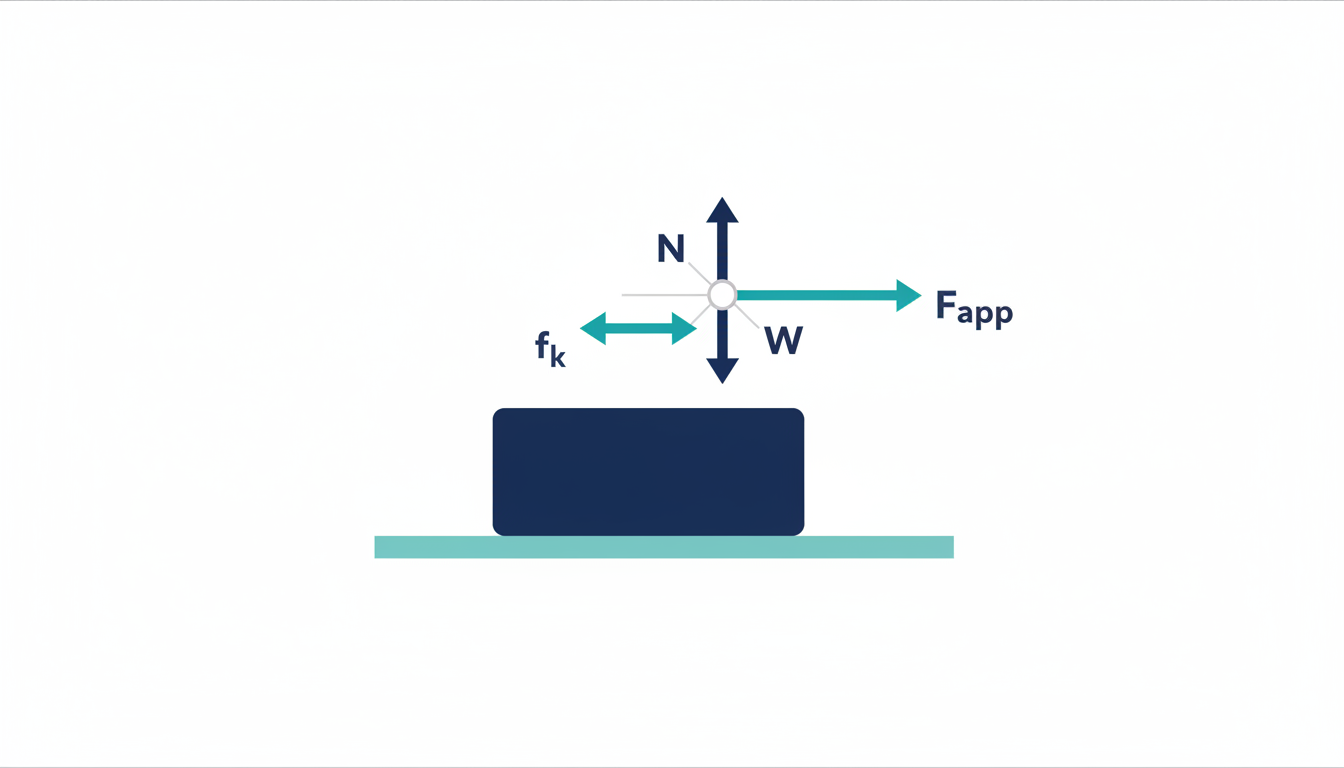

AP Physics C: Forces and Free-Body Diagrams
A free-body diagram (FBD) isolates one object and shows every external force acting on it. A correct diagram turns a physical situation into equations that can be solved using Newton’s laws.
AP Exam Tip
Draw forces acting on the selected object only, then write Newton’s second law by axis.
Quick Check: Free-Body Diagrams
A box is pulled to the right across a rough horizontal floor at constant velocity. Which statement must be true horizontally?
- The applied force is greater than friction.
- The applied force equals kinetic friction in magnitude.
- No horizontal forces act.
- Friction points to the right.
Check answer
Answer: B. Constant velocity means zero acceleration, so the horizontal net force is zero. The applied force and kinetic friction balance.
1. What counts as a force?
A force is an interaction that can change an object’s motion. In an FBD, draw only forces acting on the selected object, not forces that the object exerts on something else and not velocity or acceleration arrows.
- Weight: gravitational force, near Earth’s surface W = mg, directed toward Earth’s center.
- Normal force: contact force perpendicular to a surface.
- Tension: force exerted by a taut rope or string, directed along the rope away from the object.
- Friction: contact force parallel to a surface; it opposes relative sliding or the tendency to slide.
- Applied force: a push or pull from a person or another object.
- Spring force: for an ideal spring, F = −kx along the spring’s axis.
- Drag: resistive force from a fluid, usually opposite the object’s velocity relative to the fluid.
2. How to draw an FBD
- Choose the object and represent it as a dot or simple box.
- List every object or field interacting with it.
- Draw one arrow for each force acting on the selected object.
- Label each arrow clearly (mg, N, T, f, Fapp).
- Choose axes that simplify the math; axes may be rotated on an incline.
- Resolve angled forces into x- and y-components only after the physical forces are identified.
3. Newton’s second law in components
These equations are vector statements written along chosen axes. A force can have components in both directions. If an object has no acceleration perpendicular to a flat surface, the perpendicular net force is zero—but the normal force is not automatically equal to mg in every situation.
Worked example 1: A box on a horizontal floor
A 5.0 kg box is pulled horizontally with 20 N. Kinetic friction is 5.0 N. Find its acceleration.
Horizontal forces: 20 N right and 5.0 N left. Thus ΣFx = 20 − 5.0 = 15 N.
a = ΣF/m = 15/5.0 = 3.0 m/s² to the right.
Worked example 2: A block on a frictionless incline
A block slides on a frictionless incline of angle θ. Choose x parallel to the incline and y perpendicular to it. Weight has components mg sin θ down the slope and mg cos θ into the surface. The normal force balances the perpendicular component: N = mg cos θ. Along the slope, ma = mg sin θ, so a = g sin θ down the incline.
Worked example 3: A hanging mass
A 2.0 kg mass hangs at rest from a light vertical string. The forces are tension upward and weight downward. Since acceleration is zero, T − mg = 0, giving T = (2.0)(9.8) = 19.6 N.
4. Angled applied forces
If a force F makes an angle θ above the positive horizontal axis, its components are Fx = F cos θ and Fy = F sin θ. Check how the angle is defined before choosing sine or cosine. A pull angled upward can reduce the normal force on a box; a push angled downward can increase it.
Common mistakes
- Drawing an action-reaction pair on the same FBD. The two forces act on different objects.
- Assuming N = mg even when vertical acceleration or other vertical forces exist.
- Drawing friction opposite motion without considering the contact’s tendency to slip.
- Using the same sign for forces pointing in opposite directions.
- Including forces that do not act on the chosen object.
Practice questions
- A 4.0 kg object has a 30 N rightward force and 10 N leftward friction. Find its acceleration.
- A 3.0 kg block rests on a horizontal table with no other vertical forces. Find its normal force using g = 9.8 m/s².
- A frictionless incline is 30° above horizontal. Find the block’s acceleration down the slope.
Answers
- a = (30 − 10)/4.0 = 5.0 m/s² right.
- N = mg = (3.0)(9.8) = 29.4 N.
- a = g sin 30° = 4.9 m/s² down the slope.
AP exam strategy
Start each dynamics problem with an FBD, state your coordinate axes, write one Newton’s second-law equation per axis, and then substitute numbers. For free-response questions, labels and reasoning often matter as much as the final answer.
AP-Style Free-Response Question: Block on an Incline with Friction
Original practice question • 10 points • Suggested time: 12–15 minutes
A block of mass m rests on a rough incline of angle θ. The coefficient of kinetic friction is μk. The block is released and slides down the incline. Assume μk < tan θ.
- (2 points) Describe the free-body diagram and choose convenient axes.
- (2 points) Derive the normal force in terms of m, g, and θ.
- (2 points) Use Newton’s second law parallel to the incline to derive the block’s acceleration.
- (2 points) The block starts from rest and travels a distance L down the incline. Derive its speed at distance L.
- (2 points) For m = 2.0 kg, θ = 30°, μk = 0.20, and L = 1.5 m, calculate the acceleration and final speed. Use g = 9.8 m/s².
Reveal worked solution
(a) Draw weight mg vertically downward, normal force N perpendicular to the surface, and kinetic friction fk uphill. Choose x down the incline and y perpendicular outward.
(b) There is no acceleration perpendicular to the surface: N − mg cos θ = 0, so N = mg cos θ.
(c) Along the slope, mg sin θ − fk = ma, with fk = μkN. Therefore a = g(sin θ − μk cos θ).
(d) From v² = v₀² + 2aL and v₀ = 0, v = √[2gL(sin θ − μk cos θ)].
(e) a = 9.8(0.500 − 0.20×0.866) ≈ 3.20 m/s². Then v = √[2(3.20)(1.5)] ≈ 3.10 m/s.
Scoring rubric (10 points)
- 2 points: correct forces and axes, including friction uphill.
- 2 points: N = mg cos θ from the perpendicular equation.
- 2 points: correct parallel equation and acceleration expression.
- 2 points: correct kinematic relation and final speed expression.
- 2 points: correct numerical acceleration and speed with units.
Exam skill: Resolve weight into components relative to the incline before writing Newton’s second law.
Continue learning
Use these related lessons to reinforce this topic:
- Newton’s Second Law — apply force equations by axis.
- Kinetic and Static Friction — model the friction force.